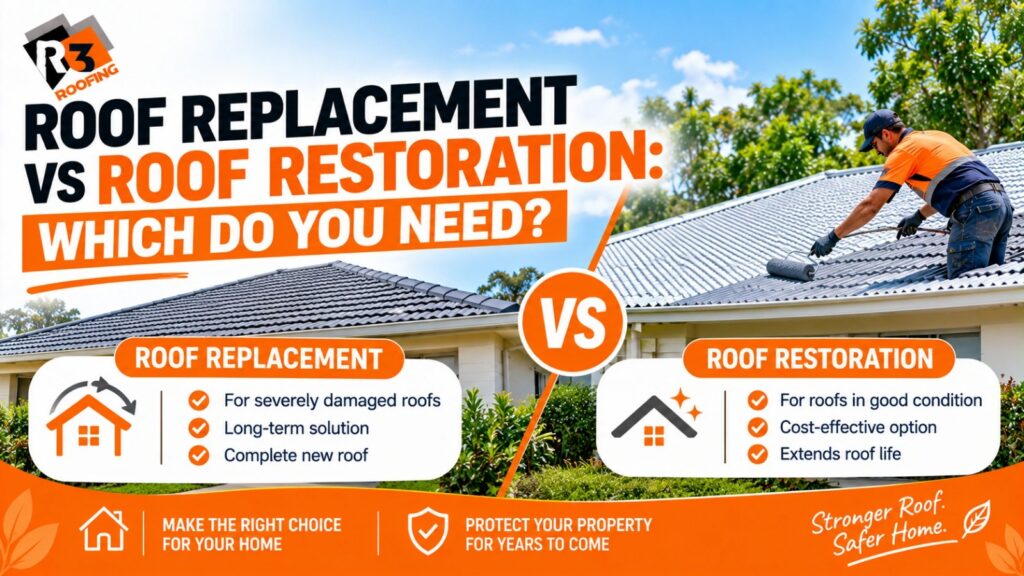
If you’re trying to decide between roof replacement and roof restoration, don’t start with the price or the age of the roof. Start with its actual condition. A structurally sound roof with manageable deterioration may only need restoration, while widespread damage, repeated failures or roofing materials that have reached the end of their useful life may justify replacement.
I see this confusion regularly: a homeowner notices leaks, faded roofing, cracked tiles, rust or general deterioration and immediately assumes the whole roof needs to come off.
Sometimes it does.
But sometimes a full replacement is unnecessary.
The important question is not simply, “Does my roof look old?”
The better question is:
Can the existing roof still provide reliable protection after the necessary repairs and restoration work, or has the roofing system deteriorated to the point where replacement makes more practical sense?
That is the decision I would want a homeowner to understand before spending money on major roofing work.
At R3 Roofing, our approach is straightforward:
Repair. Restore. Replace.
We inspect the roof first, identify what is actually happening and then explain the available options.
Roof restoration improves and extends the life of an existing roof, while roof replacement removes the existing roofing system and installs a new one. Restoration suits a roof that remains fundamentally serviceable; replacement is considered when the existing system has deteriorated beyond practical restoration.
A roof restoration works with what you already have.
Depending on the roof type and condition, restoration can involve:
The purpose is to bring an ageing roof back to a reliable condition and extend its useful life.
A roof replacement is different.
Instead of continuing with the existing roofing material, the old roof is removed and a new roofing system is installed.
That may involve:
This distinction matters because a roof can look tired without actually requiring complete replacement.
Likewise, a roof can look acceptable from the ground while having serious deterioration underneath or around critical areas such as valleys, flashings, fasteners and penetrations.
That is why I would never make the restoration-versus-replacement decision based purely on appearance.
Roof restoration is generally appropriate when the existing roof remains structurally sound and its problems can be corrected through repairs, replacement of damaged components, cleaning, sealing, repointing or suitable protective treatments.
Restoration can make a lot of sense when the roof still has good underlying condition.
For example, imagine a tiled roof that has:
That doesn’t automatically mean the entire roof needs to be replaced.
If the roof structure is sound and the problems are manageable, a properly planned restoration may address the defects while giving the roof more useful service life.
The same principle applies to metal roofing.
A metal roof with isolated corrosion, failed fasteners, damaged flashing or coating deterioration may still be suitable for targeted repairs or restoration if the underlying sheets and supporting system remain serviceable.
A proper restoration should address the cause of the problem before cosmetic work begins.
For example, painting over a leaking roof does not fix the leak.
Likewise, coating heavily corroded metal does not automatically make deteriorated metal structurally sound.
The sequence matters:
Inspect → identify defects → repair → prepare → restore → protect.
That is the difference between genuine roof restoration and simply making an old roof look newer.
Roof replacement becomes more appropriate when deterioration is widespread, the roofing material has reached the end of its useful life, structural problems are present, leaks keep returning or restoration can no longer provide a reliable long-term result.
This is where I would stop thinking about individual defects and start looking at the roof as a complete system.
Some warning signs include:
One isolated leak does not necessarily mean you need a new roof.
But if you are repeatedly repairing leaks in different parts of the roof, the pattern matters.
Multiple leak locations can indicate that the roofing system itself is deteriorating rather than suffering from one isolated defect.
A small area of surface rust can sometimes be treated.
Widespread corrosion, perforation, thinning metal or deterioration around multiple roof sections is a different situation.
At that point, coating or patching may not provide the long-term protection you actually need.
A few broken tiles are generally a repair issue.
But if tiles are brittle, cracking extensively, slipping repeatedly or failing across large sections of the roof, the economics and practicality of continued repairs change.
A sagging roof should never be treated as a cosmetic problem.
Structural issues need to be properly assessed because applying a coating or replacing visible roofing material will not solve a structural defect.
This is one of the signs I pay close attention to.
If you have repaired the same roof several times and new problems continue appearing, you need to ask whether you are extending the life of the roof or simply delaying the inevitable.
A roof that has already undergone restoration may still eventually require replacement.
If coatings are failing, leaks continue, roofing materials are deteriorating or the underlying structure is no longer suitable, another cosmetic treatment may not be the answer.
Severe storm damage can change the decision quickly.
Wind, hail, falling branches and water entry can damage multiple components at once. In those situations, the roof needs a proper assessment before deciding whether repairs, restoration or replacement are appropriate.
The decision should come down to structural condition, extent of deterioration, repair history, remaining useful life, future maintenance requirements and the cost and reliability of the proposed solution.
I would look at the decision in five stages.
If the structure and primary roofing system remain sound, restoration may still be viable.
If the supporting structure or roofing material has significant deterioration, replacement may need to be considered.
Localised problems are easier to isolate and repair.
Widespread deterioration changes the calculation.
If problems are appearing across the roof rather than in one or two areas, continuing with individual repairs may not provide the result you want.
Look at your repair history.
If you have had one repair in several years, that’s very different from calling a roofer every few months.
Repeated repair costs can become significant, but the bigger issue is reliability.
You don’t want a roof that only works until the next major storm.
Ask the roofing contractor to explain exactly what restoration will fix.
A useful restoration quote should tell you:
Replacement should also be explained properly.
You should know what is being removed, what is being installed and whether the replacement includes associated work such as flashings, insulation, roof structure, gutters, fascia or drainage.
The cheapest quote is not necessarily the cheapest solution if important work has been excluded.
Roof restoration is generally less expensive upfront than full roof replacement because it retains the existing roofing system. However, the cheaper initial option is not automatically better if the roof is already deteriorated beyond practical restoration.
This is where homeowners can get caught out.
Restoration can provide excellent value when it is applied to the right roof.
But restoring a roof that really needs replacement can simply postpone the larger expense.
For example:
Scenario A:
You have a structurally sound tiled roof with some cracked tiles, deteriorated ridge pointing and surface ageing.
A targeted restoration may address those problems without removing the entire roof.
Scenario B:
You have widespread deterioration, recurring leaks, significant structural concerns and a history of unsuccessful repairs.
In that situation, spending more money on another round of surface work may not give you the long-term result you want.
So rather than asking:
“Which option is cheaper?”
I recommend asking:
“Which option gives this roof the most reliable result for the money I am spending?”
That is a much better question.
A proper roof restoration should address the roof’s actual defects before protective or cosmetic finishing work begins. The exact scope depends on whether the roof is tiled, metal, Colorbond or another roofing system.
A restoration is not simply pressure cleaning and painting.
For a tiled roof, the work may include:
For a metal roof, restoration may involve:
The key is that the coating comes after the roof has been properly assessed and repaired.
R3 Roofing’s approach is not to use paint as a substitute for roofing work. The roof needs to be inspected and repaired before restoration work is completed.
Roof replacement involves removing the existing roofing system and installing a new one, with the exact scope depending on the existing roof, structure, material, drainage, access and project requirements.
A replacement should begin with assessment and planning.
The process can include:
The existing roof is assessed before removal.
This helps identify visible and potential underlying problems.
The contractor should clearly explain:
The existing tiles or metal sheets are removed safely.
Once the roof covering is removed, components that were previously hidden may become visible.
This is important because the new roof needs a sound base.
Depending on the project, this could mean:
Gutters, fascia and downpipes form part of the roof’s water-management system.
A replacement project is a good opportunity to identify drainage problems rather than installing a new roof over an old drainage issue.
The completed roof should be checked for installation quality, weatherproofing, drainage and finishing.
If you’re researching roof replacement Brisbane, don’t compare quotes based only on the headline price. Compare what each contractor has actually included.
No. Roof age alone does not determine whether you need replacement. Material type, installation quality, environmental exposure, maintenance history and actual roof condition all matter.
This is one of the biggest misconceptions I see.
Someone may say:
“My roof is 30 years old, so it must need replacing.”
That is not enough information.
A roof’s age tells you that it deserves attention, but it doesn’t tell you exactly what work it needs.
Two roofs of the same age can be in completely different conditions.
One may have:
The other may have:
The second roof may be a replacement candidate even if it is younger.
The first may still be suitable for restoration.
That is why R3 Roofing’s advice is to understand the age and condition of the roof together rather than using age as the deciding factor.
Brisbane’s heat, UV exposure, heavy rainfall, storms and, in some locations, coastal conditions can accelerate roof wear. These environmental factors should be considered alongside the roof’s material, installation quality, drainage and maintenance history.
Brisbane roofs have to deal with demanding conditions.
Over time, repeated exposure can affect:
Coastal properties can face additional salt exposure and corrosion risk.
Storms can also expose weaknesses that were not obvious during normal weather.
This is why I don’t treat the roof covering as an isolated component.
The roof, flashing, drainage, fascia, gutters and supporting structure all work together.
If you’re already seeing signs of water entry, R3 Roofing’s roof leak detection guide should be your next reference before assuming the roof itself needs replacement.
Roof restoration improves the existing roof, while reroofing generally involves removing the existing roofing material and installing new roofing. Restoration extends the life of a serviceable roof; reroofing provides a substantially new roofing system.
These terms are often used interchangeably, but they can describe different levels of work.
Restoration keeps the existing roof and focuses on improving its condition.
It can include:
Reroofing is more substantial.
The existing roofing material is removed and replaced with new roofing.
This can include:
So when you search for roof restoration and reroofing, make sure you understand which type of work the contractor is actually proposing.
A quote should make this clear.
You should not have to guess whether “reroofing” means a few replacement sections or a complete new roofing system.
Yes, a tile roof can potentially be replaced with Colorbond, but the existing structure, roof design, pitch, framing, drainage, insulation, ventilation and other components should be assessed before conversion.
A tile-to-metal conversion is more than simply removing tiles and putting metal sheets in their place.
The roofing system needs to be considered as a whole.
Important considerations include:
Colorbond can be a practical option for homeowners who want a lightweight, modern roofing system.
But I would never recommend choosing it purely because it looks good.
The property has to be suitable for the conversion.
R3 Roofing’s guide to Colorbond roof replacement explains why the structure, flashings, drainage, insulation, ventilation and installation quality all matter when replacing an existing roof.
Choose a roofing contractor based on the quality of the inspection, clarity of the scope, licensing, experience, workmanship, materials and warranty—not simply the lowest price.
Before accepting a quote, I recommend asking:
A roof replacement or restoration should not be based purely on photographs or a quick ground-level assessment.
You should understand why the contractor recommends restoration or replacement.
Look for details around:
This is particularly important for major roofing work.
A good brisbane roofing service should be able to explain why repair, restoration or replacement is appropriate for your particular roof.
You should not feel pressured into the most expensive option.
A professional roof inspection helps separate cosmetic deterioration from genuine roofing failure so you can make an informed decision before committing to restoration or replacement.
This is the step I would not skip.
A ceiling stain doesn’t necessarily mean the roof directly above that stain has failed.
Water can travel.
Similarly, a rusty section doesn’t automatically mean the entire metal roof needs replacing.
And an old tiled roof doesn’t automatically mean restoration is impossible.
A proper inspection should look at the complete system.
That includes:
R3 Roofing’s approach is to inspect first, explain what has been found and then recommend the practical options.
That is the approach I believe makes the most sense because you are not paying for a solution before you know what problem you actually have.
If you are comparing roof replacement services in Brisbane, don’t just ask three contractors for three prices.
Ask them to assess the roof and explain the condition first.
That gives you something meaningful to compare.
Restore when the existing roof remains structurally sound and its deterioration can be reliably corrected. Replace when the roofing system has widespread deterioration, structural problems, repeated failures or has reached a point where restoration no longer provides a sensible long-term result.
Here is the simple decision framework I would use:
The decision is not about choosing the most expensive or cheapest option.
It is about matching the work to the actual condition of the roof.
At R3 Roofing, that is why we follow a simple principle:
Repair. Restore. Replace.
We assess the roof first and then explain which option makes sense and why.
If you are unsure whether you need restoration or a roof replacement service, don’t guess from the ground.
Book a professional roof inspection and get a clear understanding of your roof’s condition before committing to major work.
Roof replacement vs roof restoration is not a competition between two services.
It is a question of what your existing roof can realistically support.
If the roof is structurally sound and the problems are manageable, restoration can extend its useful life and avoid unnecessary replacement.
If deterioration is widespread, repairs keep failing or the roofing system is no longer reliable, replacement may provide the more practical long-term solution.
The important part is getting the diagnosis right first.
If you are researching roof replacement services in Brisbane, re-roofing services Brisbane, or roof restoration and reroofing, don’t make the decision based on price alone.
Get the roof assessed.
Understand the problem.
Compare the scope.
Then choose the solution that matches the condition of the roof.
At R3 Roofing, that’s exactly what our Repair. Restore. Replace. approach is designed to do.
When you’re unsure what your roof actually needs, book a professional roof inspection before committing to major work.
Neither is automatically better; the right option depends on the condition of the existing roof. Restoration can make sense when the roof remains structurally sound and its problems can be repaired. Replacement may be necessary when deterioration is widespread or the existing roofing system has reached the end of its practical service life. For example, we would not recommend replacing an otherwise sound tiled roof just because several tiles are cracked. But if the roof has widespread deterioration and repeated leaks, continuing to repair individual areas may not provide the result you need. R3 Roofing's practical approach is to inspect the roof first, explain the available options and recommend the most suitable solution.
Roof restoration is generally cheaper upfront than full roof replacement because much of the existing roofing system remains in place. However, the cheaper option is only worthwhile if the roof is suitable for restoration. A homeowner may save money by restoring a sound roof, but restoring a roof that really needs replacement can mean paying twice when the underlying problems return. R3 Roofing's practical approach is to inspect the roof first, explain the available options and recommend the most suitable solution.
You need to assess the roof's structural condition, extent of damage, repair history and remaining useful life. A professional inspection is the safest way to make that decision. For example, isolated leaks and surface deterioration may point toward restoration, while widespread corrosion, repeated failures or structural deterioration may point toward replacement. R3 Roofing's practical approach is to inspect the roof first, explain the available options and recommend the most suitable solution.
No. Age alone does not mean a roof needs replacement. Roofing material, installation quality, environmental exposure, maintenance and actual condition all influence how long a roof remains serviceable. We've seen older roofs that were still worth restoring and newer roofs that required significant work because of damage or poor previous workmanship. R3 Roofing's practical approach is to inspect the roof first, explain the available options and recommend the most suitable solution.
The lifespan of a restoration depends on the roof's condition, the quality of the work, the materials used and environmental exposure. A proper restoration should address underlying defects rather than simply applying a new coating. For example, restoring a roof after repairing failed flashings and damaged tiles is fundamentally different from simply painting over an ageing surface. R3 Roofing's practical approach is to inspect the roof first, explain the available options and recommend the most suitable solution.
Roof restoration can include cleaning, repairs, replacement of damaged components, ridge capping work, sealing and protective coatings, depending on the roof type and condition. A tiled roof may require re-bedding and re-pointing, while a metal roof may require fastener, flashing, corrosion or coating work. R3 Roofing's practical approach is to inspect the roof first, explain the available options and recommend the most suitable solution.
Roof replacement normally involves removing the existing roofing material and installing a new roofing system. Depending on the property, the project may also include structural preparation, new flashings, insulation, roof penetrations, gutters and drainage work. This is why two roof replacement quotes can differ significantly even when they appear to describe the same project. R3 Roofing's practical approach is to inspect the roof first, explain the available options and recommend the most suitable solution.
No. Restoration improves the existing roof, while reroofing generally involves replacing the existing roofing material. Restoration keeps the serviceable roof system and addresses its defects; reroofing provides new roofing. If a contractor uses the word "reroofing", ask exactly what is being removed and replaced. R3 Roofing's practical approach is to inspect the roof first, explain the available options and recommend the most suitable solution.
Yes, a metal roof can sometimes be restored when the underlying roofing system remains suitable for continued use. The roof may require corrosion treatment, fastener replacement, flashing repairs, sealing or compatible protective coatings. However, widespread corrosion, perforation or serious deterioration may make replacement more appropriate. R3 Roofing's practical approach is to inspect the roof first, explain the available options and recommend the most suitable solution.
Yes, a tile-to-metal conversion can be possible, but the property should be assessed before the conversion. The roof structure, framing, pitch, drainage, insulation, ventilation, flashings and other components all need consideration. A tile-to-metal conversion is a roofing-system change, not simply a material swap. R3 Roofing's practical approach is to inspect the roof first, explain the available options and recommend the most suitable solution.
A properly designed and installed replacement should address the underlying causes of the existing roofing failure, but the result depends on correct installation, flashing, drainage and workmanship. Replacing roofing sheets without addressing a drainage or flashing problem can simply move the problem elsewhere. R3 Roofing's practical approach is to inspect the roof first, explain the available options and recommend the most suitable solution.
Not necessarily. Whether replacement makes sense before selling depends on the roof's condition, the likely buyer concerns, the scope of work and the overall property strategy. If the roof is serviceable but looks tired, restoration may be worth considering. If the roof has serious defects, addressing them before sale may be more important than cosmetic improvement. R3 Roofing's practical approach is to inspect the roof first, explain the available options and recommend the most suitable solution.
There is no reliable single price because roof replacement cost depends on roof size, material, access, roof design, removal requirements, structural work and the scope of the new system. For example, replacing a straightforward metal roof is very different from converting a large tiled roof to Colorbond while also upgrading insulation, gutters and structural components. The right way to price a roof replacement Brisbane project is to inspect the property and define the scope first. R3 Roofing's practical approach is to inspect the roof first, explain the available options and recommend the most suitable solution.
Yes, but compare the scope rather than comparing prices alone. Make sure each quote clearly explains the materials, removal, installation, flashings, structural work, drainage and warranty. A $20,000 quote and a $30,000 quote may not actually be quoting the same work. R3 Roofing's practical approach is to inspect the roof first, explain the available options and recommend the most suitable solution.
Book a professional roof inspection before deciding between restoration and replacement. An inspection gives you a factual starting point and helps identify whether the roof has a repairable problem, needs restoration or has deteriorated enough to justify replacement. That is much better than committing to a major roofing project based only on a leak, an old roof or what the roof looks like from the driveway. R3 Roofing's practical approach is to inspect the roof first, explain the available options and recommend the most suitable solution.