If you’re asking how much roof replacement costs, don’t rely on one headline price. In Brisbane, the final cost depends on your roof area, material, pitch, access, existing roof condition, removal requirements and the work needed underneath the roof. A realistic budget should start with the condition and scope of your roof, not a generic online average.
This is one of the first questions homeowners ask when they realise their roof may be reaching the end of its serviceable life.
And it makes sense.
A roof replacement is a major home improvement project, so you want to understand the likely cost before you start getting quotes.
The problem is that there isn’t one fixed price for a roof replacement.
Two Brisbane homes with a similar floor plan can receive completely different quotes because the roofs themselves can be very different.
One may have a simple single-storey gable roof with easy access.
Another may have multiple valleys, a steep pitch, difficult access, damaged battens, old tiles, deteriorated flashings and drainage problems.
Those two projects should not cost the same.
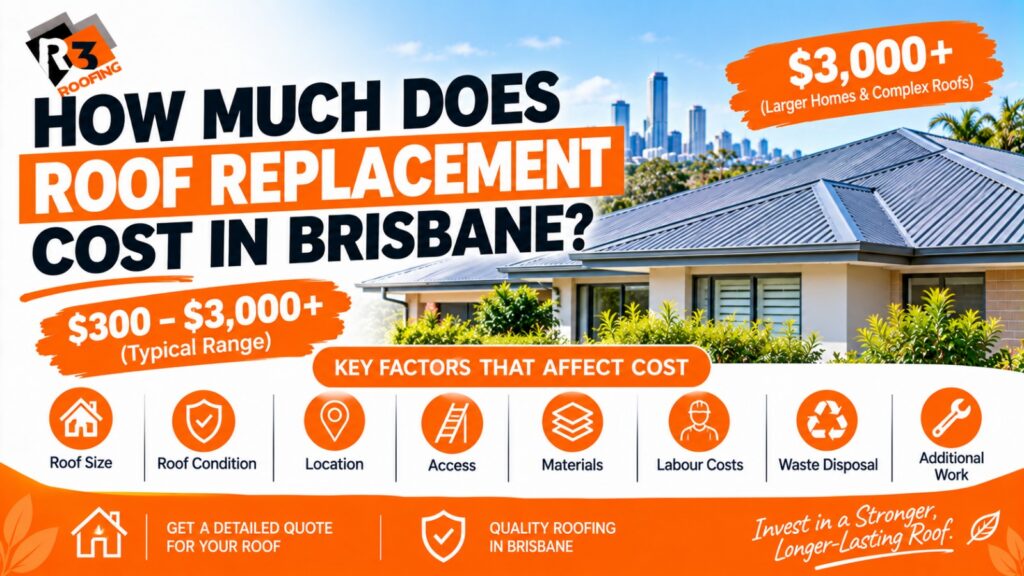
Current Brisbane roofing cost guides published in 2026 put full roof replacement broadly in the $10,000 to $40,000 range, with the lower and upper ends depending heavily on factors such as storey height, roof size, material and complexity. One current guide places single-storey replacements around 10,000–25,000 and two-storey replacements around 15,000–40,000, while another Brisbane roofing guide gives different material-based ranges. These figures are useful for budgeting, but they are not a quote for your property.
At R3 Roofing, I don’t believe homeowners should be pushed toward replacement simply because their roof is old.
Our approach is:
Repair. Restore. Replace.
The first step is understanding which of those options your roof actually needs.
A full roof replacement in Brisbane can broadly fall around 10,000–40,000, but a more useful starting point is to separate simple single-storey replacements from larger, more complex or two-storey projects. The actual price depends on the roof rather than the house alone.
Current Brisbane cost guides provide a broad market range rather than one universal figure.
One September 2026 Brisbane cost guide reports:
Another Brisbane roofing guide gives material-specific figures that vary from these ranges, reinforcing an important point: published online pricing should be treated as a budgeting guide, not as a guaranteed project price.
I would therefore use the figures like this:
Small/simple roof: budget toward the lower end.
Standard family home: expect the middle of the range to be more relevant.
Large, steep, complex or difficult-access roof: prepare for the higher end.
Roof with structural, asbestos or extensive preparation requirements: allow additional budget.
The price only becomes meaningful when you know what is included.
Roof replacement quotes are often calculated using roof area, but the per-square-metre rate is only part of the final price. Labour, access, roof pitch, removal, disposal, flashings, structural preparation and additional roofing work can significantly change the total.
A current Brisbane pricing guide reports approximately:
Roofing work | Indicative Brisbane range |
Colorbond re-roofing | 80–180/m² |
Tile re-roofing | 100–220/m² |
Full single-storey replacement | 10,000–25,000 |
Full two-storey replacement | 15,000–40,000 |
These figures are published market guides, not R3 Roofing’s pricing. They were reported as Brisbane metro figures and verified in September 2026 by the source.
Another Brisbane roofing source gives lower material-specific rates for some replacement scenarios, such as existing metal to new metal and tile-to-metal conversion. This difference demonstrates why I would not tell a homeowner to multiply one internet rate by their roof size and assume that is their final cost.
The roof area also needs to be measured correctly.
Your home’s floor area is not automatically your roof area.
A house with a 150 m² floor footprint could have a significantly larger roof surface depending on pitch, overhangs, hips, valleys and roof design.
That is why a proper roof measurement matters.
The biggest roof replacement cost factors are roof size, roofing material, pitch, design complexity, access, existing roof condition, removal and disposal, structural repairs, flashings, drainage and any additional upgrades included in the project.
More roof area generally means more materials, labour and installation time.
But bigger does not always mean proportionally more expensive per square metre because some project costs remain relatively fixed.
Steep roofs require more safety measures and can take longer to work on.
That can increase labour and access costs.
A simple gable roof is usually easier to work on than a roof with:
Every additional roof feature can add materials, labour and installation time.
Easy access can keep a project relatively straightforward.
Difficult access can introduce:
Removing concrete tiles is different from removing lightweight metal sheets.
Older materials may also require additional handling or disposal procedures.
This is one of the biggest variables.
If the roof covering is removed and the underlying structure is in good condition, the replacement can follow the expected scope.
If the contractor discovers deteriorated battens, timber, structural components or water damage, the scope can change.
A roof replacement isn’t simply about putting new sheets or tiles over the house.
Flashings around:
need to be properly considered.
A new roof still needs an effective drainage system.
If gutters, downpipes or fascia are already failing, replacing the roof without addressing those components can leave part of the roofing system compromised.
Yes. Colorbond and tile roofing have different material, labour, handling and installation requirements, so the roofing material can influence the replacement cost. However, material alone does not determine the final quote.
For Brisbane homeowners, the most common comparison is often:
Colorbond vs tile roofing.
Colorbond is lightweight and can offer efficient installation, while tile roofing has different handling and installation requirements.
R3 Roofing’s comparison of [Colorbond vs tile roofs] explains that both systems can perform well when correctly specified and installed, but their weight, installation, maintenance and repair characteristics differ.
When comparing material prices, I would also look beyond the initial installation cost.
Consider:
A lower initial material price doesn’t automatically mean lower overall ownership cost.
A tile-to-Colorbond conversion can cost more than a straightforward metal-to-metal replacement because the existing tiles need to be removed and the roof structure and supporting components may need additional preparation.
This is a common project in Brisbane.
You are not simply swapping one roof covering for another.
A tile-to-metal conversion can involve:
One current Brisbane roofing guide gives a broad 100–120 per m² budgeting range for tile-to-metal conversion, while noting that actual costs depend on access, preparation and existing roof condition.
R3’s own Colorbond replacement guide makes the same practical point: the scope can vary substantially depending on whether the project is a straightforward metal replacement or a tile-to-metal conversion.
So if you’re researching roof replacement Brisbane, make sure you tell the contractor exactly what existing roof you have.
The advertised roof replacement price may not include every component required for your property. Budget for possible additional work involving structural repairs, asbestos, scaffolding, gutters, fascia, insulation, flashings, drainage and roof penetrations.
This is where unexpected costs usually come from.
If timber, battens or other structural components have deteriorated, they may need repair or replacement before the new roof goes on.
If an existing roof contains asbestos, specialist removal and disposal can add significantly to the project cost.
One current Brisbane guide estimates asbestos-related removal and disposal can add several thousand dollars, but the actual cost depends on the amount and specific site requirements.
Never assume asbestos is included in a standard roofing quote.
Two-storey homes, steep roofs and difficult sites may require additional safety and access equipment.
If the existing gutter system is rusted, undersized, damaged or poorly positioned, replacement may be worthwhile while the roof work is underway.
Rotten or deteriorated fascia can affect gutter stability and drainage.
If you’re replacing an older roof, this may be an opportunity to review insulation and ventilation rather than closing everything up and leaving an outdated system underneath.
Old or damaged flashings may need replacement.
This is important because new roofing does not compensate for poorly detailed flashing.
Roof restoration is generally less expensive than full replacement when the existing roof remains suitable for continued service. But restoration is not a cost-saving solution if the roof has deteriorated beyond practical repair.
This is where I recommend homeowners pause before requesting a replacement quote.
Ask:
Does my roof actually need replacing?
R3 Roofing’s current service approach is built around assessing the roof first and then deciding whether repair, restoration or replacement is appropriate.
Restoration may be suitable when:
Replacement becomes more relevant when:
The goal is not to make the project as large as possible.
The goal is to match the solution to the roof.
Roof replacement becomes more justifiable when the existing roof can no longer provide reliable performance through reasonable repairs or restoration, particularly when deterioration is widespread or recurring.
For example, imagine two Brisbane homes.
The roof has:
Replacing the entire roof may be unnecessary.
A targeted repair or restoration could potentially solve the problem.
The roof has:
This is a completely different situation.
Continuing to spend money on isolated repairs may not provide a reliable result.
That is where a full roof replacement service may become more practical.
R3’s current guidance similarly distinguishes localised repair and restoration from replacement when deterioration becomes widespread or repeated repairs no longer provide sensible long-term value.
Don’t compare roof replacement quotes by the final dollar amount alone. Compare the scope, materials, removal, preparation, structural work, flashings, drainage, warranties and exclusions.
This is one of the biggest mistakes homeowners make.
You receive:
Quote A: $16,000
Quote B: $21,000
Quote C: $27,000
At first glance, the first quote looks cheaper.
But what if Quote A excludes:
Then you’re not comparing three equivalent projects.
A detailed quote makes price comparison much easier.
Roof size has a major effect on replacement cost, but house floor area is not the same as roof area. Roof pitch, overhangs, roof shape and multiple sections can significantly change the actual roofing area.
This is why I don’t recommend using your home’s floor plan as a roofing calculator.
For example, two 200 m² homes can have very different roof areas.
One might have a simple low-pitch roof.
Another might have:
The second roof can require substantially more material and labour.
A professional roofer should measure the actual roof rather than estimating the replacement price from the home’s floor area.
Two-storey roof replacements generally cost more because height, access, safety requirements, material handling and scaffolding can increase project complexity.
A current Brisbane pricing guide reports:
These are broad market figures rather than R3 Roofing prices.
The important point is that storey count isn’t the only variable.
A large, complex single-storey roof can cost more than a small, straightforward two-storey roof.
That’s why I look at the actual roof rather than using the number of floors as a standalone pricing formula.
Yes. Difficult access and steep roof pitches can increase labour, safety and equipment requirements, which can raise the replacement cost.
Consider a roof with easy driveway access and a straightforward roofline.
Now compare that with a property where:
The roofing material might be identical.
The project cost will not be.
Current Brisbane roofing cost guides specifically identify roof pitch, design complexity, access and scaffolding as major cost drivers.
Not every roof replacement requires new gutters or fascia, but deteriorated drainage and roof-edge components should be assessed while the roof is being replaced because they directly affect water management and the finished roofing system.
The roof and drainage system work together.
A new roof with old, failing gutters is not necessarily a complete solution.
Look for:
R3’s guttering and fascia service explains how gutters, fascia and downpipes work together and why drainage problems can contribute to roof and property damage.
If your fascia is deteriorated, it can also affect gutter stability.
So if you’re already paying for significant roof work, ask whether the roof-edge drainage system should be repaired or replaced at the same time.
A typical residential roof replacement can take several days, but the timeline depends on roof size, material, complexity, access, weather and the amount of preparation required.
Current Brisbane roofing sources give different timeframes because projects vary.
One Brisbane roofing source reports typical residential replacement timelines of roughly 2–5 days, while another current Brisbane cost guide gives around 3–7 days for Colorbond and 5–10 days for tile re-roofing.
Those figures should be treated as indicative.
Weather can affect roofing work significantly.
So can:
A good roofing contractor should give you a realistic expected timeframe after inspecting the property.
A professional roof replacement quote should clearly identify the roofing material, measured roof area, removal and disposal, installation, flashings, associated repairs, access requirements, drainage work, warranties and exclusions.
At minimum, I recommend looking for:
If a quote simply says “new roof” and gives you a dollar amount, I would ask for a much clearer scope before comparing it with another contractor.
The best way to reduce unexpected roof replacement costs is to inspect the roof properly before work begins and make the quote as detailed as possible, including likely preparation, access, drainage and structural requirements.
Here are the steps I recommend.
Don’t wait until the old roof is being removed to discover major issues if they can be identified beforehand.
Don’t rely on the home’s floor area.
Colorbond, concrete tile, terracotta and other materials have different costs and installation requirements.
Ask what happens if deteriorated timber, battens or structural components are found.
Make sure gutters and downpipes are assessed.
Old roofing materials have to go somewhere.
Find out whether scaffolding or special access equipment is required.
The more detailed the quote, the easier it becomes to control variations.
A professional roof inspection gives you the information needed to determine whether you need repair, restoration or replacement and helps a roofer prepare a quote around the actual condition of your property.
This is the part I would never skip.
If you call a roofing contractor and simply say:
“I need a new roof. How much?”
you are asking them to price something they haven’t seen.
Instead, start with:
“Please inspect my roof and tell me what condition it is in, whether replacement is necessary and what the replacement scope would involve.”
That changes the conversation completely.
R3 Roofing’s current process begins with a detailed roof inspection, followed by a defined scope, transparent quote and qualified roofing work.
It also means you may discover that you don’t need full replacement.
You might need:
The correct answer depends on what is actually happening on the roof.
A Brisbane roof replacement can broadly cost around 10,000–40,000 depending on the property, with current published guides placing many single-storey replacements around 10,000–25,000 and two-storey projects around 15,000–40,000. Treat these as budgeting ranges, not guaranteed prices.
If you’re searching for how much does roof replacement cost, the most useful answer is not one number.
Your final price depends on:
And before you commit to roof replacement services in Brisbane, make sure you have established that replacement is actually necessary.
Sometimes the correct answer is repair.
Sometimes it is restoration.
Sometimes it is a complete replacement.
That’s why R3 Roofing follows:
Repair. Restore. Replace.
If you are comparing a roof replacement service, roof restoration and reroofing, or re-roofing services Brisbane homeowners need, start with the condition of the roof rather than an internet price calculator.
Get the roof inspected.
Understand the scope.
Compare detailed quotes.
Then make the decision based on what your roof actually needs.
Book a professional roof inspection before committing to major roofing work.
A full Brisbane roof replacement can broadly cost around $10,000–$40,000, depending on roof size, material, pitch, access, complexity and existing roof condition. Current published guides place single-storey replacements around $10,000–$25,000 and two-storey replacements around $15,000–$40,000. For example, a simple single-storey roof with easy access can sit toward the lower part of the range, while a steep two-storey Queenslander with difficult access and structural repairs can move toward the higher end.
Current Brisbane guides report roughly $80–$180/m² for Colorbond re-roofing and $100–$220/m² for tile re-roofing. These figures are indicative market ranges rather than R3 Roofing's prices. The final quote can change because the contractor still needs to account for access, pitch, removal, disposal, flashings, structural work and other requirements.
Current Brisbane cost guides generally show Colorbond re-roofing at a lower per-square-metre range than tile re-roofing, but the total project cost depends on the entire scope. For example, converting an existing tile roof to Colorbond involves removing and disposing of the tiles and preparing the roof for the new metal system, so it is not the same as replacing an existing metal roof with new metal.
A current Brisbane guide gives approximately $100–$120 per m² as a broad budgeting range for tile-to-metal conversion, but actual costs vary significantly by roof condition, access and preparation. A conversion can involve tile removal, disposal, structural assessment, battens, insulation, new Colorbond sheets, flashings and drainage work.
Generally, yes, when the existing roof remains structurally sound and suitable for restoration. Restoration keeps the existing roofing system and addresses repairable deterioration. For example, repairing cracked tiles, ridge capping or localised metal deterioration can be more appropriate than replacing an otherwise serviceable roof.
Look at the extent of deterioration, structural condition, repair history and remaining useful life of the roof. Localised and manageable problems may suit repair or restoration, while widespread deterioration and repeated failures may indicate replacement. This is why R3 Roofing starts with an inspection rather than assuming every old roof needs a new one.
Yes. Larger roof areas generally require more roofing materials and labour, but roof size is only one part of the calculation. A small complex roof can sometimes be more difficult to replace than a larger simple roof because of valleys, hips, penetrations and access.
It often does because height and access can increase safety, scaffolding, material-handling and labour requirements. One current Brisbane guide places two-storey replacements around $15,000–$40,000 compared with $10,000–$25,000 for single-storey homes. The actual difference depends on the property.
You should have the gutters, downpipes and fascia assessed before replacing the roof, and replace deteriorated components where necessary. For example, installing a new roof while leaving severely rusted gutters and damaged fascia can leave an important part of the water-management system unresolved.
Many residential roof replacements take several days, but the exact timeframe depends on the roof size, material, weather, access and complexity. Current Brisbane sources report typical ranges from roughly 2–5 days to 3–10 days depending on the roofing material and project. A straightforward Colorbond replacement can move faster than a complex tiled re-roof.
Yes, if asbestos-containing roofing needs specialist removal and disposal, it can add substantially to the project cost. One current Brisbane cost guide estimates an additional several thousand dollars, but the actual amount depends on the quantity and site requirements. An asbestos roof should not be treated like ordinary roofing waste.
A detailed quote should explain the roofing material, roof area, removal, disposal, installation, flashings, structural preparation, access, drainage, warranties and exclusions. If one quote includes scaffolding and disposal while another excludes them, comparing only the final price will give you the wrong impression.
You can receive a rough budget estimate, but an accurate roof replacement quote should be based on an inspection and defined scope. A roofer needs to understand the roof's size, condition, access and complexity before accurately pricing the work.
Getting multiple quotes can help you compare scope and pricing, but the important part is making sure the quotes cover comparable work. For example, don't compare a basic metal replacement quote with a comprehensive quote that includes structural repairs, insulation, gutters and new flashings.
Start with a professional roof inspection. The inspection should establish whether you actually need replacement or whether repair or restoration could solve the problem. That gives you a much stronger basis for comparing roof replacement Brisbane prices and deciding what work your home actually requires.