The best roofing for a warehouse is not determined by price or appearance alone. The roof needs to suit the building’s size, roof profile, drainage, insulation requirements, weather exposure, rooftop equipment, maintenance needs and how the warehouse is actually used.
When I look at a warehouse roof, I don’t start by asking, “Which roofing material is cheapest?”
I start by asking what the building needs the roof to do.
A warehouse may have a huge roof area, forklifts moving underneath, expensive stock inside, rooftop air-conditioning, solar panels, skylights, ventilation equipment and a drainage system that has to handle a large volume of Brisbane rainfall.
That changes the roofing decision.
For many Australian warehouses, metal roofing is a practical and proven option, particularly where the building has a suitable roof profile and the system is correctly designed and installed. Industry roofing guidance also identifies metal roofing as one of the most common options for warehouses because of its suitability for large roof areas, durability and relatively straightforward maintenance.
But I don’t believe every warehouse should automatically receive the same roofing system.
The right decision comes from assessing the building first.
Metal roofing is often one of the most practical roofing options for warehouses, but the best system depends on the building’s roof design, slope, climate, insulation requirements, drainage, use and long-term maintenance requirements.
For many Australian warehouses, metal roofing provides a strong combination of durability, low weight, weather resistance and suitability for large roof areas. However, membrane and insulated roofing systems can also be appropriate depending on the building.
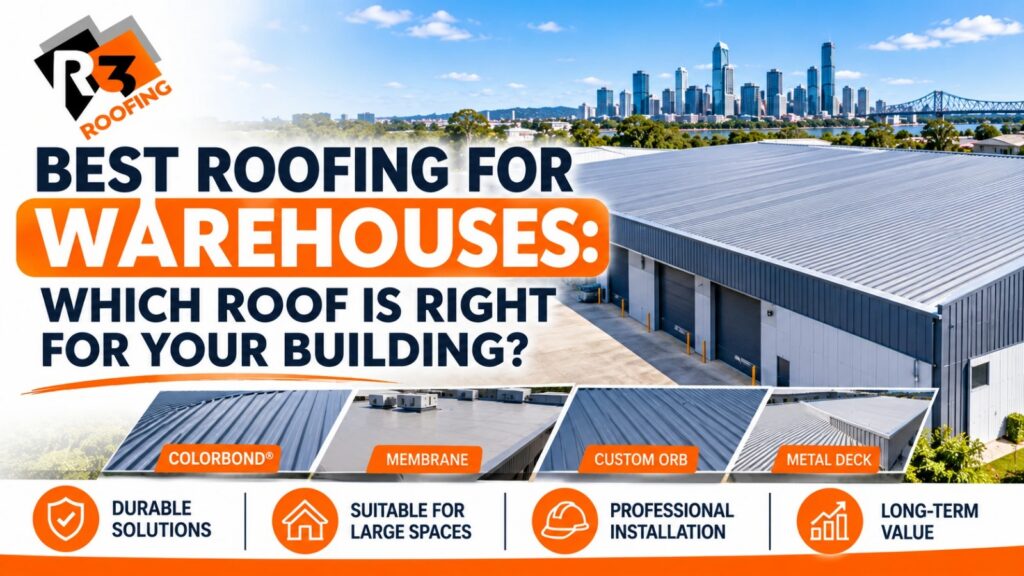
The main warehouse roofing options include:
There is no single material that wins for every warehouse.
For example, a large warehouse with a conventional pitched metal roof may be well suited to a metal roofing system.
A low-slope commercial building may have different requirements and could be better suited to a membrane system.
The roof’s existing design matters just as much as the material.
That’s why R3 Roofing approaches commercial roofing solutions by looking at the complete roof rather than simply recommending a material.
Metal roofing is common on warehouses because it is lightweight, durable, suitable for large roof areas and available in profiles that can be designed for different commercial building requirements.
Metal roofing works particularly well on many warehouses because large roof areas can be covered efficiently, while the system can be combined with insulation, flashings, drainage and other commercial roofing components.
Warehouse roofs can be enormous.
That makes weight an important consideration.
Metal roofing can provide a relatively lightweight roofing solution compared with some heavier materials, while still providing the structural and weather protection required by many commercial buildings.
Other advantages can include:
Metal sheets and panels can efficiently cover large warehouse roof areas.
A properly designed and installed metal roof can provide strong resistance to Australian weather conditions.
Commercial warehouses often require roof access for maintenance, ventilation, solar systems and other services. The roof system needs to be designed with those requirements in mind.
Individual roofing components can often be repaired or replaced when damage is localised.
Different profiles, coatings, colours, flashings and insulation options allow the roofing system to be adapted to the building.
R3 Roofing’s current services page specifically includes commercial metal roofing and describes its Colorbond and custom roofing work as suitable for commercial and industrial properties.
Yes, Colorbond steel can be a suitable warehouse roofing material when the product, profile, fixings, installation and environmental exposure are correctly considered.
Colorbond can provide a durable, low-maintenance metal roofing system for many warehouses, but the correct specification matters more than simply choosing a well-known roofing material.
Colorbond is particularly relevant when a warehouse owner wants:
However, I would never choose Colorbond simply because the name is familiar.
I would also consider:
R3’s own Colorbond guidance makes the same broader point: the performance of a metal roof depends on more than the sheet itself, including drainage, installation, insulation, ventilation, roof design and environmental exposure.
If the warehouse is near the coast, corrosion protection becomes even more important. R3’s guide to metal roofing for coastal areas explains why roofing material, fasteners, flashings and maintenance all need to be considered together.
Other warehouse roofing systems include TPO, PVC, EPDM, modified bitumen and insulated roof panels, particularly where the building has a low-slope roof or specific waterproofing and thermal requirements.
Metal roofing is not the only warehouse roofing solution. Membrane systems and insulated panels can be appropriate where the building’s roof design and performance requirements make them suitable.
TPO and PVC are commonly used on flat and low-slope commercial roofs.
They can provide continuous waterproofing across large roof areas when properly installed.
These systems can also work around commercial rooftop equipment where detailed penetrations and drainage are required.
EPDM is another membrane roofing option used on commercial buildings.
It is particularly associated with low-slope applications where waterproofing performance is a primary consideration.
Modified bitumen uses reinforced roofing layers and is another option for commercial low-slope applications.
Insulated roof panels combine roofing and insulation into one system.
This can be useful for warehouses where thermal control is important.
The important point is that the roofing material should follow the building requirements—not the other way around.
Roo Roofing’s commercial roofing guide similarly identifies metal roofing, single-ply membranes, roof coatings and restoration as different commercial roofing approaches, with suitability depending on building use, climate, budget and maintenance requirements.
Before choosing a warehouse roof, consider the building’s size, roof slope, structure, climate, drainage, insulation, rooftop equipment, solar requirements, maintenance access and expected service life.
The correct warehouse roof depends on the complete building environment. Material price should be only one part of the decision.
A warehouse can have thousands of square metres of roof area.
Even a small design mistake can therefore affect a large part of the building.
Roof slope affects how water moves across the roof.
A low-slope roof needs particularly careful attention to drainage and waterproofing.
Ask what happens inside the warehouse.
Does it store:
The consequences of a roof failure can vary significantly depending on what the building contains.
A warehouse with large internal heat loads can have very different insulation requirements from a basic storage shed.
Consider:
The roof should remain accessible for inspection and maintenance.
This is one of the areas I would never overlook.
A warehouse roof can collect an enormous amount of rainwater during a Brisbane storm.
If you plan to install solar, additional equipment or modify the building, factor that into the roofing decision before installation.
Yes. Brisbane’s intense UV exposure, heavy rainfall, storms, humidity and coastal conditions can all influence the appropriate warehouse roofing material, coatings, fasteners, flashings and maintenance strategy.
Warehouse roofing in Brisbane needs to cope with heat, UV, heavy rain and storms. Properties closer to the coast also need greater attention to corrosion exposure.
Brisbane’s weather doesn’t give a warehouse roof much downtime.
During summer, intense sunlight places repeated thermal stress on roofing materials.
During storms, large roof surfaces need to handle significant rainfall and wind.
In coastal areas, salt-laden air can also accelerate corrosion.
That means I look beyond the roofing sheet.
A warehouse roofing system needs:
R3’s recent common metal roofing problems guide highlights leaks, corrosion, loose fasteners, damaged flashing, failed sealants, storm damage and drainage problems as common issues that can affect metal roofs in Brisbane.
Insulation is important on warehouse roofs because it can reduce heat transfer through the roof and help control internal temperatures, particularly in large buildings exposed to Brisbane’s summer heat.
A warehouse roof can receive substantial solar heat. The roofing material, insulation, ventilation and overall roof design should work together to manage internal temperature and energy demand.
This matters particularly when:
A common mistake is looking only at the roofing material.
A metal roof can perform well thermally when the complete roof system is properly designed.
R3’s current Colorbond energy-efficiency guidance also notes that roof colour, insulation, ventilation, roof design and overall condition all influence the thermal performance of a metal roof.
So if you’re planning a new warehouse roof, don’t ask only:
“Which metal should I use?”
Ask:
“How should the complete roof system manage heat, water and airflow?”
Warehouse roof drainage is critical because large roof areas can collect substantial volumes of rainwater, placing significant demand on gutters, valleys, outlets and downpipes during heavy rainfall.
A warehouse roof needs a drainage system capable of safely moving rainwater away from the building. Poor drainage can cause ponding, overflowing gutters, leaks, corrosion and damage to roof edges.
This is one of the areas where I see businesses underestimate the importance of the roof system.
A warehouse roof can look perfectly healthy from ground level while its drainage system is struggling.
Problems can include:
R3’s roof drainage problems explained guide explains how the roof, gutters, fascia, valleys and downpipes need to work together as one drainage system.
For warehouse projects, this becomes even more important because of the size of the roof catchment.
A new roof with inadequate drainage is not a complete solution.
A warehouse may need repair when damage is localised, restoration when the existing roof remains structurally serviceable but needs broader work, or replacement when deterioration has become too extensive for practical restoration.
Do not automatically replace a warehouse roof because it is old, and do not keep repairing a roof indefinitely when deterioration is widespread. The correct decision depends on the condition and repair history.
R3’s commercial roofing guidance takes this same Repair. Restore. Replace. approach rather than treating every ageing roof as an automatic replacement.
Commercial roof replacement involves assessing the existing roof, developing a clear scope, removing the required roofing components, addressing underlying problems, installing the new roofing system and completing associated flashing and drainage work.
A commercial roof replacement is a complete project, not simply a process of putting new sheets over an old roof. The scope can include removal, structural assessment, insulation, roofing, flashings, penetrations and drainage.
For a warehouse, the process may include:
We assess:
The business should understand exactly what the project includes.
The existing roof covering is removed according to the project requirements.
Once the existing roof is exposed, underlying deterioration can be assessed.
The selected roofing system is installed.
Roof penetrations and transitions receive appropriate attention.
Gutters, downpipes, valleys and outlets need to work with the new roof.
The finished project should be checked against the agreed scope.
R3’s current Colorbond roof replacement guide follows this broader approach, explaining why replacement should be treated as a complete roofing project involving structure, flashings, drainage, insulation, ventilation and finishing rather than simply replacing the visible sheets.
Commercial re-roofing can be a practical option when the existing building and supporting structure remain suitable for a renewed roofing system, but the exact approach depends on the condition of the existing roof.
Re-roofing can reduce the need for unnecessary work when the existing structure remains suitable, but it should not be used to hide widespread structural or roofing deterioration.
The terminology can also cause confusion.
One contractor might describe a project as:
Don’t compare the terminology.
Compare the scope.
Ask:
For a Brisbane warehouse, commercial re-roofing in Brisbane may make sense when the existing building structure is suitable and the roofing system can be renewed effectively.
But if the underlying structure or roof system has significant deterioration, a more comprehensive replacement may be required.
Regular inspections, drainage maintenance, prompt repairs, corrosion monitoring and post-storm checks can help extend the useful life of a warehouse roof.
Warehouse roof maintenance should focus on preventing small issues from becoming major failures. Regular inspection is particularly important for large commercial roofs where problems can remain unnoticed.
A practical maintenance program should include:
Don’t wait for water to appear inside the warehouse.
Once water reaches stock, machinery, electrical systems or internal finishes, the cost of the problem can increase significantly.
When choosing commercial roofing services for a warehouse, look for relevant commercial experience, detailed inspection, a clear scope of work, appropriate materials, safety planning, warranty information and a contractor who explains the recommended solution.
A commercial roofing quote should tell you what will actually happen to the roof. Don’t compare warehouse roofing contractors on price alone.
The contractor should understand the existing roof before recommending replacement.
The scope should identify:
Warehouse roofing has different access, safety and operational considerations from residential roofing.
You should understand why the contractor recommends repair, restoration, re-roofing or replacement.
Understand both workmanship and manufacturer warranties where applicable.
R3 Roofing’s current service process includes assessment, scope development, competitive quotation, qualified tradespeople, roofing installation and final coatings, and its services cover residential, commercial and industrial properties.
For businesses researching commercial roofing services in Brisbane, this is the level of detail I recommend looking for.
You should arrange a warehouse roof inspection when you notice leaks, corrosion, damaged sheets, recurring repairs, drainage problems, storm damage or signs that the roof is approaching the end of its serviceable life.
Don’t wait until a warehouse has major internal water damage. Early inspection can identify whether the problem needs a repair, restoration, re-roofing or complete replacement.
Consider an inspection when:
A professional inspection can help you understand whether you actually need roof replacement Brisbane businesses often search for, or whether a more targeted repair or restoration will solve the problem.
The best warehouse roof is not necessarily the newest, most expensive or most popular roofing material.
It is the system that suits the building.
For many Brisbane warehouses, a correctly designed and installed metal roofing system can provide a strong combination of durability, low maintenance, large-area coverage and weather resistance.
But I would still inspect the building before making that recommendation.
The roof structure, drainage, insulation, flashings, fasteners, penetrations, environment and business requirements all matter.
At R3 Roofing, our approach is simple:
Repair. Restore. Replace.
If the existing roof can be repaired properly, we’ll identify that.
If it can be restored and continue performing, we’ll explain that.
If the roof has reached the point where replacement makes more sense, we’ll explain why.
That is how I believe warehouse owners should approach commercial roofing in Brisbane.
If your warehouse roof is leaking, deteriorating or requiring increasingly frequent repairs, you can book a professional roof inspection with R3 Roofing and get a clear assessment of what your roof actually needs.
Metal roofing is often one of the most practical roofing materials for warehouses, particularly for large Australian commercial and industrial buildings. It is lightweight, durable and available in profiles suited to large roof areas. However, I wouldn't automatically recommend metal for every warehouse. A low-slope building may have different waterproofing requirements, while a warehouse with significant thermal requirements may need an insulated roof system.
Yes, Colorbond can be an excellent option for many warehouse roofs when it is correctly specified and installed. It offers a pre-finished steel roofing system with a range of colours and protective coating technology. The important part is not simply choosing Colorbond. The profile, fixings, flashings, drainage, insulation and environmental exposure also need to be considered.
A warehouse metal roof can provide long-term service when it is correctly specified, installed and maintained, but its actual lifespan depends on the material, environment, installation and maintenance. A coastal warehouse, for example, can experience more aggressive corrosion exposure than an inland property. That's why I don't give every warehouse the same maintenance recommendation.
Neither system is automatically better for every warehouse. Metal roofing is often suitable for pitched commercial and industrial buildings, while membrane systems can be particularly useful on flat or low-slope roofs. The roof design should determine the appropriate system.
Commercial roof replacement costs vary significantly depending on roof size, access, existing roof condition, materials, structural work, insulation, drainage, flashings and labour. A simple warehouse roof and a complex commercial building with rooftop equipment can have completely different project requirements. That's why I recommend getting a detailed scope rather than relying on a generic price per square metre.
A warehouse roof should be considered for replacement when deterioration is widespread, repairs are recurring, corrosion is extensive, structural issues are present or restoration is no longer practical. One leaking section does not automatically mean you need a new roof. But if the same warehouse keeps developing leaks in different locations, it's worth assessing the entire roofing system rather than continuing with isolated repairs.
Yes, a warehouse roof can sometimes be restored if the existing system remains structurally sound and the deterioration is manageable. For example, a metal roof with surface deterioration, failing fasteners and localised flashing problems may be a candidate for restoration. A roof with widespread structural deterioration may require replacement instead.
A warehouse roof should be inspected regularly, with at least annual inspections being a sensible starting point and additional inspections after significant storms or severe weather. Large warehouse roofs can hide problems because much of the roof cannot be seen from ground level. Regular inspections help identify small problems before they affect stock, equipment or internal areas.
Yes, gutters and downpipes are an important part of the warehouse roof drainage system. A large roof can collect enormous amounts of rainwater. If the gutters or downpipes cannot move that water efficiently, the roof can experience overflow, ponding and water damage even when the main roofing sheets remain in reasonable condition.
Yes, R3 Roofing provides commercial and industrial roofing services in Brisbane, including commercial metal roofing, repairs, restoration, replacement-related work and roof drainage services. R3's current services page specifically identifies commercial and industrial roofing among its service areas.