The best industrial roofing maintenance strategy is to identify small problems before they become leaks, structural damage, business disruption or an expensive roof replacement. For an industrial or commercial property, the roof should be treated as a complete system involving roofing sheets, flashings, fasteners, penetrations, gutters, downpipes, drainage and supporting components.
Industrial roofs cover large areas and often protect valuable stock, machinery, equipment and daily business operations. When a residential roof develops a small problem, the consequences can already be inconvenient. On an industrial property, the same problem can interrupt operations and create much larger repair costs.
That is why I don’t recommend waiting until water starts entering the building before thinking about roof maintenance.
A proper industrial roofing maintenance guide should help you understand what to inspect, what problems to look for, when to repair them and when continued repairs no longer make sense.
The maintenance approach should also match the actual roof. A metal warehouse roof, large commercial roof, low-slope system or older industrial building can have very different maintenance requirements.
This guide explains how I would approach industrial roof maintenance from a practical Brisbane roofing perspective.
An industrial roofing maintenance guide is a structured process for inspecting, maintaining and repairing the complete roof system before minor defects become major failures.
It should cover more than just the visible roof sheets.
An industrial roof inspection should consider:
This system-based approach is also consistent with current preventative-maintenance guidance, which recommends maintaining a roof asset record and inspecting roofing components, drainage, penetrations, plant areas and recurring defect locations rather than relying on a generic checklist alone.
At R3 Roofing, this fits our broader approach to roofing work: Repair. Restore. Replace.
Before recommending major work, the condition of the roof needs to be understood.
Industrial roof maintenance is not simply cleaning the roof. It involves inspecting the entire roofing and drainage system, recording defects and addressing problems before they develop into leaks, corrosion, structural damage or expensive replacement work.
Industrial roofing needs regular maintenance because large roofs are continuously exposed to weather, moisture, UV radiation, temperature changes, wind, debris and operational activity.
Brisbane adds another layer of exposure through intense sun, heavy rainfall, humidity and severe weather events.
Small defects can become much larger problems when they remain untreated.
For example, a deteriorated fastener may initially cause a very small water entry point. Over time, moisture can affect the surrounding metal, insulation or internal building components.
The same applies to blocked drainage.
A gutter may appear to be a minor maintenance issue, but if water repeatedly overflows against fascia, roof edges or building components, the resulting deterioration can become much more expensive.
Our guide to [roof drainage problems]roof drainage problems explains why gutters, downpipes, fascia and roof drainage need to be considered as one system.
The objective of maintenance isn’t to make the roof look clean.
The objective is to keep the roof weatherproof, functional and reliable for as long as the existing system remains suitable for service.
Regular industrial roof maintenance helps identify leaks, corrosion, drainage problems, damaged flashings and failing components early. The goal is to prevent small defects from becoming costly failures.
You should inspect the roofing surface, connections, drainage, penetrations and areas where different materials or systems meet.
A professional inspection should not focus only on what is visible from ground level.
Look for:
For metal roofing, corrosion deserves particular attention because it can progress from surface deterioration into more serious sheet damage.
Our guide to [common metal roofing problems]common metal roofing problems covers leaks, corrosion, fasteners, flashing, sealants and drainage problems in greater detail.
Flashings are vulnerable because they protect transitions and penetrations.
Inspect areas around:
Loose or deteriorated fasteners can allow water into a metal roofing system.
Check for:
Sealants can deteriorate because of UV exposure, movement and weather.
However, simply applying new sealant over an existing problem is not always the right repair.
The underlying cause should be identified first.
Industrial buildings often have more roof penetrations than residential properties.
These can include:
Every penetration creates another location that needs proper detailing and maintenance.
Industrial roof inspections should cover sheets, flashings, fasteners, sealants and penetrations as well as drainage. These areas commonly develop defects that can eventually allow water into the building.
There is no single inspection frequency that suits every industrial roof.
The inspection schedule should consider the roof type, age, condition, environmental exposure, drainage, previous defects, access arrangements, manufacturer requirements and the consequences of roof failure.
A preventative maintenance programme should also include additional inspections after significant events such as:
Current industrial preventative-maintenance guidance similarly recommends setting inspection triggers around the specific building rather than assuming every industrial roof requires exactly the same schedule.
For a Brisbane commercial property, I would rather see the building owner maintain a documented inspection schedule than wait for an obvious leak.
Keep records of:
This makes future maintenance much easier because you can compare the roof’s condition over time.
Industrial roofs should be inspected according to their condition, exposure and operational risks rather than relying on one universal schedule. Keep dated inspection records so recurring problems and deterioration can be tracked.
The most common industrial roofing problems involve water entry, corrosion, drainage, movement and deterioration around vulnerable components.
Roof leaks: Often develop around penetrations, flashing, fasteners, joints and damaged sheets.
Corrosion: Can occur where protective coatings have been damaged or where moisture and environmental exposure persist.
Blocked gutters: Prevent rainwater from leaving the roof correctly.
Damaged flashing: Can allow water to bypass otherwise serviceable roof sheets.
Loose fasteners: Can create water-entry points and allow sheet movement.
Failed sealants: Can affect joints, penetrations and transitions.
Ponding water: Can indicate drainage or roof-design problems and should not simply be ignored.
Storm damage: Strong winds, hail and debris can damage sheets, flashings and fixings.
Roof penetrations: Poorly maintained penetrations can become recurring leak points.
Internal moisture: Stains, damp insulation, mould or damaged ceilings may indicate a roofing problem even when the exterior defect isn’t immediately obvious.
If a commercial roof is showing recurring problems, I recommend finding the cause rather than repeatedly treating the visible symptom.
Industrial roofs commonly experience leaks, corrosion, drainage problems, failed flashings, loose fasteners, deteriorated sealants, storm damage and penetration failures. Early identification helps keep repairs targeted and manageable.
Industrial roof maintenance must include drainage because rainwater needs to leave the roof efficiently.
A roof can have good-quality sheets and still develop serious problems if the drainage system cannot handle the water.
Inspect:
Industrial buildings can have very large roof catchment areas, so drainage capacity becomes particularly important during heavy rainfall.
The maintenance process should identify whether water is:
If one part of that chain fails, the whole system can be affected.
R3 Roofing’s [metal fascia, guttering and downpipe services]metal fascia, guttering and downpipe services cover gutter installation, drainage upgrades, repairs, fascia replacement and downpipe work.
Industrial roof drainage should be inspected as a complete water-management system. Gutters, downpipes, valleys, outlets and fascia need to work together to move rainwater away from the building.
The most effective way to prevent industrial roof leaks is to identify vulnerable areas before they fail.
Don’t wait for a ceiling stain.
Check:
One important point I always explain to property owners is that the visible location of a leak may not be the actual entry point.
Water can travel along the underside of roofing materials before appearing inside the building.
That means repeatedly repairing the area directly above an internal water stain may not solve the actual problem.
Our [roof leak detection guide]roof leak detection guide explains why locating the actual entry point is an important part of effective roof repair.
Don’t automatically assume that a small leak requires a complete roof replacement.
First determine:
If the damage is isolated, a targeted repair may be appropriate.
If problems are widespread, the maintenance assessment may lead to restoration or replacement.
Prevent industrial roof leaks by regularly checking fasteners, flashings, penetrations, joints and drainage. When a leak appears, find its actual entry point before deciding what repair or replacement work is necessary.
You should inspect an industrial roof after severe weather for visible damage, water entry and drainage problems.
Brisbane storms can expose weaknesses that weren’t obvious during routine inspections.
Look for:
Don’t send untrained staff onto a damaged or potentially fragile roof.
Safe access is an important part of industrial roof maintenance, particularly where the roof contains fragile surfaces, electrical hazards, fall risks or other site-specific hazards. Preventative-maintenance guidance also recommends planning safe access and identifying areas that cannot safely be inspected.
If storm damage is visible from ground level, arrange an appropriate professional inspection rather than attempting an unsafe roof assessment yourself.
After storms, check for displaced sheets, damaged flashings, loose fasteners, debris, blocked drainage and water entry. Roof access should be managed safely, and damaged or fragile roofs should be assessed by competent professionals.
Industrial roof repairs should be carried out as soon as a defect is confirmed, particularly when the problem can allow water into the building or accelerate further deterioration.
A practical way to prioritise defects is:
The key is not simply how serious the defect looks today.
It’s whether the defect is likely to continue affecting the roof if nothing changes.
Carry out industrial roof repairs promptly when defects are identified. Prioritise active leaks, structural concerns and safety issues, then address planned maintenance defects before they develop into broader roofing failures.
An industrial roof may need restoration when the existing roofing system remains serviceable but requires broader repairs, protective treatment or component replacement.
Replacement becomes more relevant when deterioration is widespread or the existing roof is no longer providing reliable performance.
This is where the difference between repair, restoration and replacement matters.
Suitable for localised problems.
Examples include:
Suitable when the existing roof remains viable but needs more comprehensive work.
This may involve:
R3 Roofing’s [commercial roof restoration services in Brisbane]commercial roof restoration services in Brisbane are based on assessing the existing roof and determining the actual cause of deterioration before developing the scope.
Replacement becomes more relevant when the roofing system has widespread deterioration, repeated failures or conditions that make ongoing repairs impractical.
For example, if an industrial metal roof has extensive corrosion across multiple sections, repeated leaks and deteriorated components throughout the system, replacing isolated sheets may no longer address the underlying problem.
That is when a proper commercial roof replacement assessment becomes important.
R3 Roofing’s [Colorbond roof replacement guide]Colorbond roof replacement guide explains why roof replacement should consider the roofing sheets, structure, flashings, drainage and other components rather than simply comparing the cost of new sheets.
Repair suits localised defects, restoration suits serviceable roofs requiring broader remedial work, and replacement becomes more appropriate when deterioration is widespread or repeated repairs no longer provide reliable performance.
When choosing commercial roofing services, don’t compare contractors only on price.
The more important question is what each contractor has actually included in the scope.
I recommend checking:
R3 Roofing’s [commercial and industrial roofing services]commercial and industrial roofing services follow a process built around assessment, scope of work, quotation, qualified tradespeople and final project completion.
For a commercial property, this matters because a low initial quote can become expensive if it excludes drainage work, damaged flashings, roof carpentry or other necessary components.
A useful proposal should make the scope clear.
Depending on the project, it may include:
If you are comparing commercial re-roofing in Brisbane, compare the scope rather than just the final dollar figure.
Choose commercial roofing services based on inspection quality, scope, materials, safety, experience, drainage, warranty and long-term suitability rather than price alone.
A useful industrial roof maintenance plan should turn inspections into an ongoing process.
I would include the following:
Record:
Record:
Separate work into:
Keep:
This gives building owners a much clearer picture of how their roof is performing over time.
Current industrial maintenance guidance also recommends retaining roof records, condition photographs, repair history, warranties and information about inaccessible areas so future inspections and capital planning can be based on actual building history.
An industrial roof maintenance plan should record the roof’s condition, defects, repairs, warranties, drainage and inspection history. Good records make it easier to plan maintenance and identify when broader restoration or replacement is becoming necessary.
Use this checklist as a starting point for your commercial or industrial roof maintenance programme.
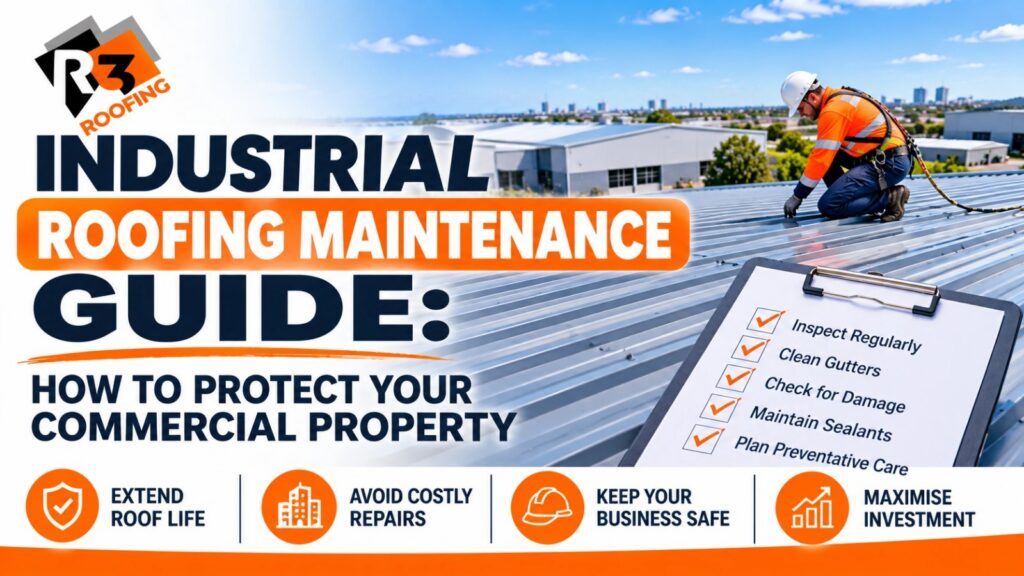
A good industrial roof maintenance checklist covers the roof surface, fasteners, flashings, penetrations, drainage, internal signs of moisture, storm damage and maintenance records. It should support a broader inspection process rather than replace professional assessment.
For this article, I recommend using natural internal-link anchors rather than forcing exact-match keywords repeatedly.
The important placements are already implemented above.
Additional internal-linking opportunities include:
I have intentionally kept these links contextual rather than inserting them as a separate link list inside the article.
An industrial roof should be inspected according to its condition, exposure, roofing system and operational risks, with additional inspections after significant weather or roofing work. There is no single maintenance interval that suits every industrial property. For example, a large Brisbane warehouse exposed to heavy storms, rooftop equipment and significant drainage loads may require a different maintenance programme from a smaller commercial building with limited roof access.
Industrial roof maintenance can include inspection of roofing sheets, flashings, fasteners, sealants, penetrations, gutters, downpipes, drainage, corrosion and previous repair areas. The exact scope depends on the roof system and its condition. I wouldn't treat maintenance as simply cleaning the roof. If the fasteners are deteriorating or water is backing up in the drainage system, cleaning alone won't solve the underlying problem.
Yes, preventative maintenance can identify conditions that commonly lead to leaks before they become major failures. It cannot guarantee that a roof will never leak. For example, replacing a deteriorated fastener or repairing damaged flashing can address a potential water-entry point before repeated rainfall causes internal damage.
Recurring leaks, corrosion, damaged flashing, loose fasteners, damaged sheets, blocked drainage and internal water stains are common signs that an industrial roof needs attention. A business owner might notice a small ceiling stain and assume it is minor. If that stain keeps returning, I would investigate the source rather than repeatedly painting over the internal damage.
An industrial roof should be considered for replacement when deterioration is widespread, failures are recurring or continued repairs no longer provide reliable long-term performance. For example, if a large metal roof has isolated corrosion, repair may make sense. If corrosion has spread across large sections and multiple components are failing, a commercial roof replacement assessment may be more appropriate.
Neither is automatically better; the right option depends on the condition of the existing roofing system. Restoration can make sense when the roof remains structurally serviceable, while replacement may be necessary when deterioration is extensive. I've seen situations where replacing a roof would have been unnecessary because the underlying system could still be restored. The opposite can also happen when repeated repairs are only delaying a larger replacement.
Yes, blocked or poorly performing gutters can contribute to water overflow, moisture damage and deterioration around the roof edge. Industrial roofs can generate significant volumes of runoff, making effective drainage particularly important. If water repeatedly overflows from the same section of a commercial building, I would check more than just the leaves in the gutter. The downpipe, gutter fall, outlet capacity, fascia and wider drainage system may also need assessment.
You may need commercial re-roofing when the existing roof has widespread deterioration or when repeated repairs are no longer providing reliable performance. A professional inspection should establish whether repair, restoration or replacement is appropriate. The key is not to decide based on age alone. The roofing material, corrosion, drainage, flashings, fasteners, structural condition and repair history all matter.
Look for relevant commercial experience, proper inspection procedures, a detailed scope, suitable materials, safety processes, clear warranty information and an approach that considers repair, restoration and replacement. When comparing commercial roofing services, I would always ask what is included in the quote. Two contractors can quote very different prices because they are allowing for very different levels of preparation and repair.
Regular maintenance can help identify and address deterioration before it develops into more extensive damage, but it cannot guarantee a specific additional service life. The result depends on the roof system, installation quality, exposure, maintenance history and condition. The purpose of maintenance is not to promise a fixed number of extra years. It is to keep the roof performing properly and make informed decisions about repairs, restoration and eventual replacement.