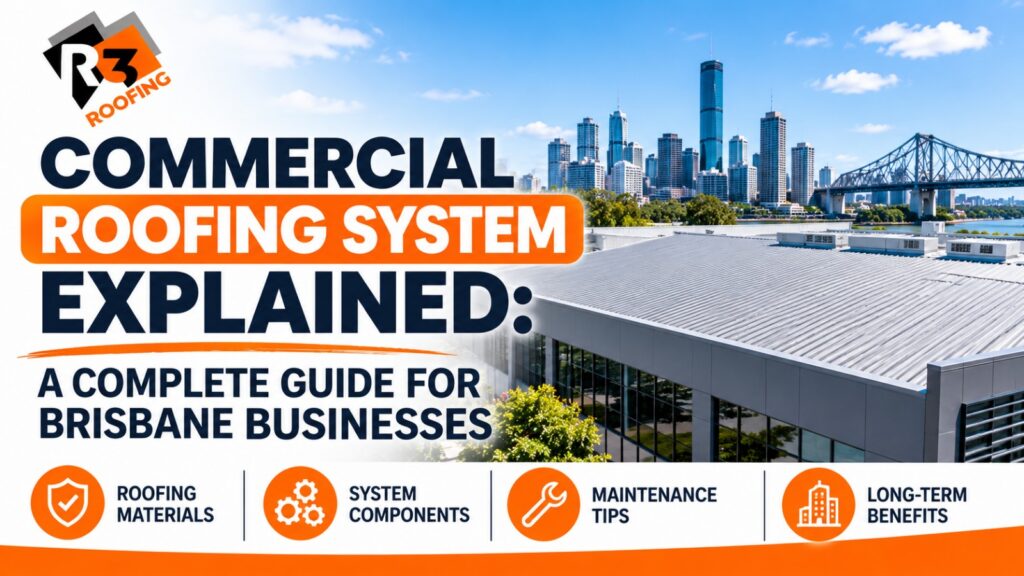
The most important thing to understand about a commercial roofing system is that it is not just the roof covering you can see from the ground. The complete system includes the roof surface, structure, fasteners, flashings, penetrations, insulation, ventilation and drainage—and every part needs to work together to protect the building.
When I assess a commercial roof, I don’t look at one component in isolation.
A leak might look like a roofing-sheet problem, but the actual cause could be a failed flashing, loose fastener, damaged penetration, blocked drainage point or deterioration around the roof edge.
That distinction matters even more on a commercial property because the roof protects much more than the building itself. It can protect stock, equipment, offices, employees, customers and day-to-day business operations.
For businesses looking at commercial roofing in Brisbane, the right solution depends on the building, existing roof system, condition, drainage, access requirements and long-term objectives.
At R3 Roofing, our approach is straightforward:
Repair. Restore. Replace.
We assess the roof first, identify what is actually happening and then recommend the most practical roofing solution.
A commercial roofing system is the complete assembly that protects a commercial building from weather, water, heat and other environmental exposure. It includes the roof covering as well as supporting and waterproofing components such as flashings, fasteners, insulation, penetrations, gutters, downpipes and other drainage elements.
A commercial roofing system is more than the visible roof surface. It is a complete combination of roofing materials, structural components, waterproofing details, insulation and drainage designed to protect the building.
A commercial roof may look simple from the ground, but there can be several layers and components working together above the ceiling.
Depending on the building, a commercial roofing system may include:
The exact configuration depends on the building design and roofing system.
For example, a warehouse may have a large metal roof with extensive drainage requirements, while a low-slope commercial building may use a membrane system with carefully designed falls and drainage outlets.
That is why I don’t believe commercial roofing should be approached as a one-size-fits-all service.
If you’re researching broader commercial roofing services in Brisbane, the first step should always be understanding what system is already installed and what condition it is in.
The main commercial roofing systems include metal roofing, single-ply membranes, built-up roofing, modified bitumen and insulated roof panels, but the right option depends on the building design, roof slope, environment and intended use.
Commercial roofing systems vary considerably. Metal, membrane, modified bitumen and insulated systems can all have different applications, so the building should be assessed before selecting or replacing a system.
Metal roofing is widely used across commercial and industrial buildings because it can provide durability, weather resistance and relatively straightforward maintenance when correctly designed and installed.
Depending on the building, commercial metal roofing can include different profiles, concealed-fixing systems or exposed-fastener systems.
R3 Roofing provides commercial metal roofing solutions alongside repair, maintenance and replacement services.
Metal roofing also needs attention to:
Our guide to common metal roofing problems explains why leaks, corrosion, loose fasteners and damaged flashing can become larger problems when ignored.
Single-ply membrane systems are commonly used on flat and low-slope commercial roofs. Common membrane categories include TPO, PVC and EPDM.
These systems create a waterproofing layer across the roof and rely heavily on correctly detailed seams, penetrations, edges and drainage.
The reference material for commercial roofing systems identifies TPO, PVC and EPDM as major single-ply membrane categories, with each offering different performance characteristics.
The important point for a business owner is not simply knowing the names.
You need to understand whether the system is suitable for your building and whether it has been correctly installed and maintained.
Built-up roofing uses multiple layers to create a durable waterproofing assembly. Modified bitumen also uses reinforced layered construction and is commonly associated with low-slope commercial applications.
These systems can be appropriate for particular commercial buildings, but their suitability depends on the existing roof design, structure, drainage and project requirements.
Insulated roof panels combine roofing and insulation into a single panel system.
This can be particularly useful for commercial and industrial buildings where thermal performance is an important consideration.
Queensland’s climate makes insulation especially relevant because roof heat can significantly affect internal temperatures and cooling demand.
A commercial roofing system normally includes the roof covering, structural support, flashings, fasteners, penetrations, insulation, ventilation and drainage components.
The roof covering is only one part of a commercial roof. Flashings, fasteners, insulation, penetrations and drainage can all determine whether the finished system remains weatherproof.
This is the part most people notice first.
It may be metal sheeting, membrane, insulated panels, tiles or another approved roofing material.
But the roof covering cannot perform properly if the components around it are failing.
Flashings protect vulnerable transition points.
These can include:
A commercial roof can have excellent sheets and still leak because a flashing detail has failed.
Fasteners secure roofing components to the supporting structure.
On metal roofs, deteriorated screws, washers or fixing points can create water entry and movement problems.
Commercial buildings often have more rooftop equipment than residential properties.
Air-conditioning systems, vents, skylights, exhaust systems, solar equipment and other services can all create penetrations that need careful waterproofing.
Insulation helps control heat transfer, while ventilation can help manage heat and moisture within appropriate roof assemblies.
The Brisbane climate makes this particularly important. Haggarty’s Brisbane commercial-building roofing guidance also highlights insulation and ventilation as important parts of overall roof performance.
This is an area I pay close attention to because drainage is part of the roofing system.
Our roof drainage problems explained guide explains how blocked gutters, inadequate drainage, damaged fascia and downpipe problems can contribute to water damage.
Commercial roof drainage is essential because rainwater needs to move efficiently from the roof surface into gutters, drains or downpipes without creating prolonged ponding or uncontrolled overflow.
Good commercial drainage protects the roof edge, flashings, fascia, structure and building interior. Poor drainage can turn a minor roofing issue into a major water-damage problem.
This becomes particularly important on large commercial roofs.
A large roof can collect a substantial volume of water during a Brisbane storm. If the drainage system cannot handle that flow, water can accumulate or discharge where it shouldn’t.
Problems can include:
A roof drainage system should be considered during both new installations and commercial roof replacement projects.
When we replace or restore a roof, I don’t want to install a new roof and leave an ageing drainage system that creates the next problem.
A properly designed commercial roofing system protects the building from water intrusion, weather exposure and deterioration while helping protect the business activities and assets inside.
A commercial roof protects more than the structure. A failure can affect stock, equipment, employees, customers, internal finishes and business operations.
Consider a warehouse storing expensive equipment.
A small roof leak may initially appear insignificant.
But if water reaches electrical equipment, stored products or internal systems, the financial impact can become much greater than the original roofing repair.
The same applies to:
That is why commercial roofing should be approached as asset protection rather than simply a construction expense.
R3’s current commercial roofing guidance similarly emphasises protecting buildings, equipment, inventory and business operations when assessing commercial roofing work.
A commercial roof may need repair when the problem is localised, restoration when the existing system remains serviceable but requires broader work, or replacement when deterioration has become too extensive for economical restoration.
The correct solution depends on the condition of the entire roofing system. A recurring leak does not automatically mean replacement, and an old roof does not automatically need to be replaced.
Repair can make sense when the problem is isolated.
Examples include:
Restoration is broader.
It may involve:
The existing roof must still be suitable for continued service.
Replacement becomes more appropriate when:
This is why R3 Roofing’s approach remains Repair. Restore. Replace.
I would rather recommend the correct solution after inspecting the roof than automatically tell a business owner that a complete replacement is required.
Commercial roof replacement involves removing the existing roofing system where required, assessing the substrate and supporting components, installing the new roofing system and completing associated flashing and drainage work.
A commercial roof replacement should begin with inspection and scope development. It may involve removal, structural checks, new roofing, flashing, penetrations, drainage and a final inspection.
A proper roof replacement Brisbane project can involve considerably more than installing new sheets.
We first need to understand the condition of the existing roof.
This can include:
The scope should clearly identify what is being replaced and what is staying.
I recommend asking:
The existing roofing material is removed according to the project requirements.
The removal process can expose issues that were not visible during the initial inspection.
Once the existing roof covering is removed, supporting components can be assessed more thoroughly.
Any damaged components should be addressed before the new roof is installed.
The new roofing system is installed according to the building’s design and the selected roofing material.
These areas require particular attention because they are common points of water entry.
Gutters, downpipes, valleys and outlets should work with the new roof.
The finished project should be checked against the agreed scope.
R3’s current Colorbond replacement guidance follows the same basic principle: replacement should be treated as a complete roofing project involving inspection, preparation, roofing, flashing, drainage and final checks rather than simply changing the visible roof sheets.
Commercial re-roofing means renewing an existing commercial roof system, either by replacing the roof covering or undertaking a broader re-roofing project while addressing the components required for reliable performance.
Commercial re-roofing is generally considered when the existing roof has deteriorated beyond practical repair or restoration but the building can be renewed with a new roofing system.
The terminology can vary between contractors.
One company may describe a project as commercial roof replacement, while another may call it commercial re-roofing.
What matters is the actual scope.
If you’re comparing commercial re-roofing in Brisbane, don’t compare terminology. Compare:
This prevents a business owner from comparing two quotes that actually cover different levels of work.
The right commercial roofing solution should be selected according to the building, existing roof condition, roof design, climate exposure, drainage requirements, business use, maintenance expectations and long-term goals.
Do not select a commercial roof simply because a material is popular. The roofing system should match the building and the conditions it will face.
A warehouse, retail centre and office building can have very different roofing requirements.
Flat and low-slope roofs have different drainage considerations from steeper metal roofs.
Brisbane roofs deal with:
Commercial roofs often have air-conditioning equipment, solar systems, exhaust systems and other services that affect access and maintenance.
A roof that looks inexpensive initially may not be the cheapest system over its full service life if it requires frequent repairs or has difficult maintenance requirements.
A commercial roofing project needs to consider how the work will affect the building’s occupants and daily operations.
That is one reason I believe the project plan is just as important as the roofing material.
The most common commercial roofing problems include leaks, corrosion, damaged flashing, deteriorated fasteners, drainage failures, storm damage and coating deterioration.
Most commercial roof failures begin around vulnerable components such as penetrations, flashings, fasteners and drainage points rather than simply through failure of the main roof covering.
Leaks are often the first visible warning sign.
However, the location where water appears inside the building may not be the actual entry point.
Metal roofs can develop corrosion where coatings have deteriorated, water remains present or environmental exposure accelerates deterioration.
Flashing around walls, valleys, penetrations and transitions can deteriorate and allow water entry.
Fastener failure can create both movement and water-entry problems.
Blocked or damaged drainage can cause water to remain on or around parts of the roof system.
Brisbane storms can place significant stress on commercial roofs.
After a major weather event, I recommend inspecting the roof rather than assuming that no visible damage from ground level means everything is fine.
Regular inspections, drainage maintenance, prompt repairs and post-storm checks can help identify commercial roofing problems before they develop into larger failures.
Commercial roof maintenance should focus on early detection. Small problems are generally easier to address before water intrusion, corrosion or structural deterioration spreads.
A practical maintenance routine should include:
Commercial roof maintenance guidance also recommends regular inspections, debris removal, drain maintenance and checks around seams, flashings and penetrations.
I also recommend keeping records.
If a particular section has been repaired three times in two years, that information becomes useful when deciding whether another repair makes sense or whether a larger roofing project should be considered.
Brisbane’s combination of intense sun, heavy rainfall, storms, humidity and, in some locations, coastal exposure means commercial roofing systems need appropriate materials, drainage and maintenance.
Brisbane’s climate places repeated stress on commercial roofs. Material selection matters, but installation quality, drainage, flashing and ongoing maintenance are equally important.
Heavy rain can quickly expose drainage weaknesses.
Strong sun can accelerate coating and sealant deterioration.
Storms can damage sheets, fasteners and flashings.
Humidity and moisture can contribute to corrosion and deterioration.
For properties closer to the coast, salt exposure can also become an important consideration.
This is why I don’t recommend choosing a commercial roof based on appearance alone.
The material needs to suit the environment, but the complete system needs to be designed and maintained properly as well.
When comparing commercial roofing services, look for relevant experience, a physical inspection, a clear scope of work, appropriate materials, safety planning, warranty information and a contractor who can explain why a particular solution is being recommended.
A commercial roofing quote should explain the work rather than simply provide a price. Compare inspection, scope, materials, safety, warranty and long-term value.
The contractor should understand the actual condition of the roof.
The proposal should explain what will be repaired, restored, replaced or coated.
Commercial roofing is different from simply repairing a small residential roof.
The materials should suit the roof design and environmental conditions.
Commercial roofing involves working at height and potentially working around employees, customers, equipment and vehicles.
Understand what workmanship and manufacturer warranties apply.
You should understand what is happening before the project starts.
R3’s current commercial roofing guidance recommends comparing contractors based on inspection, scope, materials, experience, safety, warranty and long-term value rather than price alone.
For businesses looking for broader [Brisbane roofing services] Brisbane roofing services, this is the standard I recommend using when comparing proposals.
You should book a commercial roof inspection when you notice recurring leaks, water stains, corrosion, damaged flashing, drainage problems, storm damage or repeated repair requirements.
Don’t wait for a major internal leak before inspecting a commercial roof. Recurring repairs, drainage issues and visible deterioration are reasons to investigate the roof before the problem grows.
You should also consider an inspection:
A proper inspection helps answer the question that matters most:
Do you need repair, restoration, re-roofing or replacement?
That is a much more useful question than simply asking, “How much does a new commercial roof cost?”
Commercial roof restoration improves and extends a roof that remains suitable for continued service, while replacement removes and renews the roofing system when the existing system has deteriorated beyond practical restoration.
Restoration and replacement are different solutions. The correct choice depends on roof condition, structural integrity, repair history and long-term performance requirements.
If the existing roof is structurally sound and deterioration is manageable, restoration may make sense.
If the roof has widespread deterioration, repeated failures or significant structural problems, replacement may be more appropriate.
R3’s commercial roofing guidance also makes this distinction: restoration can suit a structurally sound roof requiring broader repair and protective work, while replacement may be necessary where deterioration has progressed beyond economical restoration.
This is why I don’t recommend making the decision from a photograph or the roof’s age alone.
Yes. Guttering, fascia and downpipes can form an important part of a commercial roof drainage system and should be assessed when they affect roof performance.
A commercial roofing project should not ignore the roof drainage system. Damaged gutters, fascia or downpipes can contribute to water problems even when the main roof covering is in reasonable condition.
For example, replacing a roof while leaving badly deteriorated gutters can create an avoidable problem.
Water still needs somewhere to go.
R3’s guttering, fascia and downpipe services are therefore relevant when a roofing project also involves drainage deterioration.
Before approving commercial roof replacement, ask exactly what is included in the scope, what condition the existing roof structure is in, what materials will be used, how drainage will be handled and what warranty applies.
A detailed scope protects the business owner from comparing incomplete quotes and helps clarify what happens if hidden damage is discovered during the project.
I recommend asking these questions:
If the contractor cannot clearly explain the scope, I would not recommend making a decision based solely on the price.
A commercial roofing system is a complete building-protection system.
It is not simply the sheets or membrane you see from the ground.
The roof covering, flashings, fasteners, penetrations, insulation, structure and drainage all contribute to performance.
That is why a recurring leak should not automatically result in a complete roof replacement.
Likewise, a commercial roof that has been repaired repeatedly may eventually reach the point where another patch no longer makes financial or practical sense.
At R3 Roofing, we follow a straightforward process:
Repair. Restore. Replace.
We assess the existing roof, identify the cause of the problem, establish the scope and then recommend the solution that makes sense for the property.
For businesses considering roof replacement services in Brisbane, commercial re-roofing or ongoing maintenance, the best place to start is with the actual condition of the roof.
If you need help determining what your commercial roofing system requires, you can book a professional roof inspection with R3 Roofing.
A commercial roofing system is the complete assembly that protects a commercial building from weather and water. It can include the roof covering, structure, flashings, fasteners, insulation, ventilation, penetrations, gutters and downpipes. For example, if a warehouse has a metal roof but its flashings and drainage are failing, the roofing system is not performing properly even if the metal sheets themselves still look reasonable.
Common commercial roofing systems include metal roofing, single-ply membranes, built-up roofing, modified bitumen and insulated roof panels. The appropriate system depends on the building, roof profile, environment, drainage and performance requirements. A large warehouse may have very different requirements from a low-slope retail building, so there is no universal commercial roofing material that suits every property.
The service life of a commercial roof depends on the material, installation quality, environmental exposure, maintenance and overall roof design. There is no single lifespan that applies to every commercial roofing system. I've seen roofs deteriorate earlier than expected because small issues were ignored, while well-maintained systems can continue performing for many years.
Commercial re-roofing is the renewal of an existing commercial roof, usually involving replacement of the existing roof covering and associated roofing work. The exact scope depends on the condition of the existing system. The important thing is to understand what the contractor means by "re-roofing." One quote may include extensive preparation, flashings and drainage while another may cover only the roof covering.
A commercial roof may need replacement when deterioration becomes widespread, repairs are recurring, corrosion is extensive, structural problems are present or restoration is no longer practical. For example, one isolated leak does not necessarily justify replacement. But repeated leaks across multiple areas combined with deteriorated roofing components can indicate that a larger solution needs to be considered.
Commercial roof replacement costs vary according to roof size, roofing material, condition, access, structural work, drainage, flashings, labour and project complexity. A warehouse with straightforward access can have a very different project cost from a multi-level commercial building with rooftop equipment and difficult access. That is why I recommend comparing detailed scopes rather than relying on a generic price per square metre.
Yes, a commercial metal roof may be suitable for restoration when the underlying system remains serviceable. Restoration may involve repairing corrosion, replacing deteriorated fasteners, repairing flashing, addressing leaks and applying suitable protective treatments. However, widespread corrosion or structural deterioration may make replacement more practical.
A commercial roof should generally be inspected at least annually and after significant storms or severe weather, with frequency adjusted for the property's exposure and condition. A building near the coast, beneath large trees or exposed to heavy weather may need closer monitoring. The important thing is not to wait until water is already entering the building.
It can, and gutters and downpipes should be assessed because they are part of the roof drainage system. A new roof cannot perform properly if rainwater cannot leave the roof efficiently. I've seen situations where the roof covering was not the main issue—the drainage system was.
Yes. R3 Roofing provides commercial and industrial roofing services in Brisbane, including roof restoration, metal roofing, repairs, guttering, fascia, eave work, protective coatings and replacement-related roofing work. R3's current commercial roofing material states that its services cover commercial and industrial properties across Brisbane. For a commercial project, R3's approach is to assess the roof first, establish the scope and determine whether repair, restoration or replacement is appropriate.