The most important part of downpipe installation is not simply attaching a pipe to your gutter. The downpipe must be correctly sized, positioned, supported and connected so your roof drainage system can move rainwater away from your property without overflowing, pooling or damaging the roofline.
In Brisbane and across Queensland, heavy rainfall can put significant pressure on gutters and downpipes. If your downpipes are undersized, poorly positioned, blocked or incorrectly connected, water can overflow from the gutter and start affecting your fascia, eaves, roof edges, walls and foundations.
I often see homeowners focus on the gutter itself and overlook the downpipes. That is a mistake.
A gutter can collect rainwater effectively, but if the downpipe cannot carry that water away quickly enough, the entire drainage system becomes a problem.
This downpipe installation guide explains how the system should be planned, what sizing and positioning factors matter, which materials are suitable, when you should replace downpipes, and how downpipes work together with gutters and the rest of your roof.
A downpipe carries rainwater collected by the gutter down to ground level or an appropriate stormwater drainage system.
Think of the gutter as the collection point and the downpipe as the vertical transport system.
When rain falls onto the roof, the water runs down the roof surface and into the gutter. The gutter then directs that water towards an outlet, where the downpipe carries it away from the roofline.
A properly functioning system should:
The downpipe is therefore not an isolated component. It is part of the complete roof drainage system.
A downpipe carries rainwater from the gutter to ground level or an appropriate stormwater drainage system. Correct sizing, positioning and connection are essential because an ineffective downpipe can cause gutter overflow and water damage.
Brisbane properties experience intense rainfall, summer storms and periods of heavy runoff. That means your roof drainage system needs to cope with sudden increases in water volume.
The National Construction Code Housing Provisions specifically considers rainfall intensity, roof catchment area, gutter selection, downpipe sizing and overflow when designing roof drainage systems. The current Housing Provisions state that a downpipe must not serve more than 12 metres of gutter length and should be positioned as close as possible to valley gutters under the relevant provisions.
However, I would not recommend homeowners simply applying the “one downpipe every 12 metres” rule without considering the complete roof design.
Roof area, roof shape, rainfall intensity, gutter profile, valleys, drainage arrangement and the property’s existing stormwater system all matter.
For Brisbane homes, this becomes particularly important during major storms.
If the gutter receives more water than the downpipe can remove, the result can be:
This is why professional guttering services Brisbane homeowners use should consider the entire drainage system rather than treating a downpipe as a simple replacement component.
Correct downpipe installation helps Brisbane homes manage heavy rainfall and stormwater. The system must be designed around roof catchment, rainfall, gutter capacity, downpipe capacity and the property’s drainage arrangement.
The first step is assessment, not cutting the pipe.
Before installing a downpipe, I would look at the entire roof drainage path.
Determine which section of the roof drains into the gutter being serviced.
A larger roof catchment sends more water towards the gutter, which can affect the number and size of downpipes required.
Check whether the gutter:
There is little benefit in installing a new downpipe onto a gutter that cannot collect and direct water correctly.
Roof valleys can concentrate large amounts of water into particular gutter sections.
Downpipe positioning should therefore consider where water naturally collects.
The downpipe needs somewhere suitable to send the water.
Depending on the property, this may involve:
The new downpipe should be compatible with the gutter, roof, brackets, flashings and other connected materials.
Material compatibility matters because incompatible metals can contribute to corrosion and premature failure.
Good downpipe installation starts with inspecting the roof catchment, gutter, valleys, discharge point and existing materials. Planning the complete drainage path prevents problems that a simple pipe replacement cannot solve.
There is no single number that works for every house.
The required number depends on the roof catchment area, rainfall intensity, gutter capacity, downpipe size and drainage design.
The NCC Housing Provisions provide a general rule that each downpipe should serve no more than 12 metres of gutter length and should be positioned as close as possible to valley gutters.
But roof drainage design goes beyond measuring the gutter with a tape.
For example, imagine a Brisbane home with a large roof section feeding a long gutter. Installing one downpipe at the far end might appear convenient, but the gutter may struggle to move water efficiently during heavy rainfall.
A better design may distribute the catchment across multiple downpipes.
This is one reason I recommend having the roof and gutter system assessed before deciding how many downpipes you need.
The number of downpipes depends on the roof area, rainfall, gutter design and drainage requirements. The NCC Housing Provisions specify a maximum 12-metre gutter length per downpipe under the relevant housing provisions, but the complete roof drainage design still needs to be considered.
Downpipe size should be selected according to the gutter and roof drainage design rather than simply choosing the largest pipe available.
The NCC Housing Provisions identify several downpipe options, including:
The suitability of each option depends on the gutter type and drainage requirements.
A larger pipe does not automatically fix a poorly designed drainage system.
If the gutter itself is undersized, incorrectly sloped or poorly positioned, installing a larger downpipe may not solve the underlying problem.
Likewise, if the discharge point cannot handle the water volume, increasing the downpipe size may simply move the problem further down the system.
The correct approach is to consider:
Downpipe size must match the gutter and roof drainage design. Common Australian housing provisions include 75 mm and 90 mm round and 100 mm × 50 mm or 100 mm × 75 mm rectangular downpipes, but the correct size depends on the overall system.
The best material depends on the property, existing roof materials, exposure, appearance and budget.
Common options include:
Colorbond steel is a popular choice for Australian homes because it provides a clean appearance and can be matched with many roofing and gutter colours.
It is particularly useful when you want your downpipes to coordinate with your Colorbond roofing Brisbane homeowners commonly choose.
PVC is lightweight and resistant to rust. It can be practical in some residential drainage applications and is generally straightforward to work with.
However, appearance, exposure, impact resistance and compatibility with the existing system should still be considered.
Galvanised steel provides a durable metal option but needs to be assessed carefully for corrosion exposure and compatibility with surrounding materials.
Aluminium is lightweight and naturally corrosion resistant, making it useful for certain applications. However, installation detailing and thermal movement should be considered.
Copper provides a distinctive premium appearance and can be extremely durable, but its cost makes it a specialised choice rather than a standard solution for most Brisbane homes.
The key point is that the material should suit the entire roof drainage system.
Colorbond steel, PVC, galvanised steel, aluminium and copper can all be used for different applications. The correct choice depends on durability, appearance, environmental exposure, compatibility, maintenance and the existing roof and gutter system.
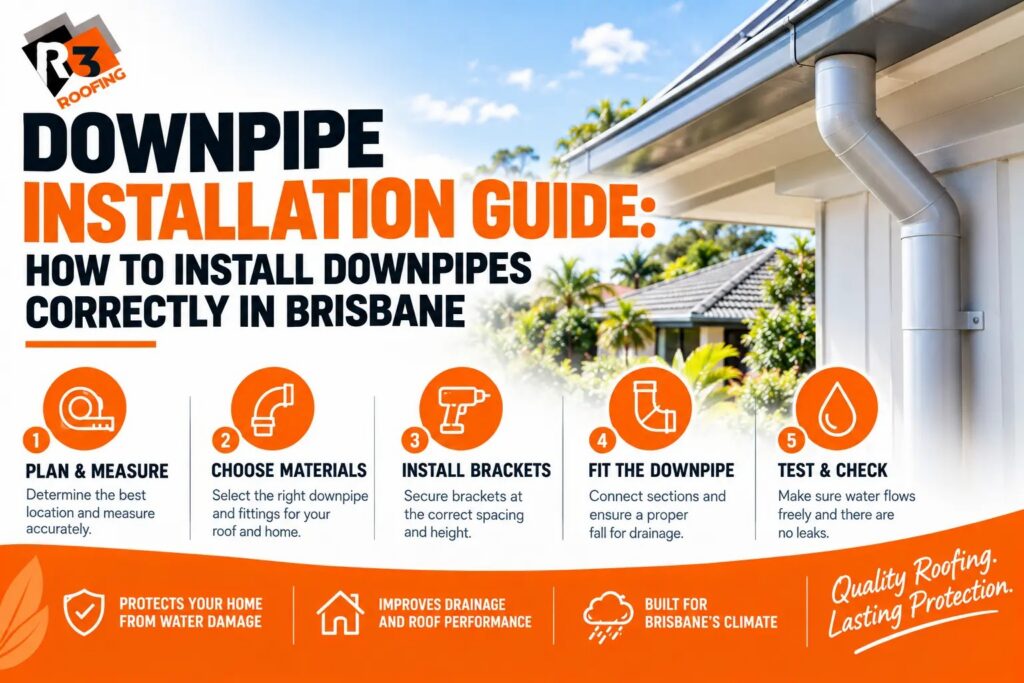
A professional installation generally follows a planned sequence rather than simply attaching a pipe to the gutter outlet.
The installer identifies the correct outlet position based on the gutter layout, roof catchment and drainage path.
The outlet must be properly connected to the gutter so water can enter the downpipe without creating unnecessary restrictions or leaks.
The installer measures the distance from the gutter outlet to the discharge point.
This is important because the pipe may need bends, offsets or connections depending on the building design.
The pipe is cut accurately to suit the required length.
Metal pipes need particular care because cut edges can be sharp and may require appropriate finishing.
Where the downpipe needs to move around eaves, walls or architectural features, appropriate elbows or offsets are installed.
The goal is to maintain a clean and reliable flow path.
Brackets or clips are used to secure the pipe to the building.
The downpipe should not be left unsupported because movement can place stress on joints and connections.
The lower end should discharge into the appropriate drainage arrangement.
The exact connection method depends on the property and applicable requirements.
Water should be introduced into the gutter to check that:
This final step is important because an installation can look perfect while still having a drainage problem.
Correct downpipe installation involves planning the outlet, measuring the run, cutting and connecting the pipe, securing it properly, connecting it to an appropriate drainage system and testing the completed installation.
Downpipes should be positioned where they can effectively collect and remove the water flowing through the gutter.
The NCC Housing Provisions state that downpipes should be located as close as possible to valley gutters because valleys can concentrate roof runoff.
In practical terms, positioning should consider:
I also want the downpipe to be visually sensible.
A technically functional installation should still look clean against the building.
This is particularly important when installing new guttering and fascia replacement as part of a broader roofline upgrade.
Downpipes should be positioned around roof catchment and water-flow requirements, with particular attention to valleys and gutter low points. Good positioning improves drainage performance and can also create a cleaner finished roofline.
The discharge point is just as important as the vertical pipe.
A downpipe should not simply release a large volume of water against the base of the house where it can pool around the building.
Depending on the property, water may need to be directed towards an appropriate stormwater system, drainage point or other approved arrangement.
Queensland requirements distinguish different categories of regulated plumbing and drainage work, with regulated work required to be performed by appropriately licensed professionals. QBCC also identifies roof drainage and downpipe connections as areas requiring appropriate installation and approval consideration.
For that reason, I would not treat a stormwater connection as a DIY shortcut.
If the project involves modifying the existing drainage system, check the applicable Queensland and local requirements before work begins.
Downpipes need to discharge water through an appropriate drainage arrangement rather than simply releasing water beside the building. Stormwater and drainage work can be regulated in Queensland, so the required licensing and approval pathway should be confirmed before installation.
Overflow protection is an important part of roof drainage design.
During extreme rainfall, the amount of water entering a gutter can exceed normal drainage capacity. If there is no suitable overflow path, water may move into areas of the building where it should never be.
The NCC Housing Provisions include requirements for overflow measures designed to reduce the risk of water entering the building.
Overflow solutions can include:
The correct solution depends on the roof and gutter design.
Imagine a Brisbane storm where a roof receives a sudden surge of water.
If the gutter fills faster than the downpipe can discharge it, water needs a controlled escape route.
Without appropriate overflow protection, the water may find its own route.
That could mean water entering the eaves, roof cavity or building structure.
Overflow protection provides a controlled path for excess rainwater when normal gutter and downpipe capacity is exceeded. It is an important part of safe roof drainage design, particularly in areas exposed to heavy rainfall.
Sometimes, yes.
If the gutters are old, corroded or undersized, installing new downpipes without addressing the gutter system may only solve part of the problem.
R3 Roofing specifically treats gutters, fascia and downpipes as interconnected components of the roof drainage system.
I would consider replacing them together when:
This is where replace guttering decisions should be based on the condition of the complete drainage system rather than one isolated component.
If the roof itself is also deteriorating, the project may form part of broader roof restoration and reroofing work.
Gutters and downpipes should often be assessed together because they work as one drainage system. If multiple components are aged, damaged or underperforming, replacing them together can produce a more reliable long-term result.
You may need downpipe replacement when the existing pipe can no longer reliably move water away from the roof.
Look for:
One small leak does not automatically mean the entire system needs replacing.
If the damage is isolated, repair may be possible.
However, repeated failures usually deserve a broader inspection.
R3 Roofing’s guidance on common roofing problems also highlights drainage issues alongside leaks, corrosion, flashing problems and storm damage as issues that should not be ignored.
Cracks, corrosion, loose connections, sagging, repeated blockages and persistent overflow can indicate that downpipes need repair or replacement. The decision should be based on the condition of the system rather than one isolated defect.
You can physically attach some basic downpipe components yourself, but that does not mean every downpipe installation is suitable as a DIY project.
The main concerns are safety, drainage design, roof access and compliance.
Working around roof edges creates fall risks, while cutting and installing metal components introduces additional hazards.
More importantly, connecting the system to stormwater drainage can involve regulated plumbing and drainage work.
QBCC states that regulated plumbing and drainage work must be performed by appropriately licensed professionals, with different categories determining whether permits, notifications or other requirements apply.
If you are simply replacing a damaged external section, the situation may be different from modifying the entire stormwater system.
My advice is simple: if the job involves roof access, changing drainage capacity or connecting into stormwater infrastructure, have the work assessed by an appropriately qualified professional.
DIY downpipe work may appear straightforward, but roof access, drainage design, stormwater connections and Queensland regulatory requirements can make professional installation the safer option.
Several mistakes can reduce the effectiveness of an otherwise new-looking drainage system.
An undersized downpipe may struggle during heavy rainfall.
The amount of water entering the gutter matters just as much as the pipe itself.
A long gutter with insufficient outlets can increase overflow risk.
Valleys can concentrate significant runoff into specific areas of the gutter.
A new downpipe cannot compensate for a severely damaged gutter.
The NCC requires materials used in gutters, downpipes and flashings to be compatible with upstream roofing materials.
Movement can stress joints and create leaks.
This can create pooling and moisture problems around the property.
Extreme rainfall needs to be considered as part of the drainage design.
A downpipe can look excellent while still being poorly designed.
The most common downpipe installation mistakes include incorrect sizing, poor positioning, inadequate support, incompatible materials, insufficient drainage capacity and ignoring overflow requirements. A complete system assessment prevents these problems.
There is no single price for downpipe installation because every property has different requirements.
The cost can depend on:
A simple replacement of one accessible downpipe is very different from installing a complete drainage system on a two-storey property.
I also recommend looking at the total scope rather than choosing a contractor based only on the lowest initial price.
If the existing gutters, fascia and roof drainage are failing, a cheap downpipe replacement may simply postpone the bigger problem.
Downpipe installation costs depend on material, length, access, number of pipes, gutter condition, drainage connections and additional work. A proper inspection and detailed scope provide a more meaningful price than a generic per-pipe estimate.
New downpipes still require maintenance.
At least once or twice a year, inspect the complete gutter and drainage system, particularly after major storms or heavy rainfall.
Check for:
If the downpipe connects to an underground drainage system, signs of slow drainage or backup should also be investigated.
Maintenance is much easier when problems are identified before the next major storm.
If your roof is already showing warning signs such as leaks, damaged sheets or blocked drainage, our roof leak detection guide explains why finding the actual source of water entry matters rather than simply repairing the visible stain.
Downpipes should be inspected with the rest of the roof drainage system at least once or twice a year and after major storms. Regular maintenance helps identify blockages, corrosion, leaks and drainage problems before they become expensive repairs.
You should arrange a professional assessment when you are unsure whether the problem is isolated or part of a larger roof drainage issue.
I would particularly recommend an inspection if you notice:
R3 Roofing’s approach is to inspect the condition of the roof and drainage system before deciding whether the appropriate solution is repair, restoration or replacement. That same principle applies to downpipes.
If the roof itself is also ageing, the drainage work may need to be coordinated with broader re-roofing services Brisbane homeowners require.
Professional help is appropriate when downpipe problems are recurring, widespread or connected to gutter, fascia, roof or stormwater issues. An inspection helps identify whether repair, replacement or a broader roofing solution is appropriate.
A downpipe might look like one of the simplest components of a roof, but it performs an important job.
The correct installation needs to account for roof catchment, rainfall, gutter capacity, downpipe sizing, positioning, material compatibility, overflow protection and the final drainage connection.
For Brisbane homes, I would never recommend choosing a downpipe based only on price or appearance.
If your gutters are overflowing, your downpipes are damaged or your roof drainage system is struggling during heavy rain, start with an inspection.
The right solution may be a simple downpipe repair. In other cases, you may need new gutters, fascia and downpipes or a broader roofing project.
At R3 Roofing, we focus on identifying the actual problem before recommending the work. Whether you need guttering services Brisbane homeowners can rely on, downpipe replacement, gutter repairs or a complete roof drainage upgrade, the goal is the same: move water away from your home reliably and protect the roofline for the long term.
If you are unsure what your property needs, book a professional roof inspection before the next major storm.
Downpipes should be replaced when they become damaged, corroded, repeatedly blocked or unable to drain water effectively. There is no universal replacement schedule because service life depends on material, installation quality, weather exposure and maintenance.
For example, if one section develops a small leak but the rest of the system is sound, repair may be enough. If several downpipes are rusted, loose and overflowing during heavy rain, replacement of the affected system may make more sense.
There is no single best material for every property, but Colorbond steel and PVC are common choices for different residential applications. The correct option depends on appearance, durability, exposure, compatibility and budget.
For example, a homeowner with a Colorbond roof may prefer a matching metal downpipe for a consistent roofline, while another property may use PVC where its characteristics suit the application.
The required number depends on the roof catchment, rainfall intensity, gutter design and downpipe capacity. The NCC Housing Provisions state that one downpipe should not serve more than 12 metres of gutter length under the relevant housing provisions.
For example, a long gutter serving a large roof area may need several downpipes rather than relying on one outlet at the end.
Downpipes should discharge through an appropriate stormwater or approved drainage arrangement rather than simply releasing large amounts of water against the building. The exact connection depends on the property's drainage system and applicable Queensland requirements.
For example, a downpipe connected to an underground stormwater system needs to be assessed differently from one designed to discharge through an approved surface arrangement.
Some basic external work may appear straightforward, but professional installation is safer when the work involves roof access, drainage changes or stormwater connections. Queensland regulates plumbing and drainage work, with different categories determining licensing, notification and permit requirements.
For example, replacing an external pipe section is very different from redesigning the drainage system and connecting it into stormwater infrastructure.
A new downpipe does not automatically solve gutter overflow if the gutter, roof catchment or drainage design is inadequate. Overflow can result from blockages, undersized gutters, insufficient downpipes, poor falls, concentrated valley runoff or inadequate drainage capacity.
For example, if a large roof section sends water into a long gutter with only one outlet, replacing that outlet alone may not resolve the problem.
They should be assessed together, and replacing them together can make sense when both systems are old or damaged. Gutters and downpipes work as one roof drainage system.
For example, installing new downpipes onto heavily corroded gutters may leave the property with the same drainage problems even though the vertical pipes are new.
The roof drainage system needs appropriate overflow measures where required by the applicable provisions. Overflow protection provides a controlled path for excess water during heavy rainfall instead of allowing water to enter vulnerable parts of the building.
For example, during a severe Brisbane storm, water entering a gutter can exceed normal drainage capacity. A properly designed overflow path helps control where that excess water goes.
Repeated overflow, slow drainage, water backing up in the gutter or poor performance during heavy rain can indicate that the drainage capacity needs to be assessed. However, the problem may not be the downpipe alone.
For example, an undersized gutter or blocked outlet can produce the same symptoms as an undersized downpipe. That is why the entire system should be checked before replacing components.
Replace guttering when corrosion, sagging, leaks or drainage problems are widespread rather than isolated. Localised damage can often be repaired, but repeated failures across several sections suggest that replacement may provide a more reliable result.
For example, one leaking gutter joint may need a repair, while multiple rusted and sagging sections throughout the property may justify a complete gutter replacement.
Yes, downpipe work can be coordinated with roof restoration when the drainage system is contributing to the roof's problems. Roof restoration may involve addressing leaks, roof materials, gutters, fascia, drainage and other components depending on the property's condition.
For example, if an older roof is being restored and the existing gutters and downpipes are also deteriorated, completing the drainage work at the same time can create a more integrated solution.