The best gutter material for Queensland is not simply the cheapest, strongest or most popular option. You need to consider Brisbane’s heavy rainfall, intense sun, storm exposure, coastal conditions, corrosion risk, roof type and how well the gutter works with the fascia and downpipes.
When homeowners ask me, “What are the best gutter materials for Queensland?”, I usually start by correcting one assumption: the material is only one part of the decision.
A good gutter system needs to collect a large amount of rainwater, move it toward the downpipes, handle Brisbane’s weather and remain compatible with the roof and fascia.
That means a material that works perfectly on one property may not be the right choice for another.
For example, a Brisbane suburban home surrounded by trees has different requirements from a coastal property exposed to salt air. A modern Colorbond roof also creates different matching and compatibility considerations from an older tiled roof.
So, rather than simply choosing a gutter because it looks good in a sample, I recommend looking at the complete drainage system.
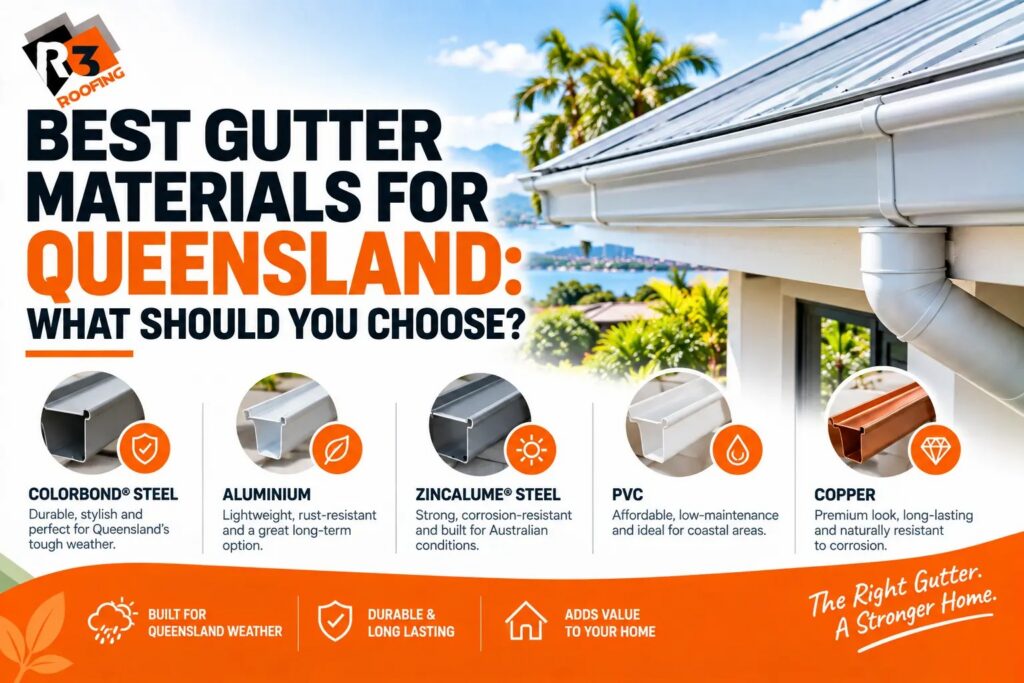
The main gutter materials used in Queensland include Colorbond steel, Zincalume steel, galvanised steel, aluminium, stainless steel, copper and PVC. For many Brisbane homes, pre-finished steel guttering provides a practical combination of strength, appearance, durability and compatibility with modern roofing systems, while specialised materials may suit particular coastal, architectural or budget requirements.
Here is the practical comparison:
Gutter Material | Main Strength | Main Consideration | Typical Use |
Colorbond steel | Durability, appearance and colour matching | Needs correct material specification | Most modern homes |
Zincalume steel | Cost-effective steel performance | Limited colour finish | Practical roofing projects |
Aluminium | Lightweight and corrosion resistant | Thermal movement and detailing | Selected residential applications |
Galvanised steel | Strong and traditional | Corrosion management | Specific applications |
Stainless steel | High corrosion resistance | Higher cost | Harsh or premium environments |
Copper | Long service potential and distinctive appearance | Expensive and specialised | Architectural homes |
PVC | Lightweight and inexpensive | UV, strength and long-term performance considerations | Selected low-demand applications |
The important thing is not to treat this table as a simple ranking.
The correct material depends on the property.
Queensland gutters must cope with strong sunlight, UV exposure, sudden heavy rainfall, storms and, in some locations, salt-laden coastal air. Material selection therefore needs to account for the property’s environment as well as its roof design.
Queensland puts a lot of pressure on roof drainage systems.
You can have long periods of strong sun followed by intense rainfall. Properties closer to the coast can also experience increased exposure to salt and corrosive conditions.
That means I look at several factors before recommending a gutter system:
Material matters, but water capacity and correct installation matter just as much.
A high-quality gutter made from the wrong material or installed with inadequate drainage capacity can still fail.
Australian roofing guidance similarly recommends considering capacity, durability, material quality and the home’s environmental exposure rather than choosing a gutter based on appearance alone.
Colorbond steel is a strong option for many Queensland homes because it combines a pre-finished protective coating, colour choice, durability and compatibility with many Australian roofing systems. It is particularly useful when homeowners want the gutter, fascia, downpipes and roof to work together visually.
Colorbond is one of the first materials I would consider for a modern Brisbane home.
One of its biggest advantages is coordination.
You can match the guttering with:
That creates a much cleaner roofline.
Colorbond steel also provides a pre-finished surface designed for Australian conditions, but the correct material specification still matters where environmental exposure is severe.
If you are already considering Colorbond roofing Brisbane, it makes sense to consider the guttering as part of the same overall roof system rather than selecting the two independently.
I would consider Colorbond especially where:
However, coastal exposure still needs to be assessed.
The correct product grade should depend on the property’s actual environment rather than simply choosing a material because it is commonly used elsewhere.
Zincalume steel can be a practical gutter material where homeowners want coated steel performance without a pre-painted colour finish. It can suit many Queensland applications, but environmental exposure and compatibility with other roof components still need consideration.
Zincalume is another steel-based option commonly used in Australian roofing applications.
Its main attraction is practicality.
You get a coated steel product without necessarily paying for the decorative colour finish associated with pre-finished products.
This can make Zincalume useful when appearance matching is less important.
However, I would not select it simply because it is cheaper.
You still need to consider:
Material compatibility is particularly important with metal roof drainage systems because incompatible materials can contribute to galvanic corrosion.
That means the gutter should be considered alongside the rest of the roof rather than in isolation.
Aluminium gutters offer low weight and good resistance to rust, but they require appropriate design, support and joint detailing because aluminium behaves differently from steel under temperature changes.
Aluminium can make sense for selected properties.
Its biggest attraction is weight.
It does not rust in the same way as steel, and it can be useful where a lightweight system is preferred.
But aluminium is not automatically better simply because it does not rust like steel.
Queensland’s heat means thermal movement needs to be considered.
The installer needs to account for:
For that reason, I would look at the entire installation rather than choosing aluminium based on one advantage.
Galvanised steel can provide a strong and economical gutter solution in appropriate environments, but corrosion exposure and maintenance requirements need to be considered carefully, particularly in wet or coastal Queensland locations.
Galvanised steel has been used in Australian roofing for a long time.
It provides a zinc coating over steel and can be a practical material in suitable environments.
However, Queensland homeowners need to think about exposure.
A property with persistent moisture, nearby salt air or poor drainage may place greater demands on the protective coating.
I would also pay close attention to debris accumulation.
Leaves and organic matter can trap moisture against the gutter and create an environment where corrosion becomes more likely over time.
That makes maintenance an important part of the decision.
Stainless steel can provide excellent corrosion resistance and durability, making it useful for demanding environments, but its higher cost means it is generally considered for specialised, premium or particularly exposed applications.
Stainless steel is a different proposition from standard coated steel.
Its major advantage is corrosion resistance.
That can make it attractive for:
But I would not automatically recommend stainless steel for every Brisbane home.
If the property does not require that level of corrosion resistance, the additional material cost may not provide a meaningful benefit.
The decision should be based on the property’s actual exposure and the expected performance requirements.
Copper gutters provide a distinctive architectural appearance and can offer long service when correctly designed and installed, but their high cost and specialised installation make them unsuitable for many standard residential projects.
Copper is generally a design-led choice.
It can look excellent on heritage, luxury or architecturally distinctive properties.
It also develops a characteristic appearance as it ages.
However, there are practical considerations.
Copper is expensive compared with common steel gutter systems, and the surrounding roof materials, flashings and fixings need to be compatible.
I would therefore treat copper as a specialised roofing decision rather than a standard gutter replacement material.
PVC gutters are lightweight and inexpensive, but Queensland homeowners should consider UV exposure, heat, strength, movement and long-term performance before using them on a property where durability is the priority.
PVC has one obvious advantage: cost.
It is lightweight and relatively easy to handle.
But gutters are exposed to Queensland weather every day.
That means the long-term performance of the material matters.
Before choosing PVC, I would consider:
For a small low-demand structure, PVC may be suitable.
For a main residential roof where the homeowner wants a durable long-term drainage system, I would assess metal alternatives carefully before making the decision.
Coastal Queensland properties require more attention to corrosion exposure than inland properties. The appropriate material should be selected according to the property’s distance from the ocean, salt exposure, roof system and required durability.
This is where the phrase “best gutter material” becomes misleading.
A material that performs well inland may need a different specification close to the coast.
Salt-laden air can accelerate corrosion, so the material and protective system need to match the exposure.
For coastal properties, I would assess:
For severe marine exposure, specialised materials or grades may be more appropriate than standard products.
This is why I would never choose gutter material based solely on what a neighbour has installed.
Their exposure may be completely different from yours.
Gutters should be selected as part of a complete roof-edge system. Roof material, fascia, guttering, downpipes, fixings and flashing should work together to manage water and avoid compatibility problems.
This is one of the most important parts of the decision.
The gutter does not work alone.
It connects to the roof and fascia, receives water from the roof surface and transfers that water to the downpipes.
So before installing new guttering, I would inspect:
Is the existing roof still performing properly?
Are there leaks, damaged sheets, cracked tiles or failed flashings?
Is the fascia strong enough to support the new gutter?
If the fascia has deteriorated, replacing the gutter without addressing it can leave the underlying problem untouched.
Can the downpipes handle the expected water flow?
A new gutter will not solve an undersized or blocked downpipe.
Are the screws, brackets and other components compatible with the selected gutter material?
This matters because incompatible metals can contribute to galvanic corrosion.
Does the property have enough downpipes and suitable drainage paths?
This is why R3 treats guttering and fascia replacement as part of the wider roof drainage system rather than simply replacing a visible length of gutter.
Yes. Gutter profile, size, fall, outlet placement and downpipe capacity can affect performance just as much as material. A high-quality material will not compensate for an undersized or poorly designed drainage system.
You can install a premium gutter material and still have an overflowing gutter.
Why?
Because material does not determine water capacity on its own.
The profile and system design also matter.
Common considerations include:
This becomes particularly important in Queensland because heavy rainfall can put significant demand on residential drainage systems.
The gutter needs to move water efficiently, not simply look good from the ground.
Repair is usually worth considering when damage is isolated and the gutter remains structurally sound. Replacement becomes more appropriate when corrosion, sagging, repeated leaks, widespread damage or poor drainage affect multiple sections of the system.
I don’t recommend replacing an entire gutter system just because one section is leaking.
If the rest of the gutter is sound, a targeted repair may be enough.
I would consider replacement when I find:
R3’s current guttering guidance similarly distinguishes between isolated gutter problems that can be repaired and situations where broader guttering and fascia replacement makes more sense.
If your current system is failing in several locations, replace guttering may provide a more reliable long-term solution than repeatedly repairing individual sections.
Guttering and roofing work should be considered together when the roof is being replaced, restored or substantially repaired, or when the existing gutter system no longer matches the condition and drainage requirements of the roof.
If you’re already planning a major roof project, it is worth assessing the gutters at the same time.
For example, if an ageing metal roof is being replaced but the gutters are also heavily corroded, installing a new roof while leaving failing gutters behind can undermine the overall result.
The same applies to fascia.
If the gutter is attached to deteriorated fascia, the supporting structure needs attention before the new drainage system is installed.
This is where broader roof restoration and reroofing decisions should be based on the actual condition of the roof rather than simply its age.
For many Brisbane homes, Colorbond steel offers a practical combination of strength, appearance, colour coordination and suitability for Australian conditions. However, the right choice can change with coastal exposure, roof material, budget, architectural requirements and drainage design.
If I were assessing a typical Brisbane residential property, I would start with the property rather than the product catalogue.
I would ask:
For many modern Brisbane homes, Colorbond steel provides a sensible balance.
But that doesn’t make it the correct answer for every Queensland property.
A coastal home may require a different specification.
A heritage property may suit copper or a traditional profile.
A specialised application may justify stainless steel.
A small low-demand structure may have completely different requirements.
The goal is to select the material and drainage design that suit the property.
The right gutter material helps maintain reliable rainwater control, but roof protection also depends on correct sizing, installation, fascia condition, downpipes and maintenance. A complete drainage system prevents water from being redirected toward vulnerable parts of the roof.
This is the part I don’t want homeowners to overlook.
Gutters are not just an exterior finishing product.
They are part of the roof drainage system.
When the system works correctly, it:
When the system fails, water can start affecting other components.
R3’s guttering services Brisbane approach is therefore based on looking at the roof, fascia, guttering and downpipes together.
There is no single gutter material that is best for every Queensland property. Colorbond steel suits many Brisbane homes, while Zincalume, aluminium, stainless steel, galvanised steel, copper and PVC can each have appropriate applications depending on exposure, design, budget and performance requirements.
The biggest mistake I see is choosing guttering based on material alone.
The better approach is to consider the complete system.
Your roof sheds the water.
The gutter collects it.
The downpipe carries it away.
The fascia supports the gutter.
The materials need to work together.
If you’re replacing an ageing system, don’t just ask, “Which gutter is cheapest?”
Ask:
Which gutter material and drainage design will work reliably on this property for years to come?
That answer depends on your roof, location, exposure and existing roofline.
If your gutters are rusted, sagging, leaking or repeatedly overflowing, R3 Roofing can assess the condition and determine whether you need a repair, replacement or broader roofing work.
For homeowners undertaking a larger project, the same assessment can determine whether re-roofing services Brisbane should be considered alongside the drainage upgrade.
If you’re unsure which gutter material suits your Queensland home, book a professional roof inspection with R3 Roofing so the roof, fascia, gutters and downpipes can be assessed as one system.
For many Queensland homes, Colorbond steel is a practical choice because it combines strength, appearance, colour coordination and suitability for Australian conditions. However, coastal exposure, roof design and drainage requirements can change the appropriate material.
For example, a standard Brisbane suburban home may suit Colorbond steel, while a property exposed to severe marine conditions may require a more specialised material specification.
Neither is automatically better for every property. Colorbond provides a pre-finished coloured surface, while Zincalume provides a coated steel option without the same colour finish.
For example, if a homeowner wants the gutter, fascia, downpipes and Colorbond roof to match, Colorbond may make more sense. If colour matching is not important, Zincalume may be worth considering.
Aluminium gutters can work well in Brisbane when they are correctly designed and installed. They are lightweight and resist rust, but thermal movement and joint detailing need to be considered.
For example, a property where low weight is important may benefit from aluminium, but the installation needs to account for Queensland heat and movement.
Yes, stainless steel can be suitable for demanding coastal environments because of its corrosion resistance. The additional cost means it is generally more relevant to properties where exposure or project requirements justify the upgrade.
For example, a home with significant salt exposure may need a higher level of corrosion protection than an inland Brisbane property.
Galvanised steel can still be suitable in appropriate environments, but corrosion exposure and maintenance need to be considered. It is not automatically the best option for every Queensland location.
For example, a gutter installed in a relatively non-corrosive environment may perform well, while a heavily exposed coastal installation needs more careful material selection.
PVC gutters can suit some low-demand applications, but homeowners should consider Queensland UV exposure, heat, storm conditions and long-term durability before choosing them.
For example, PVC may be practical on a small structure, but a homeowner replacing the complete drainage system on a main residence may want to compare metal options carefully.
The best material near the coast depends on the property's actual level of salt exposure and the complete roof system. More severe marine exposure may require specialised materials or protective grades.
For example, a property several kilometres inland has different corrosion conditions from a house immediately exposed to sea spray.
Gutter service life depends on material, installation, exposure, maintenance and environmental conditions rather than one guaranteed number of years.
For example, two homes can have the same gutter material but experience very different outcomes if one is surrounded by trees and coastal air while the other is inland with good drainage and regular maintenance.
If both are deteriorated, replacing them together can provide a more reliable long-term result. The gutter depends on the fascia for support, so installing new guttering against damaged fascia can leave a structural problem unresolved.
For example, if timber fascia has rotted behind an ageing gutter, replacing only the gutter does not address the damaged support.
Check the roof condition, fascia, gutter profile, downpipes, roof catchment, coastal exposure, existing materials and drainage requirements.
For example, choosing a gutter material without checking the number and capacity of downpipes can result in overflow even when the new gutters themselves are high quality.
No, Colorbond roofing does not automatically require Colorbond gutters, but matching materials can provide a consistent appearance and should be considered alongside compatibility and environmental exposure.
For example, a homeowner installing a new Colorbond roof may choose matching Colorbond gutters and downpipes to create a consistent roofline.
Replace guttering when corrosion, sagging, repeated leaks, widespread damage or poor drainage affect multiple sections of the system. Isolated damage on an otherwise sound gutter may only require repair.
For example, one leaking joint does not necessarily justify replacing the entire system, while several rusted and sagging sections may make replacement more practical.
Yes, guttering can be assessed and upgraded as part of broader roof restoration or reroofing work. This can be useful when the existing drainage system is ageing or no longer matches the roof.
For example, if an old roof is being substantially restored and the gutters are also corroded, coordinating the work can help create a more compatible and reliable roof drainage system.