Choosing between Colorbond and tile roofing is not simply a decision about appearance. It can affect your home’s weight, durability, maintenance requirements, storm performance, thermal comfort and long-term roofing costs. Both systems can perform extremely well when correctly specified and professionally installed, but the better choice depends on your property and what you expect from your roof.
One of the most common questions we receive at R3 Roofing is whether homeowners should choose Colorbond or traditional roof tiles.
Both roofing systems have been used successfully across Australian homes for decades, but they work differently and have different strengths.
At R3 Roofing, we don’t believe one roofing material is automatically right for every property. We assess the existing roof, building structure, design, environmental exposure and the homeowner’s long-term plans before recommending whether to repair, restore or replace.
If you’re comparing Colorbond roofing with tile roofing for a Brisbane home, this guide explains the differences that actually matter.
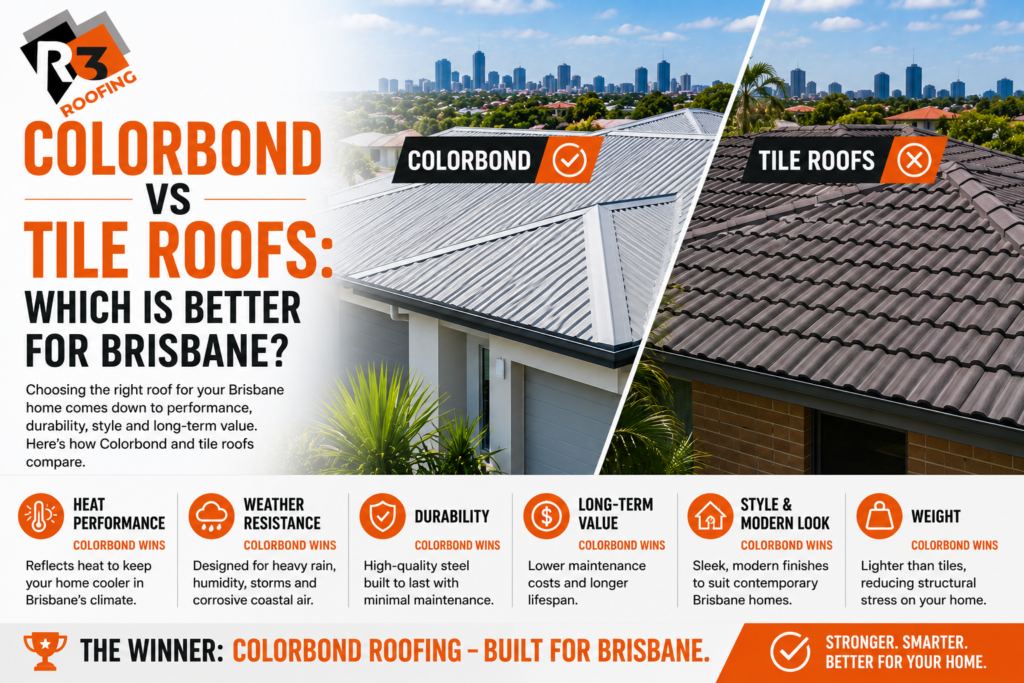
Colorbond is a lightweight steel roofing system, while tile roofing uses heavier individual tiles. Both can provide long-term weather protection, but they differ in weight, appearance, maintenance, installation and repair methods.
Here’s a quick comparison:
Feature | Colorbond Roofing | Tile Roofing |
Material | Coated steel | Concrete or other roofing tiles |
Weight | Lightweight | Heavier |
Appearance | Modern and contemporary | Traditional and classic |
Maintenance | Generally low | Moderate |
Repair method | Sheets, flashings and fasteners | Individual tile replacement and associated repairs |
Colour options | Wide range | Wide range |
Installation | Generally faster | Usually more labour-intensive |
Thermal behaviour | Depends on colour, insulation and roof design | Benefits from thermal mass |
Storm performance | Excellent when correctly installed | Excellent when correctly installed |
Lifespan | Can provide several decades | Can provide several decades |
Neither system is universally better.
The right choice depends on your home’s structure, architectural style, budget, environmental exposure and maintenance expectations.
Both Colorbond and tile roofs can perform well in Brisbane. Colorbond is often preferred for lightweight construction, modern design and lower routine maintenance, while tiles remain popular for traditional homes and their thermal mass.
Brisbane roofs experience:
This means the roofing material needs to be considered alongside installation quality, drainage, ventilation, insulation and maintenance.
Colorbond can be particularly attractive when homeowners want a lightweight, contemporary roofing system.
Tile roofing may be preferable when the architectural character of the home is important or when the existing tiled roof remains structurally sound and worth restoring.
The decision should therefore start with the property rather than the material.
Colorbond roofing offers lightweight construction, strong weather resistance, low routine maintenance, modern aesthetics, colour flexibility and efficient installation.
Colorbond roofing has become one of Australia’s most recognised metal roofing systems for good reason.
Steel roofing is significantly lighter than many tiled roofing systems.
This can be advantageous during new construction and some roof replacement projects, although the existing roof structure must still be assessed before changing roofing materials.
Colorbond generally requires less routine maintenance than tile roofing.
Homeowners still need to inspect gutters, flashings, fasteners and roof surfaces, particularly after major storms.
Colorbond works particularly well with contemporary architecture.
Its clean profiles and range of colours allow homeowners to coordinate the roof with walls, fascia, windows, gutters and other exterior elements.
Large metal roofing sheets can often be installed more quickly than individual roof tiles.
However, installation speed should never come at the expense of correct flashing, fastening, drainage or weatherproofing.
When correctly specified and installed, Colorbond can perform well in Brisbane’s demanding weather conditions.
If an existing metal roof develops damage, rust or leaking areas, professional metal roof repairs Brisbane may be enough to restore the roof without replacing the entire system.
Tile roofing provides traditional appearance, thermal mass, long-term durability and the ability to replace individual damaged tiles when the underlying roof remains in good condition.
Tile roofing continues to be a popular choice across Brisbane.
Its advantages include:
Tiles suit traditional, heritage-inspired and many established Queensland home designs.
One of the practical advantages of tile roofing is that individual damaged tiles can often be replaced without replacing the entire roof.
Tiles can provide thermal mass that influences how quickly heat moves through the roof system.
However, insulation and ventilation remain critical to overall thermal performance.
A well-installed and properly maintained tile roof can provide decades of service.
The important factor is maintaining the roof system rather than assuming tiles will last indefinitely without attention.
There is no universal winner on price because roofing costs depend on the property’s size, complexity, access, materials, labour and required preparation. Long-term maintenance and repair costs should also be considered.
When comparing Colorbond and tile roofing, homeowners often focus on the initial quote.
That’s understandable, but it doesn’t tell the whole story.
You should also consider:
A lower initial price doesn’t necessarily mean a lower overall cost of ownership.
If you’re comparing repair options, R3 Roofing’s guide to tile roof vs metal roof repair cost provides additional context on the factors that can influence roofing repair costs.
Both Colorbond and tile roofing can provide decades of service when professionally installed and properly maintained. Environmental exposure, installation quality and maintenance have a major influence on actual roof life.
There is no single lifespan that applies to every roof.
The actual service life depends on:
A roof that is regularly inspected and repaired when necessary will generally have a better chance of reaching its expected service life.
At R3 Roofing, we assess the condition of the complete roofing system rather than judging a roof solely by its age.
Colorbond generally requires less routine maintenance than tile roofing, although both systems should be inspected regularly.
A Colorbond roof typically requires:
A tiled roof may additionally require:
Neither roof should be ignored simply because it is considered durable.
Preventative maintenance can help identify problems before they become expensive restoration or replacement projects.
Both Colorbond and tile roofing can perform very well during Brisbane storms when correctly installed. The quality of fastening, flashing, drainage and installation is critical to storm performance.
Colorbond has several practical advantages during severe weather.
Large metal sheets create fewer individual roof elements than a tiled roof, while modern fastening systems secure the sheets to the roof structure.
Tile roofs also provide excellent weather protection when correctly installed, but individual tiles can become damaged, displaced or broken during severe weather.
After a significant storm, homeowners should check for:
If you notice warning signs after severe weather, review R3 Roofing’s guide to signs your roof needs immediate repairs before the damage develops further.
Neither Colorbond nor tile roofing is automatically more energy efficient. Thermal performance depends on roof colour, insulation, ventilation, roof design, ceiling construction and the overall building envelope.
Colorbond roofing can benefit from solar-reflective coating technology.
Certain Colorbond colours incorporate Thermatech® technology, which is designed to reflect more solar heat.
Tile roofing provides thermal mass, which can influence the rate of heat transfer through the roof.
However, the biggest mistake is focusing only on the roofing material.
A well-designed roof should also consider:
The right combination of roofing material and building design is more important than simply choosing one material over another.
Colorbond is often an excellent match for modern homes because its clean lines, contemporary profiles and wide colour range complement modern architectural design.
Colorbond can work particularly well with:
The roofing profile also affects the final appearance.
At R3 Roofing, our Colourbond and custom metal roofing service allows the roofing system to be considered alongside the property’s overall design rather than treating the roof as an isolated component.
Tile roofs can be an excellent choice for traditional Queensland homes because their appearance complements established architectural styles and provides a familiar residential aesthetic.
If the existing tiled roof is structurally sound, there may be no reason to replace it simply because Colorbond is popular.
Instead, the roof may benefit from:
This is where professional assessment becomes important.
A roof that looks old isn’t necessarily a roof that needs replacing.
Yes, a tile roof can potentially be replaced with a Colorbond metal roofing system, but the roof structure, pitch, framing, drainage and other components should be assessed before conversion.
A tile to metal roof conversion Brisbane homeowners consider can change both the appearance and weight of the roofing system.
However, conversion involves more than removing tiles and installing metal sheets.
The project may require consideration of:
This is why a professional assessment should come before deciding on a tile-to-metal conversion.
Repair is usually worth considering when the problem is localised and the overall metal roofing system remains in good condition.
Examples include:
In these situations, a targeted repair may provide better value than replacing an otherwise serviceable roof.
R3 Roofing’s approach is to identify the cause of the problem before recommending a solution.
If you are unsure whether your roof needs repair or replacement, a professional roof inspection can help establish the actual condition.
Metal roof replacement may be more appropriate when deterioration is widespread, the roof has recurring leaks, corrosion is extensive or continued repairs no longer provide sensible long-term value.
Replacement may be considered when:
If you’re researching metal roof replacement Brisbane, compare the scope of work rather than simply comparing the final dollar figure.
A professional replacement quote should clearly explain what is being removed, repaired, replaced and installed.
Roof restoration can be the better option when the existing roof remains structurally sound but requires repairs, cleaning, maintenance or protective treatment.
A roof may be suitable for restoration when it has:
In these circumstances, roof restoration services Brisbane may extend the useful life of the existing roof without the cost and disruption of complete replacement.
However, restoration isn’t appropriate for every roof.
If the underlying roofing system has deteriorated too far, replacement may be the better long-term decision.
Roof restoration generally improves and repairs an existing roof, while reroofing generally involves replacing the existing roofing material with a new roofing system.
Restoration may include:
Reroofing can involve:
This is why roof restoration and reroofing should not be treated as exactly the same service.
The correct choice depends on the existing roof’s condition.
A new genuine Colorbond roof already has its factory-applied coating system, so routine painting is not normally required. Painting may be considered for some existing metal roofs depending on their condition and the desired restoration outcome.
Homeowners sometimes search for metal roof painting Brisbane when their existing roof looks faded or weathered.
But painting should not be used to cover up serious roofing problems.
If the roof has:
then coating the roof won’t solve the underlying issue.
Before considering painting, determine whether the roof is actually suitable for restoration.
R3 Roofing also explains the difference between cosmetic roof painting and genuine roofing work in our guide to the truth about roof painting.
Both roofing systems can be repaired, but the repair process is different. Tile roofs often allow individual tile replacement, while metal roofs may require sheet, flashing, fastener or coating repairs depending on the problem.
Tile repair can involve replacing:
Metal roof repair can involve:
The ease of repair depends on accessibility, roof condition and the exact source of the problem.
Choose Colorbond if you prioritise lightweight construction, modern appearance, low routine maintenance and efficient installation. Choose tile roofing if you value traditional aesthetics, thermal mass and individual tile repair.
There is no universal answer.
At R3 Roofing, we assess the property first and then recommend whether repair, restoration or replacement makes the most sense.
Before choosing a roofing material, consider your home’s structure, design, environmental exposure, maintenance expectations, budget, insulation, ventilation and long-term plans.
Ask yourself:
These questions are more useful than simply asking which material is “best”.
R3 Roofing works with both metal and concrete tile roofing systems and focuses on assessing the roof before recommending repair, restoration or replacement.
Our approach is simple:
Repair. Restore. Replace.
We don’t believe every ageing roof needs to be replaced.
We also don’t believe every leaking roof can be solved with a quick repair.
The right solution depends on the actual condition of the roofing system.
R3 Roofing provides roofing solutions including:
If you’re comparing Colorbond and tile roofing, our Brisbane roofing service can help you understand the condition of your current roof and the options available.
Colorbond and tile roofing can both provide excellent long-term performance in Brisbane. Colorbond is particularly attractive for homeowners wanting lightweight construction, modern aesthetics and lower routine maintenance, while tile roofing remains an excellent choice for traditional homes and homeowners who value thermal mass and individual tile replacement.
The most important point is that there isn’t one roofing material that is automatically right for every Brisbane property.
If your existing tile roof is structurally sound, restoration may be the smartest option.
If your metal roof has localised damage, repair may be enough.
If your roof has widespread deterioration, replacement may provide better long-term value.
And if you’re renovating or changing the style of your property, a Colorbond metal roofing system may be worth considering.
At R3 Roofing, we assess the roof first and then explain the available options clearly.
If you’re unsure whether Colorbond or tile roofing is right for your Brisbane home, book a professional roof inspection with R3 Roofing and get a clear assessment before committing to repair, restoration or replacement.
Neither is universally better. Colorbond suits homeowners looking for lightweight construction, modern appearance and low routine maintenance, while tile roofing suits homeowners who prefer traditional aesthetics, thermal mass and individual tile replacement.
Both Colorbond and tile roofs can provide several decades of service when correctly installed and maintained. Actual lifespan depends on material quality, installation, environmental exposure, maintenance and storm conditions.
Colorbond generally requires less routine maintenance than tile roofing. Tile roofs can require cracked or broken tile replacement and ridge capping maintenance, while metal roofs require inspection of sheets, fasteners, flashings and corrosion.
Both Colorbond and tile roofs can perform very well during Brisbane storms when correctly installed. Secure fastening, effective flashing, proper drainage and regular maintenance are important factors in storm performance.
Not automatically. Colorbond can benefit from solar-reflective coating technology, while tiles provide thermal mass. Insulation, ventilation, roof colour and overall building design have a major influence on energy performance.
Potentially, yes. A tile-to-metal conversion requires assessment of the existing roof structure, pitch, framing, drainage, flashings, insulation and ventilation before installation.
Colorbond is often a strong choice for modern homes because of its clean profiles, contemporary appearance and broad range of colours.
Tile roofs can complement traditional and established Queensland homes particularly well. Their appearance and architectural character remain major reasons homeowners continue to choose them.
A new genuine Colorbond roof already has its factory-applied coating system and does not normally require routine painting. Painting may be considered for some existing metal roofs depending on their condition and restoration requirements.
Tile roofing generally requires more routine maintenance because individual tiles, ridge capping and other components may require attention. Colorbond generally requires less routine maintenance but still needs inspections, gutter cleaning and checks for corrosion or damage.
It depends on the roof's condition. Localised problems may only require repair. A structurally sound ageing roof may be suitable for restoration, while widespread deterioration may make replacement the better option. A professional inspection should come before making the decision.
For many Brisbane homeowners, yes. Colorbond offers durability, low routine maintenance, modern aesthetics, weather resistance and long-term value. However, the best roofing material depends on the property and the homeowner's specific requirements.