Roof drainage problems are rarely just a gutter problem. When rainwater cannot move efficiently from the roof into the gutters, through the downpipes and safely away from the property, it can cause overflowing gutters, damaged fascia, roof leaks, damp ceilings, corrosion and even structural moisture damage.
At R3 Roofing, we see homeowners focus on the obvious symptom — usually water overflowing from a gutter — when the real problem may be further along the drainage system.
The gutter might be blocked. The downpipe might not be coping with the volume of water. The gutter may have lost its fall. The fascia might have deteriorated and allowed the gutter to sag. Or the roof itself may be directing too much water into one section.
That is why I don’t recommend treating roof drainage as a single-component problem.
Your roof, gutters, fascia, valleys and downpipes need to work together. If one part stops doing its job, the rest of the system can eventually suffer.
A roof drainage system collects rainwater from the roof and directs it away from the building in a controlled path.
The basic path is:
Roof surface → valleys or roof edges → gutters → downpipes → stormwater or suitable discharge point
Every part of that path matters.
If the roof collects water correctly but the gutter is blocked, water backs up.
If the gutter is clear but the downpipe is blocked, water still backs up.
If the gutter and downpipe are working but the gutter has sagged, water can sit in the low section rather than flowing towards the outlet.
And if the fascia supporting the gutter has deteriorated, the gutter itself can lose its correct position.
Water always looks for another path when the intended drainage path is restricted.
That can mean water spilling over the front of the gutter, running behind the gutter, soaking the fascia, flowing down walls or finding its way into vulnerable areas around the roof edge.
A roof drainage system moves rainwater from the roof into gutters, through downpipes and safely away from the property. Problems with any component can cause overflow, moisture damage, roof leaks and deterioration around the roofline.
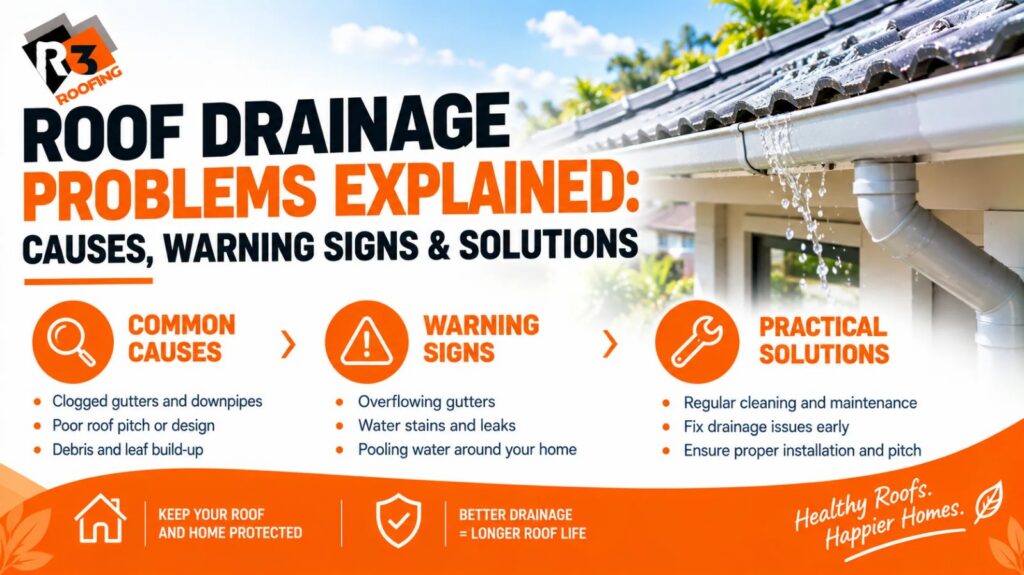
The most common roof drainage problems are blockages, inadequate drainage capacity, incorrect gutter fall, sagging gutters, damaged joints, blocked downpipes, deteriorating fascia and poor water discharge.
From a homeowner’s perspective, the important thing is understanding what each problem looks like.
Leaves, twigs, dirt, roof debris and organic matter can restrict water flow.
A small amount of debris might not cause an obvious problem during light rain. During a Brisbane downpour, however, the same gutter may suddenly overflow.
A gutter can be completely clean and still overflow if water cannot leave through the downpipe.
This is why checking the entire drainage path matters.
Gutters need to direct water towards their outlets.
If the gutter has developed low points or was not installed with the appropriate fall, water can sit in sections rather than draining efficiently.
Sagging can result from deteriorated brackets, excessive debris, water loading, movement or problems with the supporting fascia.
Once a gutter sags, water can collect in the low section.
Cracked seals, damaged joins, corrosion and physical damage can allow water to escape before it reaches the downpipe.
A large roof area can generate a significant volume of rainwater during intense rainfall.
If the drainage system cannot handle that volume, overflowing gutters may occur even when there is no blockage.
The fascia supports the gutter system on many properties.
If it deteriorates, the gutter can lose its correct alignment and become more vulnerable to sagging and overflow.
Roof valleys concentrate water.
If debris accumulates around a valley or the surrounding drainage system cannot handle the water flow, problems can develop quickly during heavy rain.
A downpipe needs to move water away from the building effectively.
If water simply discharges against the property or pools around the foundations, the drainage problem has not really been solved.
Common roof drainage problems include blocked gutters and downpipes, incorrect gutter fall, sagging gutters, damaged joints, inadequate capacity, deteriorating fascia and poorly managed roof valleys. Identifying the specific cause is more important than simply treating the visible overflow.
A clean gutter can still overflow if the drainage system has another restriction.
This is one of the most common points of confusion I see.
Homeowners often look inside the gutter, see no leaves and assume the drainage system is working properly.
But the problem may be:
For example, imagine a roof that directs a large volume of water into one gutter section.
The gutter is perfectly clean.
But if the downpipe cannot remove the water quickly enough, the gutter will eventually overflow.
That is why I recommend looking at water movement, not just gutter cleanliness.
If it is safe to observe from ground level, watch where water:
This can help identify where the drainage path is failing.
Clean gutters can still overflow because of blocked downpipes, inadequate capacity, poor gutter fall, sagging sections or roof design. The entire water path needs to be assessed rather than checking only for leaves.
Blocked or undersized downpipes restrict the amount of water that can leave the gutter system.
During ordinary rainfall, you may not notice the problem.
During heavy Brisbane rainfall, the difference becomes obvious.
Water enters the gutter faster than the downpipe can remove it. The water level rises, and eventually it spills over the gutter edge.
This can result in:
Even one blocked downpipe can affect a larger section of gutter.
The water does not necessarily stop only at the blocked outlet. It can back up along the gutter and overflow at the lowest or weakest point.
This is why downpipes should be checked as part of routine guttering services Brisbane homeowners arrange.
Blocked or undersized downpipes prevent water from leaving gutters quickly enough. During heavy rain, this can cause gutter overflow, fascia damage, roof-edge deterioration and water pooling around the property.
Gutter fall determines how efficiently water travels towards the outlet.
If the gutter is level when it should direct water towards a downpipe, or if it develops a low section, water can remain trapped.
Standing water creates several problems.
It adds weight to the gutter, places additional stress on brackets and fascia, and can contribute to corrosion and deterioration.
The original installation may have been incorrect, but gutter fall can also change because of:
If the gutter is repeatedly holding water after rainfall, I would not simply clean it and assume the problem is solved.
The fall and physical condition of the gutter should also be checked.
Incorrect gutter fall prevents water from reaching the downpipe efficiently. Persistent ponding can increase gutter weight, stress brackets and fascia, accelerate deterioration and contribute to repeated overflow.
Yes. Damaged fascia can directly affect the performance of the gutter system because the fascia often provides the structural support for the gutter.
When fascia deteriorates because of moisture, rot or long-term water exposure, the gutter can begin to pull away, sag or lose its correct position.
That creates a chain reaction:
Poor drainage → moisture exposure → fascia deterioration → gutter movement → worse drainage → more overflow.
This is why I don’t treat fascia damage as a cosmetic issue.
If the fascia is failing but the gutter is simply replaced without addressing the underlying support, the same drainage problem can return.
If both components have deteriorated, combining the work can make more sense than repeatedly repairing one component while leaving the other compromised.
R3 Roofing’s approach to guttering and fascia replacement is to address the source of the moisture problem rather than simply replacing the visible damaged section.
Damaged fascia can cause gutters to sag, move or pull away from the roofline. When gutter and fascia problems occur together, addressing both can restore proper drainage and reduce recurring moisture damage.
Poor roof drainage can contribute to roof leaks by keeping water where it should not remain.
A properly functioning drainage system moves rainwater away from vulnerable roof edges.
When water backs up, overflows or remains against roofing components, repeated moisture exposure can damage:
Blocked gutters are also recognised as a contributor to roof leaks because water can back up around the roof edge.
The important point is that the gutter overflow may not be where you eventually see the leak.
Water can travel through roofing materials, insulation, framing and other parts of the roof structure before appearing inside the home.
For example, a homeowner might notice a damp patch in a bedroom ceiling and assume the roof directly above that room has failed.
The actual entry point could be further up the roof near flashing, a valley, gutter connection or another drainage point.
R3 Roofing’s roof leak detection guide explains why locating the actual entry point matters before carrying out repairs.
Poor drainage can contribute to roof leaks by keeping water against vulnerable roofing components. The visible ceiling stain may not be directly below the actual entry point, so proper leak detection is important.
The most obvious warning sign is water overflowing from gutters during rainfall, but several other symptoms can appear before the problem becomes severe.
Look for:
If you notice water overflowing from the same section of gutter every time it rains, don’t assume it simply needs another cleaning.
Recurring overflow usually deserves a closer look at the gutter fall, downpipe capacity, roof water flow and condition of the supporting fascia.
Warning signs include overflowing or sagging gutters, damaged fascia, blocked or overflowing downpipes, water pooling around the property, ceiling stains, mould and recurring damp areas. Repeated symptoms should be investigated rather than repeatedly patched.
Brisbane’s rainfall patterns can expose drainage problems very quickly.
A system that appears to work during light rainfall may struggle when intense rain arrives.
Heavy rain puts greater demand on:
Storms can also introduce leaves, branches and other debris into the drainage system.
This is why drainage maintenance should not be treated as something you only think about after a major leak.
R3 Roofing’s guidance on preventing roof leaks in Southeast Queensland also identifies blocked gutters and drainage issues as factors that can accelerate roof-edge deterioration and contribute to premature roofing problems.
Brisbane’s heavy rainfall and storms place significant demand on roof drainage systems. Blockages, inadequate capacity, damaged gutters and poor drainage become much more obvious when intense rainfall arrives.
Gutter repair can make sense when the problem is isolated and the rest of the system remains in good condition.
Examples include:
The key is determining whether the problem is localised.
For example, if one gutter joint is leaking but the gutter profile, brackets, fascia and downpipes remain sound, a targeted repair may be all that is required.
That is very different from a gutter system where multiple sections are rusting, sagging and overflowing.
They sometimes keep repairing individual points even though the whole drainage system is deteriorating.
At that stage, repeated repairs can become a temporary solution rather than a sensible long-term one.
Gutter repair is generally appropriate for isolated problems when the overall drainage system remains sound. Multiple failing sections, widespread corrosion or recurring overflow may indicate that replacement should be considered.
Replacement becomes more appropriate when the drainage system has widespread deterioration or when the supporting fascia can no longer reliably hold the guttering.
Typical signs include:
In these situations, simply replacing one small gutter section may not solve the actual problem.
A properly planned guttering and fascia replacement can address the gutter profile, supporting fascia, brackets, outlets and downpipes as one system.
R3 Roofing’s drainage service specifically covers gutter installation, replacement, fascia work and downpipe solutions designed around Brisbane’s weather conditions.
Guttering and fascia replacement becomes more appropriate when corrosion, sagging, water damage or repeated failures affect multiple parts of the drainage system. The goal is to restore the complete drainage path, not just replace one visible component.
Yes, but the correct solution depends on what is causing the drainage problem.
Roof restoration can make sense when the existing roof remains structurally sound but needs repairs, maintenance and improvements.
For example, restoration may involve:
Reroofing is a much more substantial process because it generally involves replacing the existing roofing material with a new roofing system.
If the roof itself is still serviceable, replacing everything because of one drainage problem may be unnecessary.
But if the roof has widespread deterioration, repeated leaks and failing components, repeatedly repairing the drainage system may not solve the wider problem.
R3 Roofing’s approach is based on assessing whether a roof should be repaired, restored or replaced rather than automatically recommending one solution.
Roof restoration can address drainage-related issues when the existing roof remains serviceable. Reroofing may be appropriate when the roofing system has deteriorated extensively. The roof’s actual condition should determine the solution.
Not automatically.
Colorbond roofing Brisbane homeowners consider can provide a durable, low-maintenance roofing solution, but changing the roofing material does not automatically correct a poorly designed drainage system.
The roof still needs:
Colorbond itself can be an effective roofing material, but the performance of the complete roofing system depends on how the components work together.
R3 Roofing’s Colorbond guidance also highlights drainage, roof design, installation, insulation, ventilation and environmental exposure as important factors when assessing metal roofing performance.
A roof replacement can provide an opportunity to review the drainage system at the same time.
Instead of installing new roofing over an unchanged drainage problem, it makes sense to assess the gutters, downpipes, fascia, valleys and water flow as part of the overall project.
Colorbond roofing does not automatically solve drainage problems. A new roof still needs correctly designed gutters, downpipes, flashings and water pathways. Roof replacement can, however, provide an opportunity to upgrade the complete drainage system.
The simplest way to prevent drainage problems is to inspect the complete system regularly instead of waiting for an overflow or leak.
Look for:
Look for:
Look for:
Look for:
I recommend checking the drainage system again after severe weather.
Storms can move debris into gutters, damage brackets, displace roofing materials and expose weaknesses that were not obvious before the event.
Prevent roof drainage problems by regularly checking gutters, downpipes, fascia, roof valleys and roofing materials. Pay particular attention after storms and before periods of heavy rainfall.
Before contacting a Brisbane roofing service, try to identify the symptoms without putting yourself at risk on the roof.
You can safely observe from ground level:
These observations can help a roofing professional understand the problem faster.
But don’t climb onto a roof simply to investigate drainage.
Roof surfaces can be slippery, unstable and unsafe, particularly after rain.
Before contacting a Brisbane roofing service, record where and when water overflows, whether gutters sag, whether downpipes cope, and whether there are signs of internal water damage. Ground-level observations are safer than climbing onto the roof.
You should arrange a professional inspection when drainage problems keep returning, when water is entering the property, or when you cannot identify why the system is overflowing.
An inspection is particularly worthwhile when you notice:
The purpose of an inspection isn’t simply to tell you that something needs replacing.
It should determine why the drainage system is failing.
At R3 Roofing, that means assessing the roof, gutters, fascia, downpipes and other relevant components before recommending repair, restoration or replacement.
If the problem is isolated, a targeted repair may be enough.
If the drainage system has deteriorated, replace guttering or undertake a broader guttering and fascia replacement may be more appropriate.
If the roof itself has reached the end of its practical serviceability, then roof restoration and reroofing or replacement may need to be considered.
Book a professional roof inspection when drainage problems repeatedly return, leaks appear, fascia deteriorates, downpipes overflow or the cause is unclear. The inspection should identify the cause before recommending repair, restoration or replacement.
Roof drainage problems rarely begin with a dramatic failure.
They usually start with something small:
A blocked outlet.
A loose bracket.
A sagging gutter.
A deteriorating fascia.
A downpipe that cannot handle the water flow.
A damaged valley.
A leaking joint.
The problem is that water keeps testing the same weak point every time it rains.
That is why I always recommend looking at the entire drainage system rather than simply cleaning the gutter or sealing the visible leak.
For some Brisbane homes, a targeted repair is enough. For others, replace guttering may be the practical solution. Where the gutter and supporting fascia have both deteriorated, guttering and fascia replacement can address the problem more comprehensively.
And when drainage problems are connected to wider roof deterioration, roof restoration and reroofing may need to be considered.
R3 Roofing follows a straightforward approach:
Repair. Restore. Replace.
The right answer depends on what the roof and drainage system actually need.
If you are experiencing overflowing gutters, recurring roof leaks, damaged fascia or drainage problems and you’re unsure where the issue is coming from, arrange a professional assessment rather than continuing to patch the same symptom.
Book a professional roof inspection and find out what is actually causing the drainage problem before a manageable issue becomes a much larger roofing repair.
Blocked gutters and downpipes are among the most common causes of poor roof drainage. They restrict the normal flow of rainwater and can cause gutters to overflow during heavy rainfall.
For example, a homeowner may clean the visible leaves from the gutter and still experience overflow because the blockage is further down inside the downpipe. That is why the complete drainage path needs to be checked.
Your gutter can overflow without a visible blockage because of inadequate drainage capacity, incorrect gutter fall, a blocked downpipe, sagging gutters or excessive water entering one section of the roof.
I've seen situations where the gutter looked completely clean, but the downpipe could not remove water quickly enough during heavy rainfall. The issue wasn't cleanliness; it was drainage capacity.
Yes, blocked gutters can contribute to roof leaks by preventing rainwater from draining correctly and causing water to back up around vulnerable roof edges.
If water repeatedly remains around the roof edge, it can affect fascia, eaves, flashings and other components. A leak can then appear inside the home.
Overflowing gutters near the downpipe, water backing up during rain, slow drainage and water pooling around the discharge point can indicate a blocked or poorly performing downpipe.
For example, if one section of gutter fills rapidly while neighbouring sections remain relatively clear, the outlet or downpipe may need closer inspection.
Yes, damaged fascia can cause gutter overflow because deteriorated fascia may no longer support the gutter correctly.
As the fascia weakens, the gutter can sag or pull away from the roofline. That changes the gutter's position and can prevent water from travelling towards the downpipe properly.
Repair gutters when the damage is isolated and the rest of the drainage system remains sound; consider replacement when multiple sections are deteriorated, corroded, sagging or repeatedly failing.
For example, one leaking joint may only need repair. If several sections are rusted, the gutter is sagging and the fascia is damaged, continuing to repair individual points may not be the most practical long-term solution.
Roof drainage systems should be checked regularly and after significant storms, with the frequency increased where properties have trees, older roofing or known drainage issues.
The important thing is not to wait for a major leak before checking the system. Small problems are generally easier to address before water damage spreads.
Yes, roof restoration can address drainage-related problems when the existing roof remains structurally suitable for restoration.
For example, restoration may include repairs to damaged roofing components, flashing, vulnerable areas and drainage-related defects. If the underlying roof has deteriorated extensively, reroofing or replacement may be more appropriate.
Not by itself. A new Colorbond roof can provide a durable roofing system, but the gutters, downpipes, valleys, flashings and overall drainage design still need to be correctly installed and sized.
If you're considering Colorbond roofing Brisbane homeowners commonly choose, I recommend assessing the drainage system as part of the roofing project rather than treating the roof covering and drainage as separate issues.
Your drainage system may have enough capacity for normal rainfall but not enough capacity for intense rainfall.
This can happen because of roof size, gutter profile, downpipe capacity, roof design, blocked outlets or too much water being directed into one section.
A heavy Brisbane storm can reveal a drainage weakness that remains invisible during ordinary rainfall.
Yes. Persistent overflow and leaking gutters can expose fascia to repeated moisture and eventually cause deterioration, rot or structural weakening.
This is particularly important with timber fascia. If the source of the moisture is not fixed, replacing the damaged timber alone may only provide a temporary solution.
Yes, uncontrolled roof water can contribute to water pooling around the building and may create drainage and moisture problems near foundations.
The exact impact depends on the property's soil, drainage design, discharge location and site conditions. Downpipes should direct water to an appropriate drainage or discharge point rather than simply releasing large volumes beside the building.
If both systems have deteriorated, replacing them together can provide a more complete drainage solution.
For example, installing new gutters onto severely deteriorated fascia does not address the underlying support problem. Completing the work together can improve drainage performance and reduce the likelihood of recurring gutter movement.
Yes, persistent moisture from drainage problems can contribute to damp conditions that support mould growth.
If you notice mould, damp smells or staining around ceilings, eaves or walls, don't simply clean the visible mould. The moisture source should also be identified.
Call a professional when overflow is recurring, leaks appear, fascia is deteriorating, downpipes cannot cope, or you cannot identify the cause of the drainage problem.
A professional inspection can determine whether you need a targeted gutter repair, guttering services Brisbane homeowners use, replace guttering, guttering and fascia replacement, roof restoration or re-roofing services Brisbane homeowners may require.
The goal should always be to fix the cause rather than repeatedly treating the symptom.