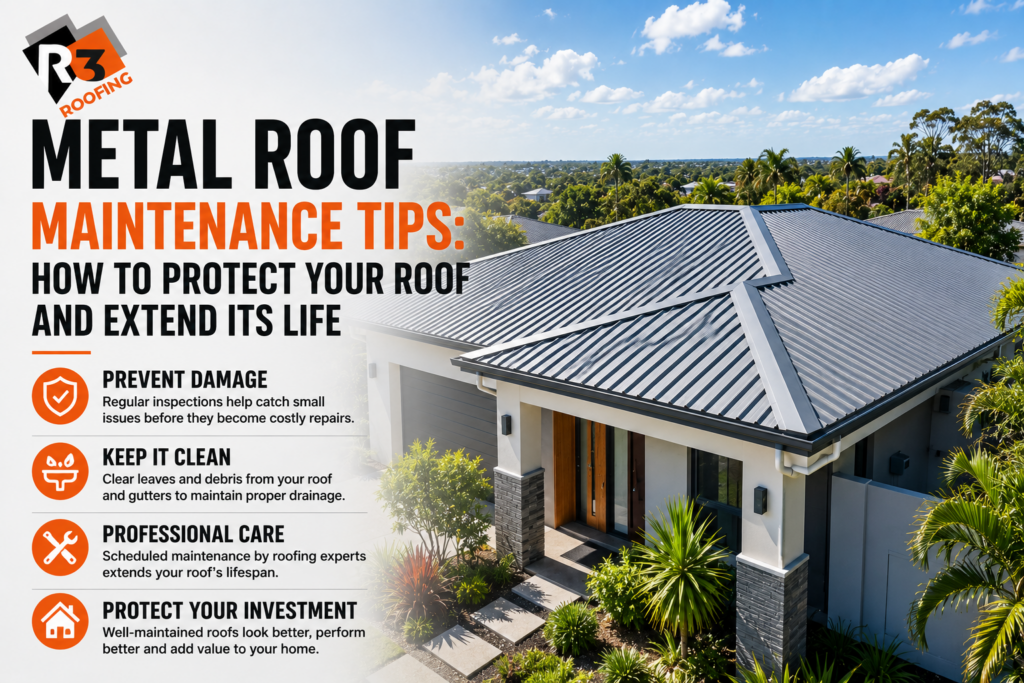
Regular metal roof maintenance can prevent small problems such as rust, failed fasteners, blocked gutters and damaged flashings from becoming expensive leaks or premature roof replacement. For Brisbane homes, I recommend inspecting the roof regularly, keeping drainage clear, addressing corrosion early and getting a professional assessment when you notice signs of deterioration.
A metal roof can last for decades, but I don’t believe you should install one and simply forget about it.
Brisbane roofs deal with intense sun, heavy rain, storms, humidity, wind and, in some areas, coastal salt exposure. These conditions gradually affect roofing sheets, fasteners, flashings, gutters, sealants and other components.
The good news is that most maintenance problems are easier to deal with when you find them early.
At R3 Roofing, we see this regularly. A homeowner may call because they have noticed one small rust spot or a ceiling stain, but once we inspect the roof properly, we sometimes find several issues developing around it.
That is why I always come back to the same principle:
Don’t wait for a roof problem to become an emergency. Inspect it, understand what is happening, and deal with the cause early.
This guide explains the practical metal roof maintenance tips I recommend for Brisbane homeowners, including what you can check yourself, what requires a professional inspection and when maintenance has become a repair, restoration or replacement issue.
Metal roof maintenance is important in Brisbane because prolonged exposure to sunlight, rain, humidity, storms, wind and coastal conditions can gradually affect roofing sheets, fasteners, flashings and drainage components.
A roof does not normally fail overnight.
Problems tend to develop gradually.
A screw begins to deteriorate. A flashing starts to separate. A small area of surface corrosion develops. A gutter becomes blocked. A seal around a penetration begins to fail.
You may not notice any of these problems from the ground.
Then a major storm arrives.
Wind-driven rain finds the weak point and suddenly you have a leak.
This is why I don’t recommend waiting until water appears on your ceiling before thinking about roof maintenance.
R3 Roofing’s own inspection guidance highlights warning signs such as rust spots on metal roofing, loose flashing, damp roof spaces, repeated storm leaks and recent hail or storm damage.
Brisbane metal roofs need regular maintenance because sun, rain, humidity, storms, wind and coastal exposure can gradually damage roofing components. Early detection helps prevent minor deterioration from becoming major roof repairs.
You should visually check your metal roof regularly and arrange a professional inspection when you notice deterioration, leaks, storm damage or other warning signs. The appropriate inspection frequency also depends on the roof’s age, condition and environmental exposure.
I don’t recommend homeowners climb onto their roof just to perform routine maintenance.
A roof can be slippery, steep and unsafe, particularly after rain.
Instead, start from the ground.
Look for obvious changes such as:
For older roofs or roofs exposed to coastal conditions, I would be more proactive.
If you have recently experienced hail, strong winds or severe storms, arrange an inspection rather than assuming everything is fine because you cannot see damage from the ground.
Regular visual checks help identify obvious warning signs, but homeowners should not climb onto roofs unnecessarily. Older, coastal or storm-exposed metal roofs deserve closer professional attention.
A proper metal roof inspection should look beyond the visible roof sheets and assess fasteners, corrosion, flashings, penetrations, gutters, drainage, roof cavity conditions and signs of water entry.
This is one of the biggest differences between looking at a roof and actually inspecting it.
Rust is one of the clearest warning signs on a metal roof.
Don’t assume one small rust spot is harmless.
The important question is why it has appeared.
It could be related to:
If corrosion is spreading, you need to understand its extent before deciding whether painting or replacement is appropriate.
Fasteners are small, but they play a major role in keeping a metal roof secure.
Look for:
A roof can have good-quality sheets but still develop problems around deteriorated fixings.
Flashings protect vulnerable junctions around walls, valleys, penetrations and roof edges.
Damaged or deteriorated flashing can allow water into the roof system.
Solar panels, vents, pipes, skylights and other penetrations create potential water-entry points.
The seals and flashings around these areas should remain in good condition.
Blocked or damaged drainage can cause water to back up onto the roof or overflow around the roofline.
Keep gutters clear and check for:
Sometimes the first evidence of a roofing problem is underneath the roof.
Look for signs of:
R3 Roofing’s inspection approach specifically considers both the roof and what is happening underneath it because the visible symptom is not always the actual source of the problem.
A metal roof inspection should cover more than the sheets. Rust, fasteners, flashings, penetrations, gutters, drainage and the roof cavity can all affect roof performance and should be assessed when maintenance problems arise.
The safest approach is to keep the roof free from excessive debris, maintain gutters and drainage, remove accumulated contaminants appropriately and avoid aggressive cleaning methods that can damage protective coatings.
I don’t recommend treating every metal roof like a surface that needs to be pressure-washed regularly.
The cleaning method should suit the roofing material and its condition.
Leaves, branches and other debris can accumulate around:
These areas deserve particular attention because trapped debris can retain moisture.
Metal roofing relies on its protective coating.
Aggressive cleaning, inappropriate chemicals or harsh mechanical treatment can damage that surface.
If the roof has significant contamination, moss, dirt or coating deterioration, I recommend getting professional advice before attempting an aggressive clean.
Your gutters and downpipes are part of the roof system.
A clean roof with blocked gutters is still a maintenance problem.
Good metal roof cleaning means controlling debris, maintaining drainage and protecting the roof’s coating. Avoid aggressive cleaning methods that could damage the protective surface.
You can reduce rust and corrosion by keeping the roof and drainage system clean, repairing damaged coatings, replacing deteriorated fasteners, addressing standing water and arranging professional inspections when corrosion appears.
The earlier you deal with corrosion, the more options you generally have.
A small surface issue may be treatable.
Widespread corrosion through the roofing material is a different situation.
This is particularly important for homes near the coast.
Salt air can accelerate corrosion, so coastal properties require more attention to fasteners, flashings, gutters and exposed metal components.
I would also avoid painting directly over untreated rust.
If you are considering metal roof painting in Brisbane, the existing roof should be assessed and properly prepared first.
Painting a deteriorated roof without addressing the underlying problem does not turn it into a healthy roof.
Preventing metal roof corrosion requires regular cleaning, sound drainage, suitable fasteners, timely treatment of damaged coatings and early professional assessment of rust. Coastal homes may need additional attention because of salt exposure.
You should repair a metal roof when the damage is localised and the underlying roofing system remains sound, while replacement becomes more appropriate when corrosion, deterioration or repeated failures are widespread.
This is one of the most common questions I get.
And there isn’t one answer for every roof.
Metal roof repairs Brisbane may be appropriate when you have:
For example, if one flashing has failed but the rest of the roof is in good condition, replacing the entire roof may make no sense.
Metal roof replacement in Brisbane becomes more relevant when:
At R3 Roofing, we don’t believe in recommending replacement simply because a roof is old.
We assess the condition first.
R3 Roofing’s approach is explicitly based around Repair. Restore. Replace., with the correct solution determined after assessment rather than treating every roof as a replacement project.
Localised metal roof damage can often be repaired, while widespread corrosion, repeated leaks and severe deterioration may justify replacement. The condition of the complete roofing system should determine the decision.
Yes, professional roof painting can help protect a sound metal roof and improve its appearance, but painting should follow proper inspection, preparation and repair of any existing roofing problems.
This is where homeowners need to be careful.
Roof painting is not simply a matter of putting paint on metal.
The roof needs to be suitable for coating.
That means checking:
If the roof is structurally sound, professional metal roof painting in Brisbane can be part of a maintenance strategy.
R3 Roofing’s roof painting service includes protective coatings and cool-roof coatings designed to provide UV protection and reflect heat.
I’ve also written more about why preparation matters in The Truth About Roof Painting in 2025.
The key point is simple:
Don’t use paint to hide a roofing problem. Fix the problem first, then protect the roof.
Professional metal roof painting can protect and refresh a sound roof, but coating should only follow proper inspection, surface preparation and repair of corrosion, leaks or other defects.
Gutters, flashings and drainage components should be treated as part of the metal roofing system because blocked or deteriorated components can cause leaks, water damage and premature roof deterioration.
I often see homeowners focus entirely on the roof sheets.
But water doesn’t care which component failed.
If your gutter is blocked and water backs up, the roof still has a problem.
If a flashing fails, the roof still has a problem.
If a valley cannot drain properly, the roof still has a problem.
Check for:
If you have a metal roof, keeping water moving away from the building is one of the simplest maintenance priorities.
Gutters, flashings, valleys and downpipes are critical parts of a metal roofing system. Keeping them clear and in good condition helps prevent water backup, leaks and premature roof deterioration.
After a major Brisbane storm, check for loose or damaged roof sheets, failed fasteners, damaged flashings, blocked gutters, fallen branches, water entry and other visible signs of roof damage, and arrange a professional inspection when damage is suspected.
Storms can create damage that is difficult to see from the ground.
Wind can lift sheets.
Hail can damage surfaces.
Branches can strike the roof.
Heavy rain can expose weak points.
And water can enter through a very small opening.
If you see a ceiling stain after a storm, don’t assume the problem will disappear when the ceiling dries.
R3 Roofing’s leak guidance explains that water can travel through a roof cavity before appearing somewhere else, which is why repairing the visible stain alone may not solve the actual leak.
You can also read our guide on signs your roof needs immediate repairs.
Storms can damage metal roofing, fasteners and flashings without obvious external signs. After severe weather, look for water entry and visible damage and arrange professional inspection when problems are suspected.
A tile to metal roof conversion can provide a lower-maintenance roofing option in some situations, but the conversion itself requires proper assessment of the roof structure, pitch, insulation, ventilation, flashings and drainage.
A tile to metal roof conversion Brisbane project can make sense for homeowners whose existing tile roof is ageing or requiring frequent repairs.
But I wouldn’t recommend conversion simply because someone says metal roofing is maintenance-free.
No roof is maintenance-free.
Metal roofing still needs:
If your tile roof is structurally sound and only requires minor repairs, conversion may not be necessary.
If the roof has reached a point where repeated repairs no longer make financial sense, a new metal roofing system may be worth considering.
A tile to metal conversion can reduce some maintenance requirements, but metal roofs still require regular inspection and care. Conversion should be based on the existing roof’s condition and the homeowner’s long-term goals.
Metal roof maintenance becomes restoration when the roof needs more comprehensive repair and protective work, while reroofing involves replacing the existing roofing material with a new system.
This distinction matters because homeowners sometimes use these terms interchangeably.
Maintenance is about preventing or identifying problems early.
Examples include:
Roof restoration services Brisbane may be appropriate when the existing roof is fundamentally sound but requires more substantial repair, preparation and protective treatment.
A proper restoration is more than cleaning and painting.
R3 Roofing specifically explains that restoration should begin with inspection and repair before protective coatings are applied.
Re-roofing services Brisbane are relevant when the existing roofing material needs to be replaced.
This may be necessary when the roof has deteriorated beyond practical repair.
For example, if an old metal roof has extensive corrosion across multiple sheets, repeated leaks and deteriorated fixings, continuing to paint and patch it may not provide good long-term value.
Maintenance prevents and identifies problems, restoration repairs and protects a sound existing roof, while reroofing replaces the existing roofing material. The correct option depends on the roof’s condition.
The most common metal roof maintenance mistakes are ignoring small rust spots, delaying leak repairs, painting over untreated problems, neglecting gutters, using inappropriate cleaning methods and attempting unsafe roof inspections.
A leak is often a symptom, not the beginning of the problem.
Coating does not fix severe corrosion.
Small screws can create large problems when they fail.
Blocked gutters can affect the entire roof drainage system.
Flashings, valleys, penetrations and the roof cavity can reveal problems that aren’t obvious from above.
A cheap quote that only includes cleaning and painting may not address the underlying roofing problems.
R3 Roofing’s own guidance warns that low-cost restorations can fail when contractors skip proper inspection, repairs and preparation.
Roof inspections can be dangerous.
If you are not trained and equipped to work safely at height, leave the inspection to a professional.
The biggest metal roof maintenance mistakes involve delayed repairs, untreated corrosion, neglected drainage, poor coating preparation, cheap restoration work and unsafe DIY inspections.
The best metal roof maintenance routine combines regular visual checks, clean gutters, early treatment of corrosion, post-storm inspections and professional assessment when you notice leaks or deterioration.
Here is the routine I recommend.
From ground level, look for:
Check:
Look for:
Arrange professional inspections rather than relying only on visual checks.
Pay additional attention to:
A practical Brisbane metal roof maintenance routine includes regular visual checks, gutter cleaning, storm inspections, corrosion monitoring and professional assessments for older or exposed roofs.
You should call a Brisbane roofing professional when you notice persistent leaks, widespread rust, damaged or loose roofing sheets, deteriorated fasteners, damaged flashing, storm damage or uncertainty about whether the roof needs repair, restoration or replacement.
The earlier you call, the more options you may have.
If you notice one small rust spot, it may be a simple maintenance issue.
If you leave it for several years and the corrosion spreads across the roof, the solution can become much more expensive.
R3 Roofing’s philosophy is straightforward: get the correct assessment first, develop the scope around what the roof actually needs, and then decide whether to repair, restore or replace.
If you’re considering a new metal roof, our Metal Roofing & Colourbond Custom Work Brisbane service is the appropriate next step for discussing a replacement or new installation.
For an existing roof, however, don’t assume replacement is automatically necessary.
Get it inspected.
Understand the condition.
Then make the decision.
Professional roofing advice is appropriate when a metal roof has leaks, corrosion, storm damage, deteriorated components or unclear repair-versus-replacement requirements. Early assessment can preserve more repair and restoration options.
A well-maintained metal roof can provide many years of reliable service, but maintenance only works when you deal with problems before they become major failures.
My advice to Brisbane homeowners is simple.
Don’t wait for a ceiling stain.
Don’t paint over rust without understanding why it is there.
Don’t ignore damaged fasteners.
Don’t let gutters stay blocked.
And don’t assume an old roof automatically needs replacement.
Start with a proper assessment.
If the roof only needs a repair, repair it.
If it needs restoration, restore it properly.
If it has reached the end of its practical life, then replacement may be the right investment.
That is the approach we take at R3 Roofing: Repair. Restore. Replace.
The objective isn’t to sell you the biggest roofing job.
The objective is to give you a roof that does its job properly for as long as reasonably possible.
A metal roof should be visually checked regularly, with professional inspections based on its age, condition, environmental exposure and any signs of damage.
For example, a newer roof in good condition may only need routine checks, while an older Brisbane roof exposed to storms or coastal conditions deserves closer attention. I would also arrange an inspection after significant storm damage rather than waiting for a leak.
You can reduce rust risk by maintaining the protective coating, keeping the roof and gutters clear, addressing scratches or coating damage, replacing deteriorated fasteners and treating corrosion early.
For example, if I find a small corrosion spot during an inspection, I would want to understand its cause before recommending painting or treatment. Simply covering it without preparation can allow the underlying problem to continue.
You should not assume that aggressive pressure washing is suitable for every metal roof because excessive pressure or incorrect cleaning methods can damage protective coatings and roofing components.
If the roof has heavy dirt, algae or other contamination, I recommend getting advice about the correct cleaning method for the particular roofing material and its condition.
Common signs include rust, leaking, deteriorated fasteners, damaged flashing, loose sheets, water stains, damaged gutters and storm-related problems.
For example, a small rust spot may be repairable, while widespread corrosion combined with repeated leaks could indicate that the roof needs more substantial work. A professional inspection can determine the difference.
Yes, roof painting can be part of maintaining a structurally sound metal roof when the surface is correctly prepared and the appropriate coating system is used.
I would not use painting to hide corrosion or leaks. Those problems need to be addressed before coating. R3 Roofing's approach is to inspect and repair the roof before applying protective coatings.
A well-maintained metal roof can provide a long service life, but its actual lifespan depends on the roofing material, installation quality, environmental exposure, maintenance and the condition of individual components.
For example, a roof in a coastal environment may experience more corrosion than a comparable roof further inland, so maintenance requirements and expected service life can differ.
Repair a metal roof when the damage is localised and the underlying roof remains sound. Replacement becomes more appropriate when corrosion and deterioration are widespread or repairs are repeatedly failing.
I don't recommend replacing a roof simply because it has reached a certain age. I recommend looking at its actual condition and understanding what needs to be fixed.
No, not every metal roof needs to be painted simply because it is a metal roof. Painting becomes relevant when the existing coating needs restoration, the roof is suitable for recoating or a protective/cool-roof coating forms part of the recommended maintenance plan.
The roof should be assessed first to determine whether painting is appropriate.
A tile to metal roof conversion can offer a practical, lower-maintenance roofing system in some circumstances, but metal roofs still require inspection, gutter maintenance, corrosion checks and storm inspections.
For example, converting an ageing tiled roof may make sense when repeated repairs are becoming uneconomical, but conversion should be based on the roof's condition and the homeowner's long-term objectives.
Roof restoration repairs and protects the existing roof when the underlying system remains suitable, while reroofing replaces the existing roofing material with a new system.
For example, a structurally sound metal roof with surface deterioration may be suitable for restoration, while a roof with widespread corrosion and repeated failures may be better suited to reroofing.
There is no single cleaning interval that suits every metal roof. Cleaning requirements depend on the roof's environment, debris levels, contamination, vegetation and exposure to salt or moisture.
I recommend keeping gutters and drainage clear and dealing with accumulated debris rather than cleaning simply according to a fixed calendar.
Yes. You should check for visible damage after a major storm and arrange a professional inspection if you notice leaks, damaged roofing, fallen branches, loose components or other concerns.
Storm damage isn't always obvious from the ground. Water can also travel through the roof cavity before appearing as a ceiling stain, so the visible location of a leak may not be its actual source.