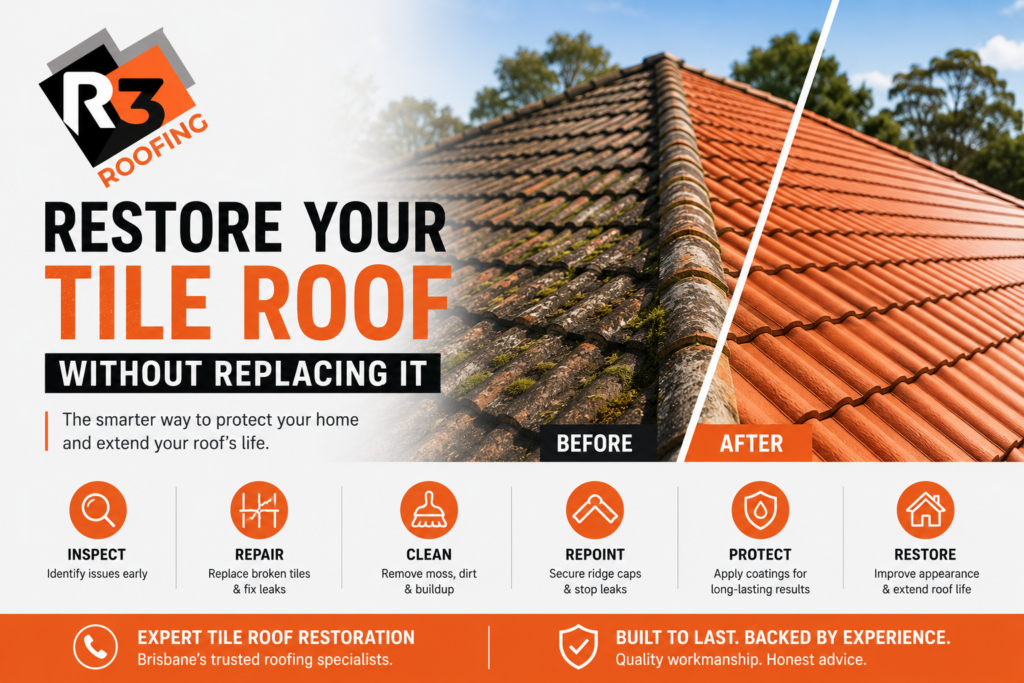
The best way to restore a tile roof without replacing it in Brisbane is to carry out a complete roof tile restoration—not simply paint the roof. A proper restoration includes a professional inspection, replacing broken tiles, repairing ridge caps, fixing leaks, cleaning the roof, and applying protective coatings where required. In many cases, this approach restores your roof’s appearance, improves weather protection, and extends its lifespan by decades without the cost of a full replacement.
One of the biggest misconceptions we see is homeowners believing an ageing roof automatically needs replacing. In reality, many tiled roofs in Brisbane remain structurally sound. The visible problems—faded tiles, moss growth, leaking ridge caps, cracked tiles, or minor storm damage—can often be repaired without replacing the entire roof.
At R3 Roofing, we always inspect the condition of the roof before recommending any solution. If restoration will provide the same long-term outcome as replacement, we’ll tell you. Our goal is to help homeowners make informed decisions based on the roof’s actual condition rather than selling unnecessary work.
For many Brisbane homes, yes.
Roof replacement should only be considered when the roof structure or a large percentage of the roof covering has reached the end of its service life.
If the roof frame is sound and most tiles remain in good condition, roof tile restoration is usually the better investment.
Restoration allows us to:
Replacement, on the other hand, involves removing the entire roof and installing a new roofing system, making it considerably more expensive.
Our philosophy is simple—we recommend replacement only when restoration is no longer practical.
Roof tile restoration is often the best option when the roof structure remains sound. It repairs existing damage, improves performance, and costs significantly less than replacing the entire roof.
Restoring a tiled roof properly requires more than cleaning and painting. Every stage plays an important role in ensuring the roof performs as well as it looks.
Every successful restoration begins with understanding the roof’s condition.
We inspect:
This allows us to identify both visible and hidden issues before any restoration work begins.
Broken or cracked tiles should always be replaced before restoration.
Individual damaged tiles allow water into the roof cavity and can quickly create larger problems if left untreated.
Replacing only the damaged tiles preserves the integrity of the existing roof while avoiding unnecessary replacement.
Over time, Brisbane roofs collect:
Cleaning removes these contaminants and prepares the surface for repairs and coatings.
More importantly, cleaning often exposes small defects that would otherwise remain hidden.
One of the most common causes of tiled roof leaks is deteriorated ridge capping.
Older cement bedding can crack as roofs naturally move over time.
Modern flexible pointing materials provide greater durability and accommodate minor roof movement far better than traditional mortar.
Finding the source of a roof leak isn’t always straightforward.
Water frequently travels through roof cavities before becoming visible inside the home.
We inspect:
This ensures we’re repairing the actual cause—not simply the location where water appears indoors.
Not every roof requires recoating.
When suitable, protective coatings improve:
The coating should always be the final step—not the first.
Applying paint over unresolved leaks simply hides the problem temporarily.
Before completion, we carry out a final inspection to ensure every repair has been completed correctly.
Our goal is not simply to improve appearance but to restore the roof’s long-term performance.
The best roof tile restoration follows a structured process: inspection, repairs, cleaning, ridge cap repointing, leak detection, protective coatings where appropriate, and a final quality inspection.
Most homeowners aren’t roofing experts—and they shouldn’t have to be.
The easiest way to determine whether restoration is possible is through a professional inspection.
Signs your roof is usually suitable for restoration include:
Replacement becomes more likely when:
We’ve inspected roofs that looked beyond repair from the street but only required targeted repairs and restoration.
Likewise, we’ve seen roofs that appeared perfectly acceptable yet had hidden structural issues beneath the tiles.
That’s why professional assessment is essential.
Visible wear doesn’t automatically mean replacement. A professional inspection determines whether restoration can safely extend the life of your existing tiled roof.
A properly restored roof addresses far more than cosmetic issues.
It commonly resolves:
Most roof leaks originate from damaged tiles, deteriorated ridge caps or flashing failures rather than the tiles themselves.
Replacing isolated damaged tiles restores waterproofing while preserving the existing roof.
Modern flexible pointing significantly improves durability compared with older cement mortar.
Removing biological growth improves drainage while reducing moisture retention on the roof surface.
Protective coatings restore colour while improving weather resistance where appropriate.
Storm-related tile damage can often be repaired without replacing the entire roof.
Roof tile restoration addresses leaks, broken tiles, ridge cap issues, moss growth, faded coatings, and many forms of minor storm damage without requiring a full roof replacement.
It’s understandable to want to save money by tackling roof repairs yourself. However, roof restoration involves much more than replacing a few broken tiles or applying a fresh coat of paint.
A professional restoration addresses the underlying causes of roofing problems, ensuring the roof performs properly for years rather than simply looking better for a few months.
At R3 Roofing, every restoration begins with a detailed inspection. We identify issues that are often hidden from view, including deteriorated ridge capping, damaged flashing, blocked valleys, moisture beneath the tiles, and early signs of structural movement. These problems are easily missed during DIY repairs.
Professional restoration also means using the right materials and installation methods. Whether we’re completing Roof Tiling Repair & Restore, repairing ridge caps, or restoring an ageing tiled roof, every repair is completed to improve the roof’s durability rather than just its appearance.
Professional roof restoration addresses the root cause of roofing problems, not just the visible symptoms. It provides safer, longer-lasting results and helps prevent future repairs.
Choosing the right contractor is just as important as choosing the right roofing solution.
Many companies specialise in only one service, such as roof painting or complete replacements. As a result, homeowners are often presented with a single recommendation instead of the option that genuinely suits their roof.
At R3 Roofing, we believe every roof deserves an honest assessment before any recommendation is made.
Feature | R3 Roofing | Typical Roofing Company |
Offers roof repairs, restoration and replacement | ✓ | Often only one option |
Thorough roof inspection before quoting | ✓ | Sometimes |
Specialists in tiled and metal roofing | ✓ | Varies |
Honest repair-first recommendations | ✓ | Replacement often recommended |
Colourbond roofing expertise | ✓ | Limited |
Roof leak detection included | ✓ | Additional charge may apply |
Guttering & Downpipes services | ✓ | Not always available |
Facia Boards Repair & Replace | ✓ | May outsource |
Roof maintenance services | ✓ | Limited |
Eave linings installation | ✓ | Rarely offered |
Rather than pushing the most expensive option, we explain the condition of your roof, discuss the available solutions, and help you choose the one that delivers the best long-term value.
R3 Roofing provides repair, restoration and replacement services under one roof, allowing homeowners to receive unbiased recommendations based on the actual condition of their roof.
A roof restoration shouldn’t focus solely on the roof tiles.
Several connected components play an important role in protecting your home, and restoring the roof without inspecting them can leave underlying problems unresolved.
Blocked, rusted or poorly draining gutters can allow water to overflow into fascia boards, walls and foundations.
Damaged fascia boards often result from leaking gutters or long-term moisture exposure. Replacing deteriorated fascia at the same time as roof restoration improves both appearance and structural support for the guttering.
Where timber fascia has deteriorated extensively, replacing it with durable modern materials can reduce future maintenance.
Water stains or sagging eave linings often indicate roof leaks or poor roof ventilation. Repairing damaged eaves during restoration helps complete the entire roofing system.
Flashings around chimneys, skylights and roof penetrations should always be inspected for corrosion, movement or gaps.
Proper ventilation reduces heat build-up and moisture inside the roof cavity, helping extend the life of roofing materials.
By inspecting the entire roofing system—not just the tiles—we help prevent recurring issues after restoration is complete.
A complete roof restoration includes inspecting gutters, fascia, flashings, eaves and roof ventilation to ensure every part of the roofing system performs as intended.
A professionally restored roof can provide decades of reliable performance, but regular maintenance is essential.
We recommend homeowners:
Small maintenance jobs completed early are almost always less expensive than major repairs later.
Whether your home has tiled roofing, Colourbond, or metal roofing, preventative maintenance remains the most cost-effective way to maximise its lifespan.
Routine inspections, gutter cleaning and timely repairs significantly extend the life of a restored roof while reducing the risk of expensive future repairs.
Restoring a tile roof doesn’t have to mean replacing it. In many cases, a professionally completed roof tile restoration delivers outstanding long-term performance while saving homeowners thousands of dollars compared with a complete roof replacement.
The key is understanding the true condition of your roof before making a decision. A detailed inspection allows hidden issues to be identified, damaged components to be repaired, and the most appropriate solution to be recommended.
At R3 Roofing, we don’t believe in one-size-fits-all recommendations. We carefully inspect every roof and provide honest advice based on its condition. Whether your home needs Roof Tiling Repair & Restore, roof leak detection, Guttering & Downpipes, Facia Boards Repair & Replace, fascia replacement, eave linings installation, or a complete restoration, we’ll help you make an informed decision that protects both your home and your budget.
Yes, in many cases it can. If the roof structure remains sound and the damage is limited to cracked tiles, leaking ridge caps or worn coatings, restoration is usually the smarter option. We've restored many Brisbane roofs that homeowners initially believed needed replacing, delivering excellent results at a much lower cost.
A professionally restored tile roof can last 15–25 years or more. The exact lifespan depends on the roof's condition before restoration, the quality of workmanship, and ongoing maintenance. Regular inspections help maximise its longevity.
Yes, significantly. Because the existing roof structure remains in place, restoration is generally much more affordable than a complete replacement while still extending the roof's service life.
The roof is inspected, repaired, cleaned and restored. This usually includes replacing damaged tiles, repairing ridge caps, detecting and repairing leaks, cleaning the roof, and applying protective coatings where appropriate. Each stage is designed to improve both performance and appearance.
Yes, if the leaks are caused by repairable roofing defects. Common causes such as cracked tiles, damaged ridge caps and faulty flashing can often be repaired during restoration. More extensive structural issues may require additional work.
Often, yes. If your Guttering & Downpipes or fascia boards show signs of deterioration, replacing them during the restoration is usually more cost-effective than returning to complete the work later. It also ensures the entire roofing system functions properly.