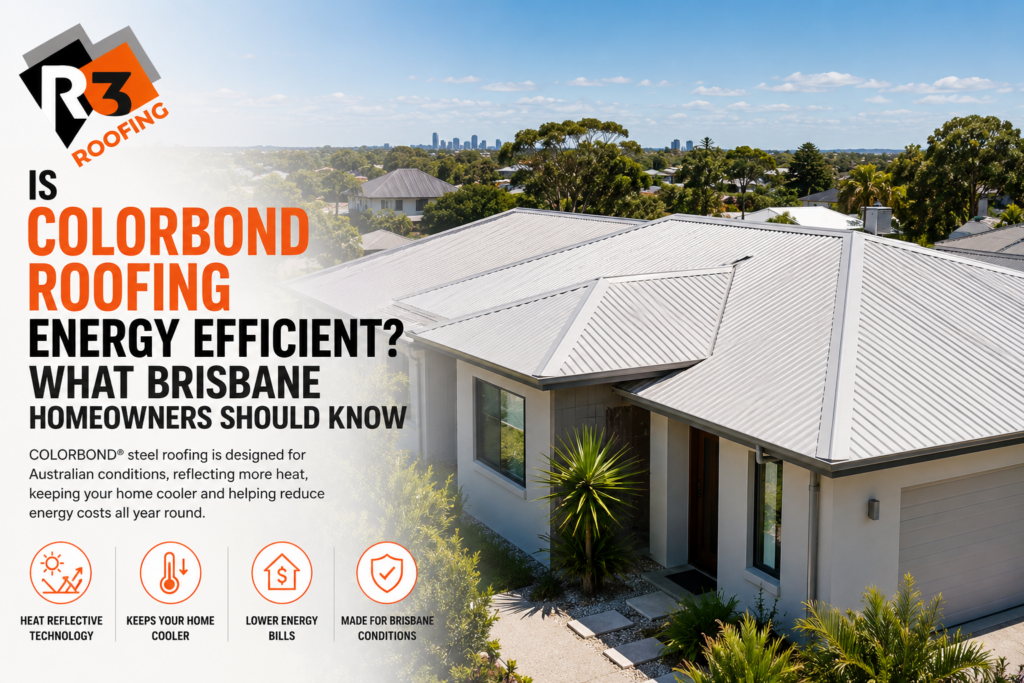
Yes, COLORBOND® roofing can be energy efficient, but the roof colour, insulation, ventilation, roof design and overall condition all affect the result. For Brisbane homes, choosing a solar-reflective COLORBOND® colour and combining it with good insulation and ventilation can help reduce heat entering the roof space and reduce the demand on air conditioning.
One of the questions I hear from homeowners is whether a metal roof is actually a good choice for energy efficiency.
It is a fair question.
Metal gets hot in the Queensland sun, so it is easy to assume that a metal roof will automatically make the house hotter.
That is not necessarily the case.
When you choose a properly specified COLORBOND® steel roof, the colour and coating technology can influence how much solar heat the roof absorbs. COLORBOND® steel’s Thermatech® solar reflectance technology is designed to reflect more of the sun’s heat on hot, sunny days, which can help keep homes cooler.
But I would not tell a homeowner that simply installing COLORBOND® will solve every energy-efficiency problem.
Your roof is one part of the building envelope.
Insulation, ventilation, roof cavity design, ceiling construction, windows, shading and the condition of the roof all matter.
That is why, at R3 Roofing, we look at the whole roofing system rather than recommending a product based on one feature.
Yes, COLORBOND® roofing can be energy efficient, particularly when you select an appropriate roof colour with solar-reflective properties and combine the roof with effective insulation and ventilation.
COLORBOND® steel’s Thermatech® technology is designed to reflect more solar energy from the roof surface. According to COLORBOND®, 21 of its Classic colours, along with six Matt colours, feature Thermatech® solar reflectance technology, with Night Sky® being the exception among the core Classic colours.
The practical benefit is straightforward.
If your roof absorbs less solar heat, there can be less heat transferred into the roof space and ultimately into the living areas below.
That can help your air conditioner maintain a comfortable indoor temperature.
However, I want to make one thing clear.
Energy efficient does not mean the roof will stay cold all day.
A roof exposed to Brisbane’s summer sun will still heat up. The objective is to manage how much solar energy the roof absorbs and how much heat reaches the inside of the home.
COLORBOND® roofing can improve thermal performance when the right colour and roofing system are selected. Solar-reflective technology can reduce solar heat absorption, but insulation, ventilation and the overall home design also determine energy efficiency.
COLORBOND® roofing can help reduce heat entering a home by using solar-reflective colour technology that reflects more of the sun’s energy from the roof surface.
Think about the difference between wearing a black shirt and a light-coloured shirt on a hot Brisbane afternoon.
The same basic principle applies to roof surfaces.
A darker surface generally absorbs more solar energy, while lighter and more reflective surfaces can reflect more of that energy.
COLORBOND® addresses this through its Thermatech® technology.
This does not mean you have to choose a white roof.
COLORBOND® offers a broad colour range, and many of its colours incorporate solar-reflective technology. The important thing is to understand the thermal characteristics of the colour you are considering rather than choosing based purely on appearance.
At R3 Roofing, I would also look at what is happening underneath the roof.
If you have excellent solar reflectance but poor insulation, you are leaving part of the potential thermal benefit on the table.
COLORBOND® reduces solar heat gain through reflective roofing technology and appropriate colour selection. The benefit becomes more effective when the roof is combined with good insulation and ventilation.
Yes, roof colour can affect thermal performance because different colours absorb and reflect different amounts of solar energy.
This is one of the easiest things for homeowners to overlook.
You might choose a roof colour because it looks great with your brickwork, windows and exterior paint.
That is important, but in Brisbane I would also consider how that colour performs in our climate.
COLORBOND® explains that lighter colours can help create cooler roofs and may contribute to improved energy efficiency, particularly in warmer parts of Australia.
For a Brisbane home, I would consider:
You do not necessarily need to choose the lightest colour available.
You need to choose a colour that gives you the combination of appearance, thermal performance and long-term suitability you actually want.
Dark colours can absorb more solar heat than lighter colours.
That does not automatically make a dark COLORBOND® roof a bad choice.
The overall performance depends on the roof system, insulation, ventilation, building design and the specific colour’s solar reflectance characteristics.
If you love a darker roof, I would not tell you to abandon the idea without looking at the complete system.
COLORBOND® roof colour affects solar heat absorption. Lighter and more reflective colours can provide better thermal performance in hot climates, but the final result also depends on insulation, ventilation, roof orientation and building design.
Thermatech® is a solar-reflectance technology used in many COLORBOND® steel colours that is designed to reflect more of the sun’s heat from the roof surface.
This is one of the main reasons COLORBOND® can be considered an energy-efficient roofing option.
The technology works by improving the roof surface’s ability to reflect solar radiation rather than simply absorbing it.
That matters particularly in Queensland, where roofs can receive intense sunlight for long periods.
COLORBOND® states that Thermatech® can help keep homes cooler during hot sunny conditions and may reduce reliance on air conditioning. Actual results vary depending on roof colour, insulation, building design, location and how the building is used.
That last point is important.
I would never promise a homeowner a specific reduction in electricity bills based on the roof alone.
Your home’s energy consumption depends on many variables.
Thermatech® is COLORBOND® steel’s solar-reflectance technology. It is designed to reflect more solar heat and can help improve thermal comfort, although actual energy savings depend on the complete building system.
No. A COLORBOND® roof can contribute to energy efficiency, but the roof alone cannot make an entire home energy efficient.
This is where I think roofing advice sometimes becomes too simplistic.
A roof can have excellent reflective properties and still perform poorly from a whole-house energy perspective if the ceiling has inadequate insulation or the roof cavity has poor ventilation.
For example, imagine two identical homes with the same COLORBOND® roof.
One has:
The other has:
The two houses can perform very differently even though they have the same roofing material.
That is why I look at the roof as part of a system.
COLORBOND® roofing can contribute to energy efficiency, but it cannot compensate for poor insulation, ventilation, windows, shading or other building-envelope problems.
Insulation slows heat transfer from the roof space into the home, while appropriate ventilation can help manage heat and moisture within the roof cavity. Together, they can significantly influence how comfortable a home feels underneath a metal roof.
This is especially important in Brisbane.
During summer, the roof is exposed to high levels of solar radiation.
Some of that heat will enter the roof space.
The question is how effectively your home manages that heat before it reaches the rooms below.
Ceiling insulation is one of the most important factors.
A reflective roof with poor insulation is not making the most of its potential.
If your insulation has deteriorated, been compressed, moved or become wet because of a roof leak, its performance can also be affected.
That is one reason roof maintenance matters to energy performance.
Ventilation helps manage heat and moisture in the roof cavity.
The correct ventilation approach depends on the design of the home and roof.
You should not simply install ventilation products without considering the existing roof structure and airflow.
A leaking roof can also create problems for insulation and the roof cavity.
If moisture gets into insulation, timber or other roof components, the problem is no longer just about energy efficiency.
It becomes a roof maintenance issue.
If you are noticing leaks or unexplained changes in indoor comfort, I recommend arranging an inspection rather than assuming you simply need more insulation.
Insulation reduces heat transfer from the roof space into the home, while appropriate ventilation helps manage heat and moisture. Roof condition also matters because leaks can damage insulation and reduce overall building performance.
COLORBOND® can provide strong thermal performance, but it is not accurate to say that it is automatically more energy efficient than every other roofing material in every home.
Roof performance depends on the entire system.
Tile roofs can also perform well thermally because their mass and construction behave differently from lightweight metal roofing.
Metal roofing can perform very well when combined with appropriate insulation, reflective colours and suitable roof design.
So I would not choose between tiles and metal purely on the basis of the material.
I would consider:
If your existing tile roof is structurally sound, there may be no reason to replace it simply because you want better energy performance.
If your existing roof is deteriorating, however, the conversation changes.
That is where repair, restoration, reroofing or replacement becomes relevant.
COLORBOND® is an energy-efficient roofing option, but no roofing material is automatically best for every home. Thermal performance depends on the roof material, insulation, ventilation, design, climate and condition of the complete system.
Yes, an existing metal roof can often be improved through appropriate repairs, coatings, colour selection, insulation and ventilation, depending on its condition.
This is where I always recommend starting with an assessment.
Don’t spend money on energy-efficiency upgrades while ignoring a roof that is leaking or badly deteriorated.
For example, if you have rusted sections, failed fasteners or damaged flashings, those problems should be addressed first.
Our metal roofing and Colourbond services can be considered when an existing metal roof needs more substantial work.
Depending on the condition, options can include:
The correct option depends on the condition of the roof.
An existing metal roof can often be made more thermally effective through repairs, suitable coatings, insulation and ventilation improvements. The first step is identifying the actual condition of the roof.
Yes, a properly selected reflective roof coating can improve the thermal performance of an existing metal roof by reflecting more solar radiation, but roof painting should not be treated as a substitute for repairing a deteriorated roof.
This is particularly relevant to Brisbane homeowners with an older metal roof.
If the roof is structurally sound but the coating has faded or deteriorated, repainting with an appropriate cool-roof coating can be worth considering.
R3 Roofing currently provides roof painting and protective roof coatings, including cool roof coatings designed to reflect heat and provide UV protection.
However, there is a big difference between properly restoring a roof and simply spraying paint over it.
Before painting, I want to know:
Our approach is consistent with the advice in The Truth About Roof Painting: roof painting should be part of a proper roofing process, not a shortcut around necessary repairs.
Reflective roof coatings can improve the thermal performance of an existing metal roof, but painting should only follow proper inspection, preparation and repairs where required.
You should repair a roof when the damage is localised, restore it when the underlying roof remains sound but needs maintenance and protective work, and replace it when deterioration has progressed beyond practical repair.
This is the approach I take at R3 Roofing.
I don’t believe an old roof should automatically be replaced just because it is old.
I also don’t believe homeowners should keep repairing a roof indefinitely when replacement is clearly the better long-term decision.
If you have isolated rust, damaged sheets, failed fasteners or a specific leak, metal roof repairs Brisbane may be the appropriate starting point.
A small repair can protect the roof and prevent water from reaching insulation and internal structures.
For example, a failed flashing may be allowing water into the roof cavity. Fixing that issue can be far more sensible than replacing the entire roof.
Roof restoration and reroofing are not the same thing.
Restoration generally aims to repair and extend the life of an existing roof, while reroofing involves replacing the roofing material.
Our roof restoration services Brisbane approach starts with assessment rather than assuming the roof needs a coating.
As R3 Roofing explains, a proper restoration involves inspecting the roof and repairing underlying problems before applying protective coatings.
A metal roof replacement Brisbane project may make more sense when corrosion is widespread, the roof has repeated leaks, materials have deteriorated significantly or ongoing repairs no longer provide good value.
The important part is getting the diagnosis right.
Repairs suit localised problems, restoration suits structurally sound roofs that need maintenance and protective work, and replacement suits roofs that have deteriorated beyond economical repair. An inspection should determine which option makes sense.
A tile to metal roof conversion can provide good thermal performance when the new metal roof is correctly specified and installed with appropriate insulation, ventilation and colour selection.
A tile to metal roof conversion Brisbane project is not simply about replacing one roof covering with another.
I would first look at:
There can be other reasons to convert as well.
Some homeowners want a lighter roofing system. Others prefer the appearance and lower maintenance requirements of metal roofing.
If the existing tile roof is already deteriorating, conversion may become a more practical option than repeatedly repairing individual problems.
But again, I would not recommend conversion simply because someone says metal is automatically more energy efficient.
The building needs to be assessed as a whole.
A tile to metal roof conversion can provide strong thermal performance, but the result depends on the new roof’s colour, insulation, ventilation, design and installation. Conversion should be assessed based on the entire roofing system rather than energy efficiency alone.
Before choosing COLORBOND® roofing, Brisbane homeowners should consider the roof colour, solar reflectance, insulation, ventilation, roof condition, coastal exposure, roof design, installation quality and long-term maintenance.
I would also consider whether you actually need a new roof.
If your existing roof is performing well, replacing it purely to chase lower energy bills may not make financial sense.
If the roof is already ageing, leaking or requiring repeated repairs, then energy performance becomes one of several factors worth considering during replacement.
Before choosing your roof, ask:
This is the type of assessment I recommend before making a major roofing investment.
Brisbane homeowners should consider roof colour, solar reflectance, insulation, ventilation, roof condition, coastal exposure and long-term maintenance before choosing COLORBOND®. A new roof should solve an actual roofing need rather than being installed solely because it is marketed as energy efficient.
Yes, COLORBOND® roofing can be a worthwhile choice for Brisbane homes when the product, colour and complete roofing system are properly matched to the property.
The energy-efficiency benefit comes primarily from managing solar heat rather than expecting the metal itself to somehow keep the house cool.
For a Brisbane homeowner, I would focus on the combination of:
COLORBOND® steel also has durability and sustainability characteristics beyond thermal performance. COLORBOND® states that its steel contains recycled content and is 100% recyclable, while its long service life can help reduce the resources and energy associated with more frequent replacement.
At R3 Roofing, our approach is simple: repair, restore or replace based on what the roof actually needs.
If your current roof is leaking, rusting or showing signs of deterioration, don’t assume the answer is automatically a new roof.
And if you’re considering COLORBOND® because you want a cooler, lower-maintenance roof, make sure the rest of the roofing system supports that goal.
The best roofing decision is the one that works for the condition of your roof, your home and your long-term plans.
Yes, COLORBOND® roofing can be energy efficient because many colours use Thermatech® solar-reflectance technology to reflect more of the sun's heat.
For example, a Brisbane home with a suitable reflective roof colour, good ceiling insulation and appropriate ventilation can manage summer heat more effectively than a poorly insulated roof with high solar heat absorption. The actual result depends on the complete building design.
Yes, a suitably selected COLORBOND® roof can help reduce solar heat entering the home, particularly when combined with good insulation and ventilation.
I would not expect the roof alone to make a dramatic difference if the rest of the house has poor thermal performance. A homeowner with inadequate ceiling insulation may still experience significant heat transfer even after installing a reflective roof.
Lighter and more solar-reflective COLORBOND® colours generally provide better thermal performance in hot climates because they reflect more solar energy.
For Brisbane, I would consider the colour's thermal properties alongside appearance. The best colour is one that works with the home's design and provides the level of solar reflectance appropriate for the property.
A dark roof can absorb more solar heat than a lighter, more reflective roof, but that does not mean every dark COLORBOND® roof will make a home uncomfortably hot.
Insulation, ventilation, roof construction and the specific colour's solar-reflectance characteristics all matter. If you prefer a dark roof, I would look at the complete system rather than ruling it out immediately.
Yes, roof insulation is extremely important because it helps slow the transfer of heat from the roof space into the living areas.
A reflective COLORBOND® roof and effective insulation work together. If your roof has excellent solar reflectance but poor insulation, you may not achieve the thermal performance you expect.
Yes, an appropriate reflective roof coating can improve the thermal performance of an existing metal roof by reflecting more solar heat.
However, the roof should be inspected first. If it has rust, leaks, failed fasteners or other deterioration, those issues need to be addressed before applying a coating.
Not automatically. Roof restoration can be a practical option when the existing roof is structurally sound and needs repairs, preparation and protective coatings.
Replacement becomes more appropriate when the roofing material has deteriorated beyond economical repair. At R3 Roofing, we recommend assessing the roof before deciding between repair, restoration and replacement.
Yes, a tile to metal roof conversion can be energy efficient when the new metal roof is correctly specified with appropriate insulation, ventilation and colour selection.
For example, if an ageing tiled roof already needs significant repairs, conversion to a well-designed COLORBOND® metal roof can be considered as part of a broader roofing upgrade. It should not be done solely on the assumption that metal roofing is automatically more energy efficient.
Yes, roof damage can contribute to higher energy use if it allows moisture into insulation, damages building components or reduces the roof system's ability to control heat.
For example, a roof leak that saturates insulation can reduce its effectiveness. Rising energy bills can therefore sometimes be a sign that a roof needs inspection, although there can be many other causes.
Repair your metal roof when the damage is localised and the underlying roof remains sound. Consider replacement when corrosion, leaks or deterioration are widespread and ongoing repairs no longer provide good long-term value.
For example, replacing a few damaged sheets may be sensible for an otherwise healthy roof. If multiple sections are severely corroded and repairs keep recurring, replacement may be the better investment.
Yes, both can potentially improve overall roof performance, but they achieve it differently.
Restoration keeps the existing roof and addresses problems such as deterioration, leaks and protective coatings. Reroofing replaces the existing roofing material and provides an opportunity to select a new system with appropriate thermal characteristics.
The right choice depends on the roof's condition rather than a generic recommendation.
COLORBOND® roofing can provide a long service life when correctly specified, installed and maintained, but the actual lifespan depends on exposure, installation quality, maintenance and environmental conditions.
For example, a roof in a highly exposed coastal environment needs different consideration from one further inland. R3 Roofing also notes that environmental exposure can affect roofing lifespan, particularly in coastal locations.