Queensland — inspection schedules, maintenance steps, and what actually causes premature ageing.
A metal roof in Southeast Queensland doesn’t fail because the material is weak — it fails because heat cycling, storm exposure, and small maintenance gaps compound over years without anyone checking on them. The single biggest lever for preventing leaks and extending roof life isn’t a product or a coating — it’s catching fastener, flashing, and drainage issues before they become water damage. This article walks through exactly what to check, how often, and where most Southeast Queensland metal roofs actually fail first.
Metal roofs don’t usually leak because the sheeting itself fails — they leak at the connection points. Fasteners loosen as the metal expands and contracts through Southeast Queensland’s heat swings, rubber washers under screws perish faster in UV-heavy climates, and flashing around penetrations (vents, skylights, solar mounts) shifts slightly with every storm. Add in the region’s storm season, and you’ve got a roof that’s constantly moving, constantly exposed, and constantly losing tiny amounts of protection at the same handful of points.
The leak itself is rarely the actual problem — it’s usually the last stage of something that started months earlier at a fastener or flashing joint nobody was checking.
Skimmable summary: Metal roof leaks in Southeast Queensland almost always start at fasteners and flashing, not the sheeting itself, driven by heat cycling, UV-perished washers, and storm movement.
A well-installed Colourbond roof is built to last 50-plus years, but plenty of roofs don’t get close to that because of a handful of avoidable issues:
None of these age the roof overnight. They’re slow, cumulative issues — which is exactly why they’re preventable if someone’s actually looking for them on a schedule, rather than only after a leak shows up inside the house.
Skimmable summary: Premature ageing in metal roofs is driven by cumulative issues — debris, blocked drainage, corroding fasteners, UV coating breakdown — not a single dramatic failure.
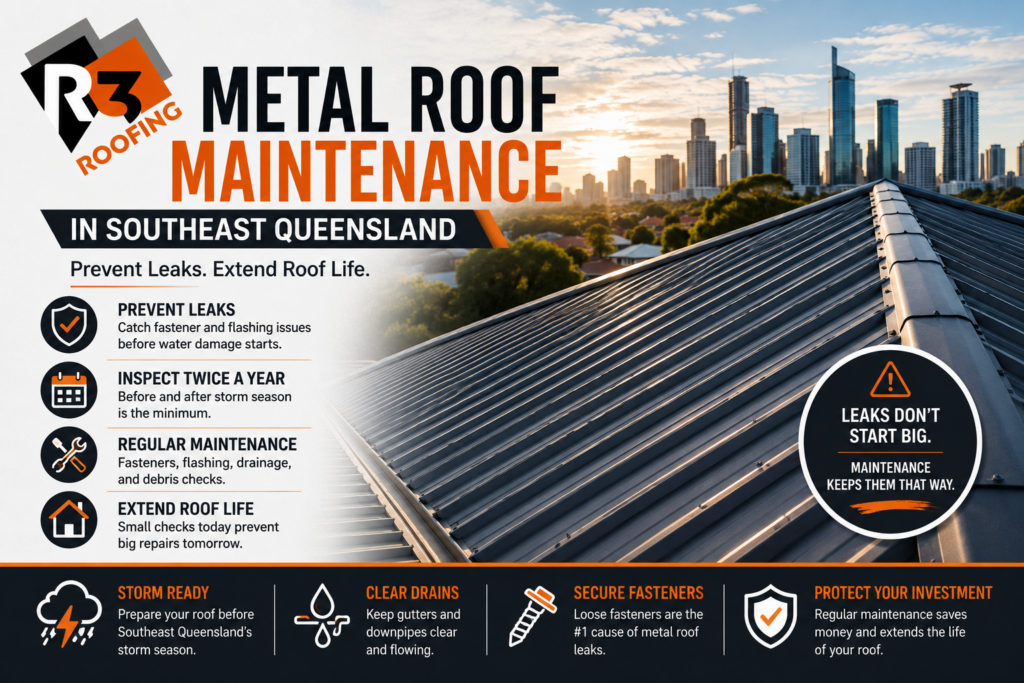
Twice a year is the practical minimum for Southeast Queensland — once before storm season and once after. Storm season inspections catch loose fasteners or lifted sheeting before summer’s heavy rain finds them; post-season inspections catch whatever the storms actually did before it’s had months to worsen.
If your property has overhanging trees, is on a particularly exposed site, or the roof is already past 15–20 years old, a quarterly check is worth the extra effort. It’s a short visual inspection either way — the cost of catching an issue early is nothing compared to repairing water damage that’s spread into the ceiling and framing.
Skimmable summary: Inspect a metal roof at least twice a year — before and after storm season — and increase to quarterly for older roofs, exposed sites, or properties with overhanging trees.
Metal roof maintenance isn’t just “look at it once a year.” A proper maintenance visit covers:
This is essentially what our roof maintenance services cover on a scheduled basis — the goal is catching a loose fastener during a routine visit instead of finding out about it from a water stain on the ceiling six months later.
Skimmable summary: Proper metal roof maintenance covers fasteners, flashing, debris, corrosion checks, and drainage — not just a quick visual glance once a year.
Some maintenance is genuinely fine to do yourself. Other parts carry real risk — both to the roof and to whoever’s up there doing it.
Task | DIY-Suitable | Best Left to a Professional |
Clearing visible debris from the ground/gutter line | Yes | — |
Checking gutters for overflow after rain | Yes | — |
Inspecting fastener tension and flashing seals | Limited — hard to assess accurately without roof access experience | R3 Roofing |
Identifying early corrosion vs. surface staining | Limited — easy to misjudge severity | R3 Roofing |
Replacing perished screws/washers | Not recommended without proper fall protection | R3 Roofing |
Recoating or repainting sections | Not recommended — coating selection and TSR rating matter | R3 Roofing |
DIY is useful for the ground-level checks — clearing gutters, watching for obvious debris, noticing stains after a storm. Anything that involves getting on the roof itself, assessing fastener condition, or judging whether corrosion is cosmetic or structural is where a professional roof maintenance visit earns its cost, mainly because misjudging it either way costs more than the inspection would have.
Skimmable summary: Ground-level checks are fine to DIY; anything involving roof access, fastener assessment, or corrosion judgment is safer and more accurate left to a professional like R3 Roofing.
Guttering and downpipes aren’t a separate system from your roof — they’re the part of it that actually gets the water away once it lands. A blocked or poorly sized gutter forces water to pool along the roof edge, which accelerates corrosion right at the point where fasteners and flashing are already most vulnerable. We see this constantly: a metal roof that’s otherwise in good condition, with early corrosion concentrated entirely along one edge where the guttering had been overflowing for months.
Our Guttering & Downpipes service exists partly because of this exact overlap — a roof maintenance visit that ignores the gutters is only checking half the drainage system.
Skimmable summary: Blocked or undersized guttering causes water to pool at the roof edge, accelerating corrosion exactly where fasteners and flashing are most exposed — gutters and roof condition can’t be assessed separately.
Yes, and it’s one of the most overlooked connections in roof maintenance. Fascia boards support your guttering — if the fascia has started rotting or deteriorating, the gutter it’s holding up can sag or pull away from the roofline, which then causes the exact drainage problems described above. It’s a chain reaction: fascia fails, gutter sags, water pools, roof edge corrodes faster.
Fascia Boards Repair & Replace and fascia replacement are usually thought of as separate jobs from roof maintenance, but on a lot of Southeast Queensland properties, fixing the fascia is what actually stops the roof edge corrosion from continuing.
Skimmable summary: Deteriorating fascia lets guttering sag or separate from the roofline, which causes the same drainage problems that accelerate roof edge corrosion — fascia condition and roof lifespan are directly linked.
Most maintenance issues can wait for a scheduled visit. A handful can’t:
For any of these, don’t wait for the next scheduled inspection — emergency roofing services exist specifically for the gap between “this needs attention” and “this needs attention right now.” A tarped, temporary fix on the day of a storm is far cheaper than the water damage that builds up over a week of waiting for a standard booking slot.
Skimmable summary: Active leaks, storm-lifted sheeting, impact damage, or leaks near wiring all warrant emergency roofing services immediately rather than waiting for a scheduled inspection.
Colourbond metal roofing is generally more leak-resistant than tile over the roof’s lifetime, mainly because it has far fewer physical joints for water to find a way through — a tile roof has thousands of individual tile junctions; a metal roof has sheet overlaps and a much smaller number of flashing points. That said, “more leak-resistant” doesn’t mean “leak-proof” — the fastener and flashing points that do exist are exactly where the maintenance described above matters most.
If you’re deciding between materials for a new install or a re-roof, our metal roofing contractors can walk you through whether Colourbond suits your specific roof design, and if you’re restoring an existing tiled roof instead, Roof Tiling Repair & Restore and roof tile restoration cover that side of the comparison.
Skimmable summary: Colourbond is generally more leak-resistant than tile due to fewer joints, but it isn’t leak-proof — its remaining fastener and flashing points still need the same maintenance attention as any other roof.
We run scheduled roof maintenance services specifically built around this — fastener checks, flashing inspection, corrosion assessment, and drainage checks in one visit, rather than treating the roof and the guttering as two separate problems. Where a visit turns up something bigger — fascia replacement, eave linings installation, or gutter work — it gets scoped and handled as part of the same project instead of a second booking with someone else. And if something happens that can’t wait, our emergency roofing services cover the gap until a full repair can be scheduled.
Skimmable summary: R3 Roofing combines roof, fascia, and guttering maintenance into a single scheduled service, with emergency roofing services available for anything that can’t wait for a routine visit.
The honest version of “how do I prevent roof leaks and extend my metal roof’s life” is: get someone up there twice a year, fix small things while they’re still small, and don’t treat the roof, gutters, and fascia as three unrelated systems — because on every roof we’ve inspected, they never actually are.
At least twice a year — before and after storm season. We've had customers push this out to "whenever it looks bad," and by the time a metal roof visibly looks bad, the fastener corrosion or flashing gap has usually been developing for a year or more already.
In most cases, yes. A leak is almost always isolated to a specific fastener, flashing point, or damaged section rather than a sign the whole roof needs replacing. We've fixed plenty of roofs with a leak traced back to a single lifted sheet edge from a storm, not the material itself failing.
Indirectly, yes — darker colours absorb more heat, which increases the rate of thermal expansion and contraction at fasteners over time. It's not usually the deciding factor in roof choice, but on a property with intense western sun exposure, it's worth factoring into the conversation.
Often, yes, if the underlying sheeting and structure are still sound. We check the coating condition and TSR rating during inspection and will tell you honestly if a recoat solves the actual problem or if it's just delaying a replacement that's coming anyway.
Check for staining near penetrations first — vents, skylights, solar mounts — since flashing around these points fails more often than the flat sheeting itself. If you can't safely access the roof, that's exactly the situation emergency roofing services are for rather than climbing up in the rain to check yourself.