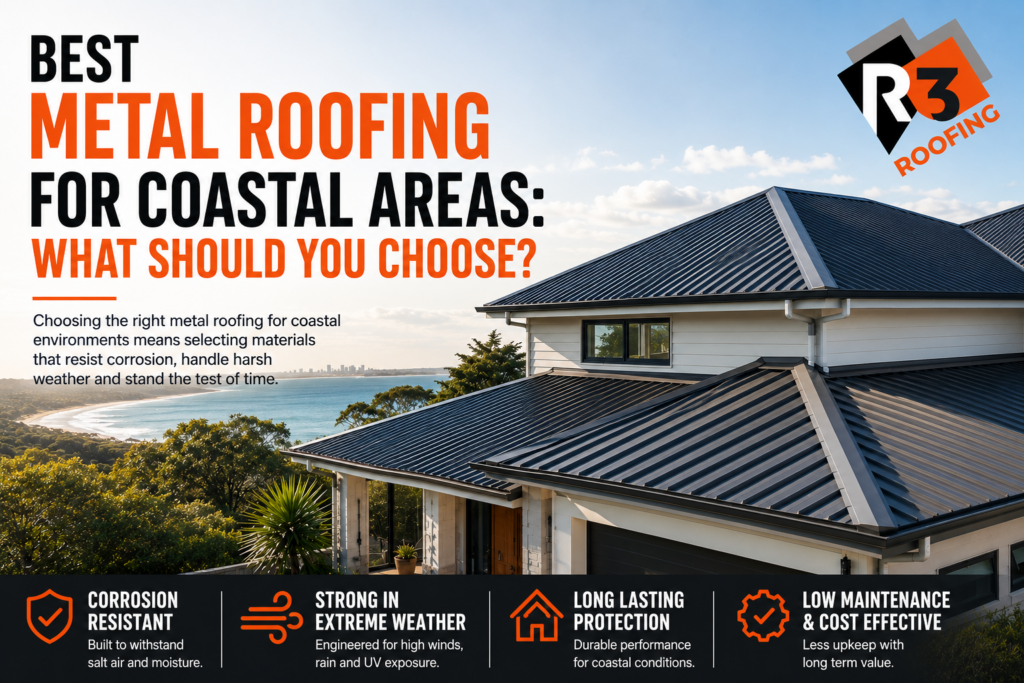
The best metal roofing for coastal areas is not simply the cheapest steel sheet you can buy. For homes exposed to salt air, the roofing material, corrosion rating, fasteners, flashings, installation quality and maintenance routine all need to work together. In Brisbane and Moreton Bay, especially around coastal locations such as Bribie Island, the right specification can make a major difference to how long your roof performs.
If you live near the coast, you already know the weather can be different. You get stronger exposure to salt air, high humidity, intense UV, heavy rain and, depending on the location, strong winds and storms.
That combination puts more pressure on a roof than many homeowners realise.
I have worked on roofs where the main metal sheets were still in reasonable condition, but the screws, flashings or valley components had already started to deteriorate. That is why I don’t look at coastal roofing as simply a choice between “metal” and “tile”.
You need to look at the complete roofing system.
In this guide, I’ll explain what I would consider when choosing metal roofing for a coastal home, what causes coastal roofs to fail, when repairs or painting make sense, and when replacement is the better option.
Coastal environments are harder on metal roofs because salt carried through the air can accelerate corrosion, particularly around exposed fasteners, flashings, joints and other vulnerable components. UV exposure, humidity, rain and strong winds add further stress to the roofing system.
If you’re close to breaking surf, you need to take corrosion protection seriously from the beginning.
Salt deposits can settle on roofing sheets and components. When moisture is present, the salt can contribute to an electrochemical corrosion process. Over time, this can lead to:
The important point is that corrosion does not always start where you expect it.
A homeowner may look at the centre of the roof and think the metal looks fine. Meanwhile, the fasteners around the edges or penetrations may already be showing signs of deterioration.
Coastal roofs experience increased corrosion risk because salt air, moisture, UV exposure, rain and wind place additional stress on metal sheets, fasteners, flashings, gutters and other roofing components.
For most Australian coastal homes, a properly specified COLORBOND® steel roofing system is an excellent option, but the correct corrosion-resistance level depends on how exposed the property is to the marine environment. In particularly aggressive marine locations, higher-grade steel or aluminium may be more appropriate.
I would never recommend choosing a coastal roof purely because someone says, “COLORBOND is good near the beach.”
The actual exposure matters.
A property a few kilometres inland is not experiencing the same environment as a house directly exposed to breaking surf.
COLORBOND steel is one of the most practical choices for Australian homes because it combines durability, appearance, available profiles and established Australian roofing applications.
For many coastal Brisbane and Moreton Bay properties, it can provide a strong balance between performance and cost when the correct product and installation system are selected.
For more severe marine exposure, a higher level of corrosion protection may be required.
This is particularly important when a property is very close to breaking surf or is exposed to persistent salt spray.
The correct product should be selected based on the actual environmental conditions rather than simply choosing a product because it is marketed as “coastal.”
Aluminium is another option worth considering for highly exposed marine environments.
One of its biggest advantages is that aluminium does not rust in the same way steel does. It is lightweight and can perform well in marine conditions.
The trade-off is usually cost, availability, material characteristics and the specific roofing system being installed.
The best metal roofing for a coastal property depends on its level of marine exposure. COLORBOND steel is a practical choice for many Australian coastal homes, while higher-corrosion-resistant steel or aluminium may be more suitable for severe marine environments.
Yes, COLORBOND steel can be an excellent choice for coastal homes when the correct product is selected for the environment and installed with suitable fasteners, flashings and accessories.
This is where I think homeowners sometimes get confused.
The sheet itself is only one part of the roof.
You can install a high-quality metal sheet and still have problems if you use unsuitable fasteners or poorly specified flashings.
For a coastal roof, I would look at:
COLORBOND® steel also gives homeowners a broad range of colours and profiles, so you don’t necessarily have to choose between appearance and performance.
Lighter colours can also be useful in Brisbane’s warm climate because they can reflect more solar heat than darker colours.
COLORBOND steel is a strong coastal roofing option when its corrosion protection is appropriate for the property’s exposure and the complete roof system, including fixings and flashings, is correctly specified.
Salt air accelerates corrosion by depositing salt particles on exposed roofing components, particularly when combined with moisture. The areas most likely to show problems first can include fasteners, flashings, joints, penetrations and other components where moisture and salt can remain.
This is one reason I tell homeowners not to judge a coastal roof simply by looking at the roof sheets from the ground.
A roof can look fine from your driveway and still have problems developing in less visible areas.
On coastal properties, I pay particular attention to:
Another issue is material compatibility.
Different metals should not simply be mixed together without considering compatibility. Poorly selected combinations can contribute to galvanic corrosion.
This is why coastal roofing is a job where product selection and installation details matter.
Salt air can accelerate corrosion on coastal metal roofs, with fasteners, flashings, valleys, penetrations, gutters and incompatible metal combinations often becoming problem areas before the main roof sheets fail.
There is no single metal roofing profile that is automatically best for every coastal property. The right profile depends on the roof design, pitch, wind exposure, drainage requirements, appearance and installation system.
Corrugated roofing is a proven Australian roofing profile and remains a popular choice for homes.
Its simple shape provides effective water shedding and suits many traditional and modern homes.
Ribbed profiles can provide a clean appearance and are suitable for many residential applications.
The important thing is not just the profile itself but whether the selected system is appropriate for the roof pitch, wind conditions and coastal exposure.
Concealed-fix systems remove exposed fasteners from the visible roof surface.
That can be particularly attractive for coastal applications because exposed fasteners can become one of the vulnerable points of a roofing system.
However, concealed fixing does not automatically make a roof corrosion-proof. The complete system still needs to be correctly designed and installed.
If your coastal property is exposed to strong winds or severe storms, the roof needs to be designed and installed for the applicable wind conditions.
That includes:
The best coastal metal roofing profile depends on the property’s roof design, pitch, wind exposure and corrosion environment. Corrugated, ribbed and concealed-fix systems can all work when correctly specified and installed.
The metal sheets are only one part of a coastal roof. Fasteners, flashings, gutters, downpipes, fascia, penetrations and installation details can determine whether the roof continues performing properly in a marine environment.
Fasteners deserve particular attention.
A roof can have excellent metal sheets but still develop problems if the screws or other fixings are not appropriate for the environment.
For coastal properties, I want the fasteners specified for the actual corrosion exposure rather than using whatever is cheapest.
Flashings protect vulnerable junctions around roof edges, walls, valleys, penetrations and other transitions.
If a flashing deteriorates, water can enter the roofing system even when the main roof sheets are still in good condition.
Your drainage system also needs to cope with the coastal environment.
Rusting or deteriorating gutters can create water management problems and can contribute to moisture damage around the roofline.
If you are already replacing the roof, it makes sense to assess the condition of the gutters, downpipes and fascia at the same time.
Coastal moisture can also affect timber fascia.
If the fascia is already showing rot or water damage, replacing it with a more durable material may be worth considering.
R3 Roofing also works with metal fascia and Colorbond solutions where a lower-maintenance roofline is appropriate.
A coastal roofing system should be assessed as a complete system. Fasteners, flashings, gutters, downpipes and fascia can fail before the main roof sheets and should be selected and maintained for the same environmental conditions.
Regular inspection and fresh-water washing are two of the simplest ways to help a coastal metal roof perform for longer. Promptly repairing corrosion, damaged fasteners, blocked gutters and deteriorated flashings can prevent small problems from becoming major roofing work.
I would rather find a small corrosion issue early than have a homeowner call after water has entered the roof cavity.
For a coastal property, your maintenance routine should include:
Don’t wait until you see a ceiling stain.
By the time water becomes visible inside the house, it may have already travelled through the roof space.
This is also where professional inspections become useful. A roofer can inspect areas that are difficult or unsafe for a homeowner to access.
Coastal metal roofs last longer when homeowners regularly remove salt and debris, inspect vulnerable components, clean gutters, address corrosion early and arrange professional inspections after significant weather events.
You should repair a coastal metal roof when the damage is localised, consider painting when the roof is structurally sound and the coating system is appropriate, and replace the roof when corrosion, deterioration or structural problems have progressed beyond practical repair.
This is where I recommend getting a proper assessment before spending money.
I don’t believe every old roof needs to be replaced.
Metal roof repairs may be appropriate when:
If you are searching for metal roof repairs Brisbane, don’t just ask for a price to patch the visible problem. Ask what caused it and whether other areas of the roof are showing the same signs.
Metal roof painting Brisbane can make sense when the roof remains structurally sound and the existing coating needs restoration or you want to improve the roof’s appearance and heat performance.
Painting is not a substitute for repairing severe corrosion.
You cannot paint over a serious roofing problem and expect the problem to disappear.
The surface needs appropriate preparation, treatment and coating for the existing roof condition.
A metal roof replacement Brisbane project may be the better option when the roof has widespread corrosion, repeated leaks, significant deterioration or has reached a point where ongoing repairs no longer provide sensible long-term value.
The key is diagnosis.
At R3 Roofing, our approach is to assess the condition first and then explain what needs to be done now, what can wait and whether repair, restoration or replacement is the most sensible option.
Metal roof repairs are appropriate for localised damage, roof painting can help protect and refresh a sound roof, and full replacement is more appropriate when corrosion and deterioration are widespread or repairs no longer provide good long-term value.
A tile to metal roof conversion can be worth considering when an existing tiled roof is ageing, repeatedly requiring repairs, or when the homeowner wants a lighter metal roofing system, but the existing roof structure and the suitability of the proposed metal system should be assessed first.
A tile to metal roof conversion Brisbane project is not simply a matter of removing tiles and putting sheets on top.
The roof needs to be assessed properly.
I would consider:
There can be good reasons to make the change, particularly where an older tiled roof has reached the point where repeated repairs are no longer economical.
But there are also situations where the existing tile roof can be repaired or restored successfully.
That is why I always come back to the same principle: diagnose first, then decide.
A tile to metal roof conversion can be a practical option for an ageing Brisbane roof, but the existing structure, roof pitch, condition, coastal exposure and proposed metal roofing system should be assessed before conversion.
Before choosing a coastal roofing contractor, ask how they will assess the property’s marine exposure, what roofing material and corrosion protection they recommend, which fasteners and flashings they will use, and what maintenance the finished roof will require.
I would also ask the contractor to explain the scope in plain English.
You should be able to understand:
Be cautious of quotes that only say “new metal roof” without explaining what product, profile, fixings and preparation are included.
A coastal roof needs more thought than that.
A good coastal roofing contractor should explain the property’s exposure, roofing material, corrosion protection, fasteners, flashings, installation process, warranties and maintenance requirements before work begins.
For most Australian coastal homes, a correctly specified COLORBOND® steel roofing system offers an excellent balance of durability, corrosion protection, appearance and value. For properties in more severe marine environments, a higher-corrosion-resistant steel product or aluminium roofing may be worth considering.
But I would not choose a roof based on the sheet material alone.
The best coastal roof is a complete system.
That means:
If you live around Brisbane or Moreton Bay and your roof is showing rust, leaks, ageing coatings or repeated storm damage, don’t assume you automatically need a complete replacement.
Get the roof assessed first.
At R3 Roofing, we believe homeowners deserve to know what is actually wrong with their roof before deciding how much money to spend on it. Sometimes the right answer is a repair. Sometimes it is restoration. Sometimes replacement makes more sense.
The important thing is getting the diagnosis right.
The best metal roofing for coastal areas is a correctly specified corrosion-resistant metal roofing system, with COLORBOND® steel being a strong option for many Australian coastal homes.
The important part is matching the product to the property's exposure to salt air and breaking surf. A roof close to the ocean needs more consideration than one further inland. Fasteners, flashings and other components also need suitable corrosion protection.
Yes, COLORBOND steel is suitable for many coastal properties when the correct product is selected for the environment.
For example, a home in a coastal Brisbane or Moreton Bay suburb may experience regular salt exposure, but the exact level varies depending on its distance from the ocean and exposure to breaking surf. That is why I would assess the property rather than automatically specify the same product for every coastal home.
Yes, salt air can accelerate corrosion on metal roofing and associated components.
In my experience, homeowners often focus on the roof sheets but forget about screws, flashings, valleys, gutters and other exposed components. These areas can show corrosion before the main sheets appear seriously damaged.
A coastal metal roof should be inspected regularly and washed down as appropriate to remove accumulated salt and debris, with more frequent attention required for properties with higher marine exposure.
If you live close to the ocean, I would also pay attention after major storms. Look for rust, damaged fasteners, lifted sheets, loose flashings, blocked gutters and signs of water entry.
Repair a coastal metal roof when the damage is localised and the underlying roof remains sound; replacement is more appropriate when corrosion and deterioration are widespread or repeated repairs no longer provide sensible long-term value.
For example, a few failed fasteners or one damaged section does not automatically mean you need a new roof. On the other hand, widespread corrosion across multiple sheets combined with recurring leaks may make replacement the more practical long-term solution.
Metal roofing can be an excellent coastal option, but whether it is better than tiles depends on the property, existing roof condition, exposure and the homeowner's priorities.
Metal roofing is lightweight and available in corrosion-resistant systems, while tile roofs can also perform for decades when correctly installed and maintained. I would assess the existing roof before recommending one material over another.
A tile to metal roof conversion can be worthwhile when an ageing tiled roof requires extensive work or the homeowner wants to move to a metal roofing system.
However, the conversion needs to be assessed properly. The roof structure, pitch, battens, existing damage, flashings, gutters and proposed metal profile all need to be considered before the project begins.
Yes, if the metal roof is structurally sound and the existing surface can be properly prepared and coated.
Painting is not a solution for severe corrosion or structural deterioration. If the underlying metal has deteriorated significantly, applying a new coating may only hide a problem that still needs to be addressed.
Common warning signs include rust spots, deteriorating screw heads, leaking during rain, damaged flashings, rusted valley trays, peeling coatings, loose sheets, water stains and repeated storm-related problems.
If you notice any of these signs, I recommend having the roof inspected before the damage spreads.
You can reduce corrosion risk by choosing the correct roofing material, using suitable corrosion-resistant fasteners and flashings, keeping gutters clear, removing salt and debris, and arranging regular roof inspections.
The biggest mistake is waiting until corrosion becomes obvious from the ground. Early detection usually gives you more options and can reduce the amount of work required.